

Articles

Union Arena: Can You Mix Different Series? No | 2026
No—you cannot mix cards from different series in the same Union Arena main deck under the standard deck-building rules. You can play a deck from one series against a deck from another, and combine eligible releases within the same series. Action Point cards are handled separately: their artwork does not have to match your main deck’s series.
- Can you play Union Arena with cards from different series? Against each other, yes; inside one standard main deck, no.
- Union Arena main decks contain 50 cards from the same series, with a maximum of four copies per card number.
- Union Arena uses three Action Point cards separately; their series artwork does not restrict your main deck.
- Delightful TCG serves Japanese trading-card collectors; tournament eligibility requires a separate check of Bandai’s rules.
Can you play Union Arena with cards from different series?
Different series can battle each other, but they cannot share a standard main deck. Bandai’s Union Arena rules distinguish the series your deck belongs to from the series your opponent chooses.
| What you want to do | Standard-rule answer | Best for | Benefit | Limitation |
|---|---|---|---|---|
| Play different series against each other | Yes | Anime crossover matches | Each player chooses a favorite series | Each main deck still follows its own construction rules |
| Mix unrelated series inside one main deck | No | Agreed house-rule experiments only | Lets friends try a custom crossover | Not a standard legal deck |
| Combine eligible releases from one series | Yes | Updating an existing deck | Adds choices without changing series | Card limits and event eligibility still apply |
| Use Action Point artwork from another series | Yes | Personalizing your play area | Separates artwork preference from deck choice | Action Point cards remain separate from the main deck |
For the next step, use the Union Arena deck-building guide for beginners.
Why this matters
Union Arena delivers its crossover through matches, not unrestricted deck construction. That distinction matters before you choose cards: a favorite character from another series is not automatically an upgrade for your existing deck.
For your 2026 deck check, start with Bandai’s official Union Arena rulebook, then consult the card list and rules for the event you plan to enter. The rulebook answers the construction question; the event rules answer whether your particular cards are eligible there.
Delightful TCG is a shop for Japanese trading-card collectors, not a substitute for Union Arena tournament rules. Enjoy collecting across franchises, but keep your collecting wish list separate from your legal deck list.
Different opponents: crossover matches are allowed
You and your opponent do not need to choose the same series. A deck built around one anime can face a deck built around another because Union Arena provides the shared game system for that matchup.
That is the central distinction. The crossover happens across the table, while each player’s main deck stays within its permitted series.
If your friend collects a different franchise, you do not need to rebuild both decks around a shared title just to play a normal match. Check each deck independently for construction and card eligibility, then play using the same Union Arena rules.
Best for: friends who want their favorite series to face each other. The benefit is that both players keep their chosen theme. The limitation is that crossover opponents do not create permission to borrow cards from each other’s series.
Different releases: same-series cards can work together
A different booster release does not necessarily mean a different series. Union Arena cards from eligible releases belonging to the same series can be combined in a deck, subject to the usual construction requirements.
Think of the series as the deck’s permitted card pool, not the individual package you opened. A starter deck and a booster release can contribute cards to the same build when their cards belong to that permitted series.
This gives you room to update a deck without abandoning its identity. The catch is that an additional release does not erase copy limits, printed conditions, or event restrictions.
For a 2026 purchase, confirm the exact series designation and edition before treating a new release as an upgrade. Similar characters, related storylines, or familiar artwork are not a replacement for the official card classification.
Best for: players improving a deck they already enjoy. Combining eligible same-series releases expands your choices, but you still need to select cards that support the deck’s actual plan.
Different colors: color does not replace the series restriction
Union Arena’s series restriction and its colored energy requirements answer different questions. Series determines which cards belong together in a standard main deck; energy requirements determine whether you can play those cards during a game.
Matching colors do not make unrelated series compatible. A card from another series remains outside your main deck’s permitted card pool even if its color looks perfect for your strategy.
Conversely, the series restriction does not mean every card in your deck must share one color. You can build within the permitted series using different colors, but your energy generation must support the requirements printed on your cards.
Best for: players who understand their deck’s energy plan. Multiple colors offer more choices within a series, but they also ask more of your energy setup. A legal combination is not automatically a dependable one.
When you sort cards, check series before color. That order prevents you from spending time building a combination that fails the basic construction rule.
Action Point cards: different artwork is allowed
Union Arena uses 3 Action Point cards separately from the 50-card main deck. Their artwork does not need to belong to the same series as the cards in your main deck.
This is the exception that causes confusion. An Action Point card with artwork from another franchise does not mean that franchise’s character, event, or field cards can enter your main deck.
Treat Action Point cards as their own category when checking your setup. Do not count them toward the main deck, and do not use their artwork as evidence that mixed-series construction is allowed.
Best for: players who want a personal touch without changing their deck. Different Action Point artwork lets you express another favorite series. It does not expand your main deck’s legal card pool.
For a 2026 event, distinguish permitted personalization from card eligibility. Follow the event’s requirements for the cards and accessories you bring, even when your main deck already passes the series check.
How do I check whether my Union Arena deck is legal?
Start with the series check, then count the cards and verify their identities. Bandai’s standard construction rules require 50 main-deck cards, 3 separate Action Point cards, and no more than 4 copies of the same card number unless an applicable rule or card instruction provides otherwise.
Use this sequence before sleeving a new build:
- Series check. Identify the official series designation for every main-deck card. Remove cards belonging to a different series, even when their colors or effects seem compatible.
- Card count. Count the main deck separately from the Action Point cards. The main deck contains 50 cards; the Action Point setup contains 3 cards.
- Copy limit. Group main-deck cards by card number. Check the maximum of 4 copies rather than assuming a different illustration creates a different card.
- Energy plan. Read the energy requirements and effects of the cards you selected. Check that your permitted card pool supports the plays you intend to make.
- Event eligibility. Read the applicable tournament rules, including edition, language, release eligibility, and any restrictions affecting your list.
The order matters. A color-compatible card from the wrong series fails at the first step, so there is no reason to evaluate it as an official deck upgrade.
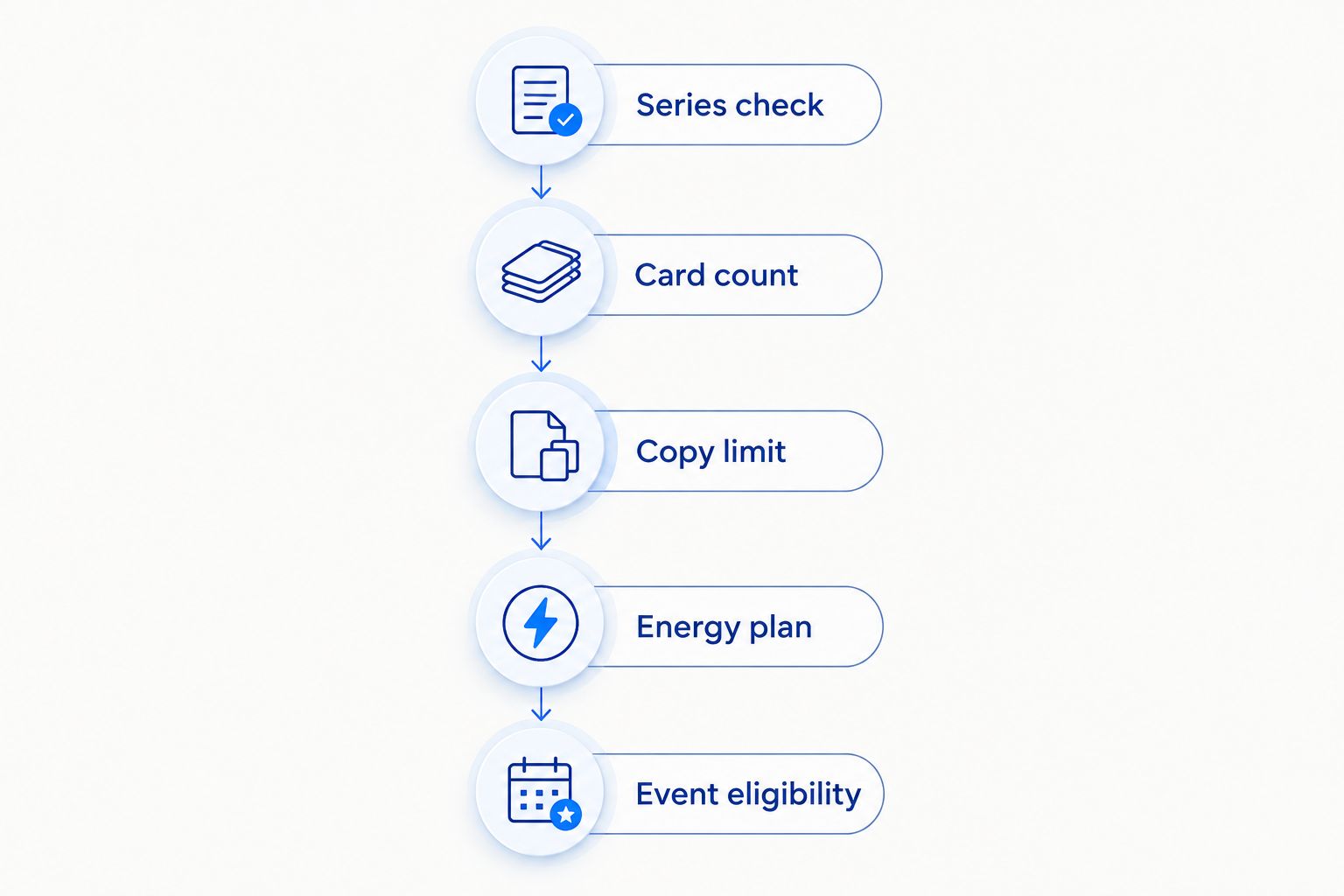
Keep the exact card numbers in your written list. That makes alternate artwork easier to track and gives an organizer a clear way to identify the cards you are asking about.
Why the answer changes depending on what you mean
The phrase different series can describe several situations. Only some involve mixing main-deck cards, so state exactly what you want to do before looking for a ruling.
- Opponent’s series: different-series decks can face each other. Your opponent’s choice does not change your construction requirements.
- Main-deck series: unrelated series cannot share a standard main deck. Color matching does not create an exception.
- Release identity: separate products can contain cards for the same permitted series. Package names alone do not settle compatibility.
- Card category: Action Point cards sit outside the main deck. Their artwork follows a different rule from main-deck series construction.
- Event requirements: a constructed deck must also meet the rules of the event where you use it. Series compatibility is only one part of eligibility.
- House rules: friends can agree to a custom mixed-series game. That agreement does not establish official tournament legality.
For 2026 preparation, describe your question using exact card numbers and the event you mean. Asking whether a specific card can enter a particular deck produces a clearer answer than asking whether two anime are compatible.
Can I mix different series if we only play at home?
Yes, if everyone agrees to house rules before playing. Make clear that the mixed-series deck is a custom format, not a standard legal Union Arena deck.
The upside is creative freedom: you can try the crossover you actually want. The drawback is that you are changing the permitted card pool, so your results do not show how the deck performs under standard construction rules.
Agree on the boundaries first. Decide whether all series are permitted, whether you are keeping the normal card counts and copy limits, and how you will handle disputes about interactions.
Keep a separate standard deck list. That gives you a clear version to use when you return to normal play, rather than trying to remember which cards were house-rule additions.
Can I use Japanese Union Arena cards in a US event?
Do not assume a Japanese card is eligible for a US event simply because its series matches your deck. Card-language and edition requirements are separate from the same-series construction rule.
For a US event in 2026, consult the applicable Bandai tournament rules and the organizer’s event information before choosing imported cards for play. Identify the exact event and edition when asking for clarification.
Delightful TCG’s Japanese trading-card products are relevant to collectors, but collecting suitability does not establish tournament eligibility. A genuine card can still be the wrong edition for the event you plan to enter.
What should I check before buying cards for a Union Arena deck?
Choose the permitted series and edition before choosing the product. Then decide whether your goal is opening cards, collecting artwork, or obtaining particular cards for a written deck list.
The catalog includes a Bandai Union Arena Full Metal Alchemist booster. Treat that as a series-specific product to evaluate, not as evidence that its cards can be inserted into any Union Arena deck.
Delightful TCG sells Japanese trading-card sealed products and singles. Those product types serve different collecting goals, but neither the shop name nor the package artwork settles your deck’s eligibility.
Before buying for play, record the exact card numbers you need. Check the series, edition, and event rules against that list; then evaluate products that match it. Opening a booster is a collecting experience, not a guarantee of completing a particular deck.
FAQ
Can you play Union Arena with cards from different series in one deck?
No. A standard Union Arena main deck must use cards from the same permitted series; matching colors do not allow unrelated series to share a deck.
Can my Union Arena deck battle a deck from another anime?
Yes. Different-series decks can play against each other using Union Arena’s shared rules, provided each deck meets the applicable construction requirements.
Can I combine a Union Arena starter deck with booster cards?
Yes, when the cards belong to the same permitted series and are eligible for your format. Keep the main deck at 50 cards and observe the copy limit for each card number.
Do Union Arena Action Point cards have to match my series?
No. The 3 Action Point cards are separate from the main deck, and their artwork does not have to match its series.
Can I mix colors in a Union Arena deck?
Yes, within the permitted series. Your energy generation still needs to meet the printed requirements of the cards you want to play.
How many cards are in a Union Arena deck?
A standard Union Arena main deck contains 50 cards, with 3 Action Point cards kept separately. The normal copy limit is 4 cards with the same card number.
Do alternate-art Union Arena cards have separate copy limits?
No, not when they share the same card number. Count those versions together toward the normal limit of 4 copies.
Can I bring a house-rule mixed-series deck to a tournament?
Not to an event using standard same-series construction rules. A custom mixed-series deck requires a format that explicitly permits it; an agreement between friends is not tournament permission.
One last thing
Different artwork does not mean a different deck-building identity. Before adding an alternate-art card, compare its card number with the copies already in your list.
That small check catches a mistake that sorting by character or illustration misses. Keep your collection organized however you enjoy it, but build your playable list around series designations, card numbers, and the rules of your chosen event.