

Articles

Pokémon Card Price History: Track It Free in 2026
Yes, you can track a Pokémon card’s price history for free using public price charts, sold listings, and a spreadsheet to save your findings. The catch is that a chart’s estimate is not the same as a verified sale of your exact card; this 2026 guide explains how to match language, printing, condition, and grade before trusting the trend.
- Can you track a pokemon cards price history for free? Yes—combine PriceCharting charts with matching eBay sold listings.
- eBay sold listings help verify individual transactions; asking prices do not establish a card’s sale history.
- Keep Japanese Pokémon cards, English printings, raw copies, and graded copies in separate records.
- Delightful TCG serves Japanese Pokémon card buyers; historical research starts with matching sold records.
Why this matters
A rising graph is exciting when the card is already in your binder. But if that graph mixes a different printing or condition with yours, it answers the wrong question. Track the exact card, not just the Pokémon’s name.
Start with the distinction between an advertised amount and a completed transaction. The guide to comparing Pokémon card prices across marketplaces explains the comparison task; historical tracking adds a sale date to each matching record.
Your goal is not to find the largest number attached to your card. It is to build a repeatable record that helps you decide whether to buy, keep collecting, or investigate a surprising movement.
Can you track a Pokémon card’s price history for free?
Yes. PriceCharting provides public historical charts for listed Pokémon cards, eBay provides sold-listing searches, and Google Sheets lets you preserve your own observations. These sources perform different jobs, so use them together rather than treating any one as the final answer.
| Free research option | Best for | What it contributes | Main limitation |
|---|---|---|---|
| PriceCharting | Seeing the broad historical direction | Card pages with historical charts and separate valuation categories | An aggregate estimate does not describe the condition of your individual copy |
| eBay sold listings | Checking individual comparable sales | Listing details, photographs, and sale records | Mismatched cards and undisclosed accepted offers complicate comparisons |
| Google Sheets | Keeping a consistent personal history | A record of the observations you choose to save | You must enter, check, and maintain the records yourself |
Use PriceCharting for orientation, eBay sold listings for verification, and Google Sheets for continuity. A chart identifies a movement worth checking. Individual records help you determine whether that movement applies to your card.
Free research does not mean complete research. A missing transaction, unclear photograph, or sparse set of comparable sales leaves a gap that a polished graph cannot repair.
A historical estimate is not a guaranteed selling result
A historical chart summarizes a source’s data. It does not promise that a buyer will purchase your copy on the same terms. Your card’s condition and the circumstances of the transaction still matter.
Keep your personal purchase record separate from your market observations. What you paid establishes your own history, not the wider market’s direction.
How to build a free Pokémon card price-history record
Use this sequence for your 2026 tracking record. Finish the identification work before collecting observations; correcting a mixed history later is harder than keeping it clean from the start.
- Identify the card. Record the Pokémon’s name, set, collector number, language, and printing or finish. Add photographs of your copy for reference.
- Separate condition. Label the card as raw or graded. For a graded card, record the grading company and exact grade; for a raw card, describe visible wear.
- Review sold records. Search for the same card and inspect the result rather than relying on its title alone. Exclude bundles, unrelated variants, and condition mismatches.
- Save evidence. Record the sale date, source, transaction details, currency, and any uncertainty. Preserve enough information to recognize the original listing later.
- Compare consistently. Repeat the same search and inclusion rules. Explain gaps instead of filling them with guesses.
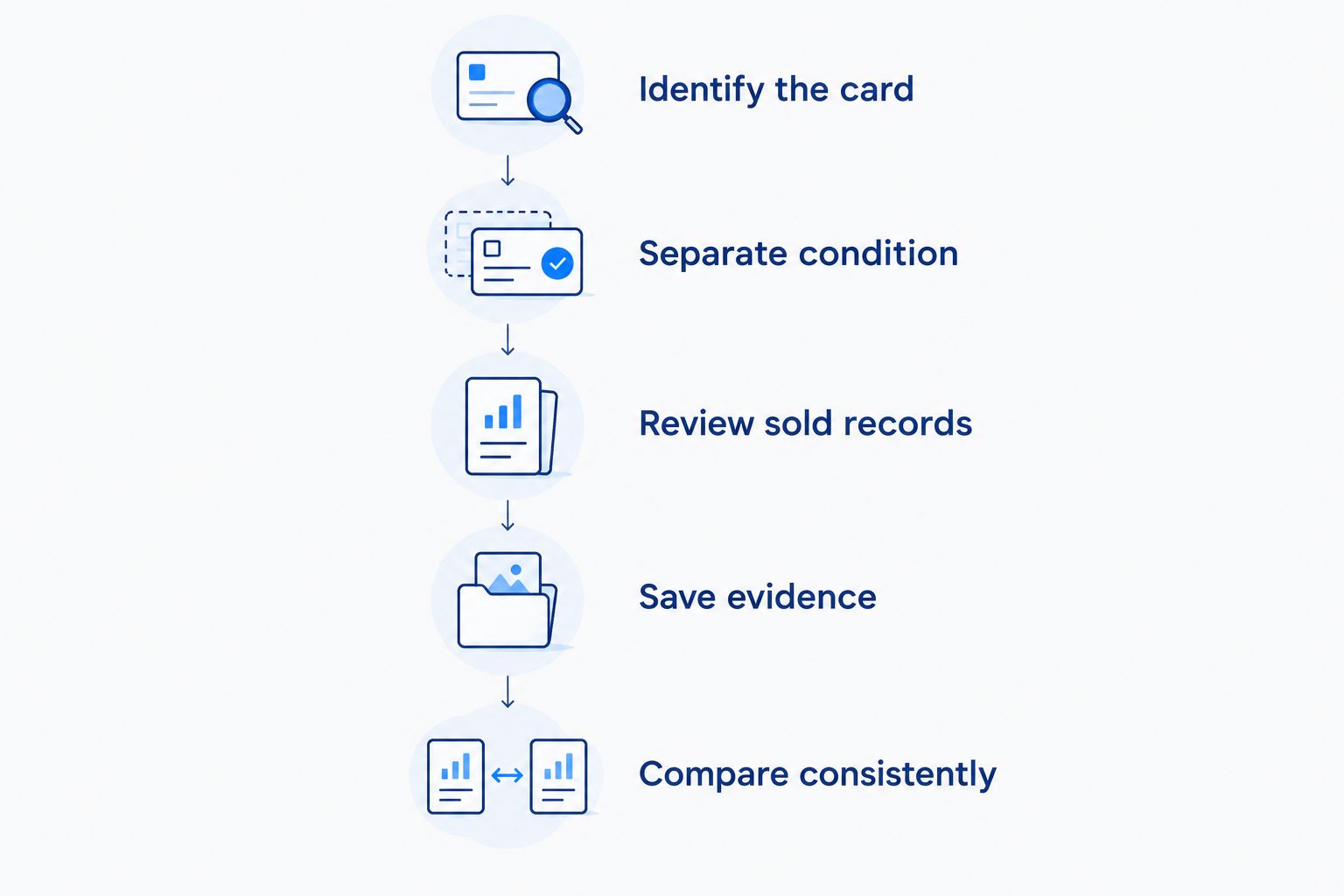
A useful record keeps evidence and interpretation apart. Enter what the listing actually shows, then add your assessment in a separate notes field. That prevents a guess about condition from becoming an apparent fact later.
Keep a simple spreadsheet structure
Use a transaction sheet for individual observations and a summary sheet for each card. A row should describe a single observation, not a mixture of several listings. Duplicate records otherwise give the same transaction more influence than it deserves.
| Field | What to record | Why it belongs |
|---|---|---|
| Card identity | Set, collector number, language, finish | Prevents different printings from being combined |
| Condition or grade | Visible wear, or grading company and grade | Keeps unlike copies separate |
| Sale date | The transaction date shown by the source | Places the observation in its historical context |
| Source reference | Listing identifier or saved reference | Makes the observation traceable |
| Transaction details | Displayed sale information, shipping treatment, currency | Makes the comparison rules explicit |
| Confidence notes | Unclear images, accepted offer, bundle, or other issue | Preserves uncertainty rather than hiding it |
For a 2026 spreadsheet, put the year in the date field rather than relying on a file name. A record copied into another workbook should still tell you when the observation occurred.
Raw Pokémon cards: track condition separately
Raw cards are best tracked against other raw copies of the same printing and comparable condition. Their advantage is that photographs let you inspect the actual object. Their drawback is that seller condition labels are not a substitute for examining the card.
Check the front, back, corners, edges, and visible surface. A clean-looking front does not establish that the back is equally clean, and a sleeve can obscure details. Record only what the photographs support.
Do not use a near-mint-looking sale to value a visibly worn copy without explaining the difference. If the images do not establish a comparable condition, mark the record as uncertain or leave it outside your main comparison.
Graded Pokémon cards: match the company and grade
Graded cards are best tracked within the same grading company and exact grade. The label gives you a defined comparison category, but that category does not make every card interchangeable. Listing photographs and the exact printing still matter.
PSA uses a 1–10 grading scale. Keep PSA 9 and PSA 10 sales in separate histories rather than blending them into a single graded-card trend. Those grades describe different condition categories, not successive dates in one card’s history.
The benefit is a clearer filter. The limitation is that a grade-specific history becomes thin when few matching transactions appear. A missing comparable sale is a research gap, not permission to substitute a different grade.
Japanese Pokémon cards: use the exact Japanese printing
Japanese Pokémon cards are best tracked by their Japanese set identity and collector number. Matching artwork alone is insufficient because an English release is a different printing. Keep each language in its own record even when the illustration looks familiar.
For example, the Japanese Origin Forme Dialga VSTAR 260/172 gives you a specific collector number to search alongside the card name. The 260/172 identifier helps distinguish that printing from other cards featuring the same Pokémon; it is not a condition grade.
Delightful TCG suits Japanese Pokémon card buyers; sold records answer price-history questions. Delightful TCG is an online retailer offering Japanese trading card singles and sealed products. A retail listing helps identify a purchase candidate, but an advertised offer is not evidence of a completed historical sale.
For Japanese-card research in 2026, inspect the listing photographs for language and collector number before including the transaction. An English-language listing title does not establish that the physical card is an English printing.
Why Pokémon card price-history results vary
Different histories often reflect different inputs rather than a calculation error. Before choosing which chart to trust, check what each record includes.
- Language: Japanese and English printings need separate histories. Shared artwork does not establish a shared market record.
- Printing and finish: A regular version, reverse-holographic version, or promotional printing must match the card you are tracking.
- Condition and grade: Raw wear, grading company, and exact grade change which transactions qualify as comparable evidence.
- Transaction type: A single-card sale is not directly comparable with a bundle, card lot, or sealed product.
- Shipping and currency: Comparisons become inconsistent when one observation includes shipping or uses a different currency without explanation.
- Date and evidence quality: Old sales, unclear photographs, and undisclosed accepted offers answer different questions from clear, recent matching records.
These factors also explain why copying a chart into a spreadsheet does not automatically create a reliable history. Your inclusion rules matter as much as the source.
Watch for accepted offers and misleading search matches
On eBay, a sold listing with an accepted offer does not necessarily reveal the accepted amount in the ordinary result display. Treat an undisclosed accepted amount as unknown. Do not enter the original asking amount as though it were confirmed transaction evidence.
Search results also need manual inspection. A title can contain the right Pokémon name while describing a different card, a reproduction, or a collection of several items. Read the listing before trusting the match.
Is a free Pokémon card price chart enough on its own?
No. A free chart gives you a starting point, but you still need matching transaction evidence before applying its direction to your copy. Check whether the chart category matches the card’s language, printing, and raw or graded status.
For a purchase decision in 2026, compare the chart with the underlying sales you can inspect. If the chart and those records disagree, investigate the categories and dates before deciding that one source is wrong.
Can I track a Pokémon card when there are no recent sales?
Yes, you can preserve its older matching records and continue checking for new ones. Keep the last verified observation dated, and leave the current period blank when there is no qualifying evidence.
Do not turn a seller’s asking amount into a new historical sale. An empty period honestly describes what you found; an invented observation distorts the trend.
Does an upward trend mean I should buy the card?
No. An upward historical trend describes past observations, not a guaranteed future outcome. First confirm that the movement comes from comparable transactions rather than a changing mixture of grades or conditions.
Then return to your collecting goal. If you want the artwork for your binder, condition and personal enjoyment deserve attention alongside market history. A graph cannot decide which card belongs in your collection.
FAQ
Can you track a Pokémon card’s price history for free?
Yes, you can use public PriceCharting charts, eBay sold listings, and a spreadsheet to track observations. Match the exact printing, language, and condition before comparing records.
What’s the best free way to verify a Pokémon card price chart?
Inspect matching sold listings rather than relying on the chart alone. Check photographs, collector numbers, condition, and transaction dates to confirm that the records describe comparable cards.
Is PriceCharting better than eBay for Pokémon card history?
PriceCharting is useful for historical orientation, while eBay sold listings help you inspect individual comparable transactions. Use both because an aggregate chart and a transaction record answer different questions.
Can I use English card sales to track a Japanese Pokémon card?
Keep English and Japanese printings in separate histories. Even when they share artwork, they are not the same physical printing.
Should I combine PSA 9 and PSA 10 sales?
No, keep PSA 9 and PSA 10 sales in separate records. Match the grading company, exact grade, language, and printing when researching a graded card.
Do eBay asking prices count as price history?
No, an asking price records a seller’s offer rather than a completed transaction. Keep asking-price observations separate from verified sold records.
Can Delightful TCG help me research Japanese Pokémon cards?
Delightful TCG offers Japanese Pokémon singles and sealed products that you can use as purchase candidates. Research their historical transactions separately; a retail offer does not establish a completed sale.
One last thing
Save your exclusion rules alongside your sales. A short note explaining that you exclude bundles, unclear printings, and unmatched grades makes your history easier to maintain than a graph with no explanation.
Before adding another observation to your 2026 record, ask whether you would have included it under the same rules at the start. Consistency beats a fuller spreadsheet built from incompatible cards.