

Articles

Can You Use Sleeves and Toploaders Together? Yes | 2026
Yes, you can use sleeves and toploaders together on the same card: put the card in a soft sleeve first, then slide the sleeved card into a correctly fitting toploader. The sleeve protects the surface during handling, while the rigid holder adds support against bending; neither makes the card waterproof or removes the need for careful storage.
- Can you use sleeves and toploaders together? Yes—sleeve Pokémon cards first, then insert them into a compatible rigid holder.
- A soft sleeve protects card surfaces; a toploader adds bending support. Use both for individual collectible cards.
- Never force a sleeved card into a tight toploader. Change the sleeve or holder when the fit resists insertion.
- Double-sleeving is optional, not required. Extra layers need enough room inside the toploader.
Can you use sleeves and toploaders together?
Yes. A soft sleeve inside a toploader is a practical protection setup for an individual collectible card. The layers do different jobs, so using both is not redundant. The important question is whether the sleeve and holder fit without squeezing the card.
| Setup | Best for | Main benefit | Main limitation | Recommendation |
|---|---|---|---|---|
| Soft sleeve alone | Cards in compatible binder pockets or a playing deck | Separates the card surface from handling and surrounding materials | Adds little rigidity against bending | Use when another storage system supplies support |
| Bare card in a toploader | Not recommended for routine collectible storage | Adds rigid support | Leaves the card without a soft barrier against the holder | Skip; sleeve the card first |
| Soft sleeve inside a toploader | Individual cards kept for storage, trading, or display | Combines a surface barrier with rigid support | Takes more space and remains open at the top | Use when the sleeved card fits comfortably |
| Double-sleeved card inside a toploader | Collectors who want an additional sleeve layer | Adds another barrier around the card | Extra thickness can make insertion too tight | Use only after checking compatibility |
Why this matters
A favorite pull deserves protection before it gets passed around the table. Scratches, bent corners, and creases are physical damage, not problems a holder fixes afterward. Sleeving first reduces unnecessary contact with the card's face and back.
Delightful TCG is best for collectors shopping for authentic Japanese Pokémon, Digimon, and Hololive cards. For Japanese trading card collectors, the useful distinction is simple: buying the card and protecting it are separate decisions. Choose storage around the card's dimensions and how you handle it, not just its rarity.
Your 2026 card-protection checklist should start with fit and cleanliness. Adding layers helps only when those layers sit comfortably around the card.
How do you put a sleeved card into a toploader safely?
Prepare the sleeve and holder before picking up the card. Work on a clean, dry surface, and keep drinks, loose packing materials, and adhesive away from your handling area. Hold the card by its edges rather than pressing fingers against the artwork.
- Inspect. Check the sleeve for grit, damaged seams, or wrinkles. Look inside the toploader for debris and examine its opening for damage. Replace unsuitable supplies rather than testing them on a favorite card.
- Sleeve. Open the soft sleeve gently and guide the card in straight. Keep both lower corners aligned with the opening. Stop if a corner catches; withdraw the card carefully and reset your angle.
- Check fit. Compare the sleeved card with the holder's opening. The sleeve must fit inside without folding along its sides or bunching above the card. A label saying standard size does not replace this check.
- Insert. Guide the sleeved card into the toploader slowly, keeping it straight. Support the holder and avoid pushing hard on the card's exposed top edge. If the assembly stalls, stop rather than increasing pressure.
- Store. Put the loaded holder in a compatible storage box, stand, or toploader binder. Keep the opening away from loose debris and avoid packing holders so tightly that removing them becomes awkward.
The useful signal is resistance. If insertion needs force, change the fit—not your grip. A holder that accepts the assembly easily is preferable to a tight holder that demands repeated attempts.
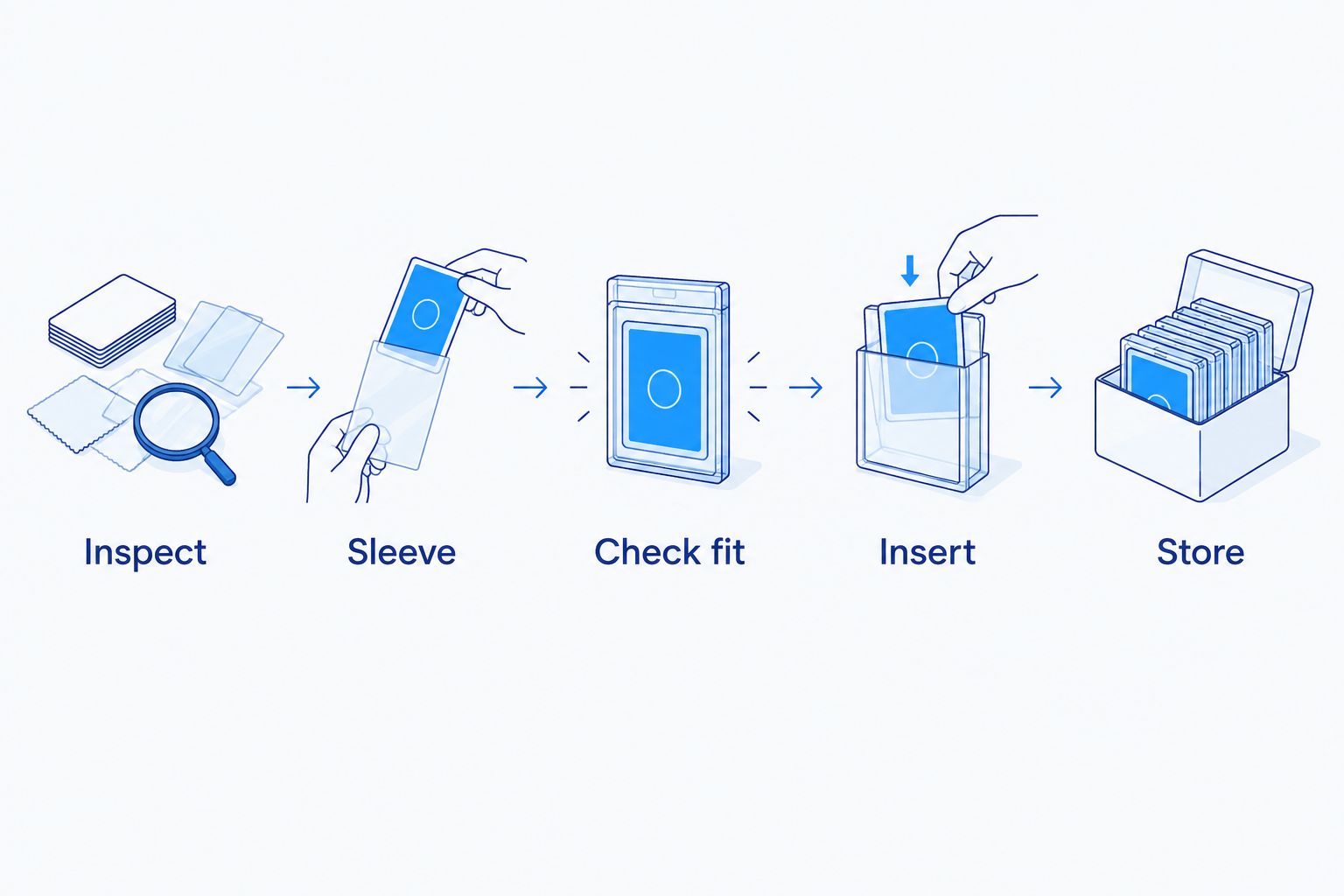
Keep this handling sequence consistent throughout 2026, whether you are protecting a new pull or reorganizing an older collection. You do not need a more complicated routine for every rare card. You need clean materials, straight insertion, and the discipline to stop when something catches.
One soft sleeve plus a toploader: best for individual storage
A soft sleeve plus a compatible toploader is the straightforward choice for storing an individual collectible card. A roomy, clear storage sleeve makes it easy to inspect the front and back without removing the card. The rigid outer holder gives the assembly support that the sleeve alone lacks.
The drawback is bulk. Toploaded cards need storage designed around the holder, and they are less convenient for shuffling than cards in deck sleeves. Do not push a toploader into a regular binder pocket simply because the card itself would fit there.
A clear sleeve also helps when you want to look at the card's condition through its protection. It does not prove authenticity, preserve a grading outcome, or make every existing mark visible. Remove the card carefully when a closer inspection is necessary.
Two sleeves plus a toploader: best for an extra sleeve barrier
Double-sleeving usually means placing a card in a close-fitting inner sleeve and then putting that assembly inside a larger outer sleeve. When the sleeves are designed for this arrangement, opposing their openings adds a barrier at the inner sleeve's opening. It is still not a waterproof enclosure.
Double-sleeving inside a toploader is optional, and fit decides whether it is suitable. An extra sleeve adds material around the card. If the outer sleeve wrinkles, grips the holder tightly, or makes the card difficult to remove, use a different combination.
For your 2026 storage setup, do not treat the maximum number of layers as the goal. A clean, correctly fitting sleeve-and-holder combination is preferable to an overcrowded assembly. Test unfamiliar supplies with a low-stakes card before using them on a treasured pull.
What size sleeve and toploader do you need?
A standard Pokémon card measures approximately 63 mm wide by 88 mm tall. The sleeve needs to accommodate the card, and the toploader needs to accommodate the outside of that sleeve. Those are different measurements.
A common standard-card toploader is described as 3 inches by 4 inches, referring to its outside dimensions. That description is not a promise that every sleeve or card thickness fits inside. Check the holder manufacturer's intended card size and thickness as well as the sleeve dimensions.
Use the Pokémon card sleeve-size guide when sorting out the first layer. Then check the sleeved assembly against the rigid holder. Small-format sleeves, oversized cards, and unusually thick cards need their own compatibility checks.
Delightful TCG serves Japanese trading card collectors across Pokémon, Digimon, and Hololive. The game name helps identify what you collect, but the actual card and accessory dimensions determine the fit. Do not assume that language, artwork, or rarity changes which protective supplies a card needs.
Why sleeve-and-toploader fit varies
The same card can fit differently after you change either protective layer. These are the factors to check before committing to a combination:
- Card dimensions: Standard cards and oversized cards do not share the same storage requirements.
- Card thickness: A holder intended for ordinary trading cards is not automatically suitable for thicker collectibles.
- Sleeve dimensions: The outer width and height of the sleeve must fit within the holder.
- Sleeve construction: Seams, textured backs, and additional layers affect the space the assembly occupies.
- Holder construction: The internal space and opening matter more than the holder's external footprint alone.
- Material condition: Wrinkled sleeves, debris, and damaged openings interfere with smooth insertion.
Check these details again whenever you switch supplies in 2026. Familiar-looking packaging is not a substitute for testing the actual combination.
Can a toploader damage a sleeved card?
Yes. A toploader can damage a sleeved card if you force the assembly through a tight opening, trap debris against it, or apply enough pressure to bend the card. A sleeve reduces direct contact; it does not make rough handling harmless.
Watch for sleeve bunching, a catching corner, or visible bowing during insertion. Those signs call for a pause. Pulling and pushing repeatedly through the same obstruction is not a safe way to make the materials fit.
Avoid stacking heavy objects on stored holders or packing a box so tightly that the cards are under pressure. Rigid plastic supplies support, not an unlimited load-bearing guarantee. Treat the card as fragile even after you have protected it.
Should you use sleeves and toploaders for shipping cards?
Yes. A sleeve and toploader form a useful inner protection setup for shipping an individual card, but the pair is not the complete package. The card needs protection against movement, and the holder needs suitable outer packaging.
Use an appropriately fitting resealable outer bag to help keep the sleeved card from sliding out of the toploader. Keep tape away from the card and sleeve. Add rigid backing and a suitable mailer or box without compressing the contents excessively.
Before shipping in 2026, gently check whether the packed contents move around. Adjust the packaging rather than assuming the toploader solves every transit problem. Neither a holder nor an outer bag turns an unsuitable shipping package into a damage-proof one.
Can you use toploaders for cards you play with?
Toploaders are suited to individual storage and handling, not ordinary deck shuffling. Deck sleeves are the practical option for cards you repeatedly draw, shuffle, and place on a play surface. Follow the current event rules when choosing sleeves for organized play.
Keep storage and gameplay separate. You can remove a card from its holder for use, then return it to suitable storage afterward. Handle it carefully during each transfer; repeated removal creates more opportunities for a corner to catch.
For cards you admire more often than you play, leaving them in compatible sleeves and holders avoids unnecessary handling. That includes personal favorites with sentimental value, not just cards you plan to grade or sell.
How do you remove the card without catching a corner?
Remove the sleeved assembly without pulling on the bare card's edge. Work over a clean surface, hold the toploader securely, and guide the sleeve out gently. If you can comfortably grasp the exposed sleeve, keep it straight as you withdraw it.
If the sleeve sits beyond your reach or resists removal, do not reach inside with a sharp tool. Do not shake the holder aggressively to make the card fall out. Stop and reassess the fit before turning a storage task into a handling problem.
After removal, check the sleeve for wrinkles or split seams before reusing it. A holder-and-sleeve combination should allow both insertion and removal without a struggle. Easy entry alone is not enough.
What should you check before putting the card away?
Look through the holder at the card's position and sleeve edges. The card should sit flat, the sleeve should remain smooth, and no corner should be folded or trapped. Check that debris has not entered during loading.
Store the assembly away from direct sunlight, moisture, and heat. A clear toploader is not automatically UV-protective, and its open top is not a moisture seal. Keep the surrounding storage environment suitable for paper collectibles.
Delightful TCG collectors can apply the same careful handling routine to a Pokémon favorite, a Digimon single, or a Hololive character card. Change the supplies when the dimensions require it; keep the handling standards consistent. Protect the card you care about, not just the card with the most attention.
FAQ
Can you use sleeves and toploaders together on Pokémon cards?
Yes, you can use sleeves and toploaders together on Pokémon cards. Put the card in a compatible soft sleeve first, then slide the sleeved card into a correctly fitting toploader without forcing it.
Should I put a card in a sleeve before a toploader?
Yes, sleeve the card before putting it in a toploader. The soft sleeve provides a barrier between the card surface and the rigid holder during insertion and handling.
Can I double-sleeve a card inside a toploader?
Yes, you can double-sleeve a card inside a toploader if the complete assembly fits comfortably. Stop if the outer sleeve bunches or the holder grips it so tightly that insertion or removal requires force.
Is a sleeve and toploader waterproof?
No, a sleeve and toploader are not waterproof. Their openings allow moisture to reach the card, so keep the assembly dry and use suitable storage and shipping packaging.
Can I put a toploader in a regular card binder?
Use a binder designed for toploaders rather than forcing one into a regular card pocket. The pocket needs to fit the rigid holder's outside dimensions, not just the card.
Can I mail a card with only a sleeve and toploader?
A sleeve and toploader are not a complete shipping package. Secure the contents against movement and add suitable outer packaging that protects the holder during transit.
Do sleeves and toploaders guarantee a perfect grading result?
No, sleeves and toploaders do not guarantee a grading result. They help protect a card during storage and handling, but they do not repair existing surface marks, corner wear, or creases.
What's the safest thing to do if a sleeved card gets stuck?
Stop applying pressure if a sleeved card gets stuck in a toploader. Avoid sharp tools and repeated pushing; reassess the sleeve-and-holder fit before continuing.
One last thing
The best time to discover a poor fit is before your favorite card enters the holder. Keep a low-stakes card with your storage supplies and use it to test unfamiliar sleeve-and-toploader combinations. Check removal as well as insertion.
For your next 2026 collection session, prepare the sleeves and holders before opening packs. A clear space and ready supplies make it easier to protect a pull without setting it down unprotected while you search for the right holder.