

Articles

CPC Benchmarks by Pokémon Card Category, Ranked 2026
No ad platform publishes cost-per-click data broken out by individual Pokémon card product category — Google Ads Keyword Planner buckets booster boxes, singles, and accessories under the same broad "Shopping" and "Hobbies & Leisure" codes. What you can benchmark honestly in 2026 is competitive pressure: which categories draw the most bidders, and which ones let a smaller seller compete without overpaying for a click.
- CPC benchmarks by Pokémon card product category don't exist as a published dataset — Google groups these queries under broad Shopping and Hobbies codes.
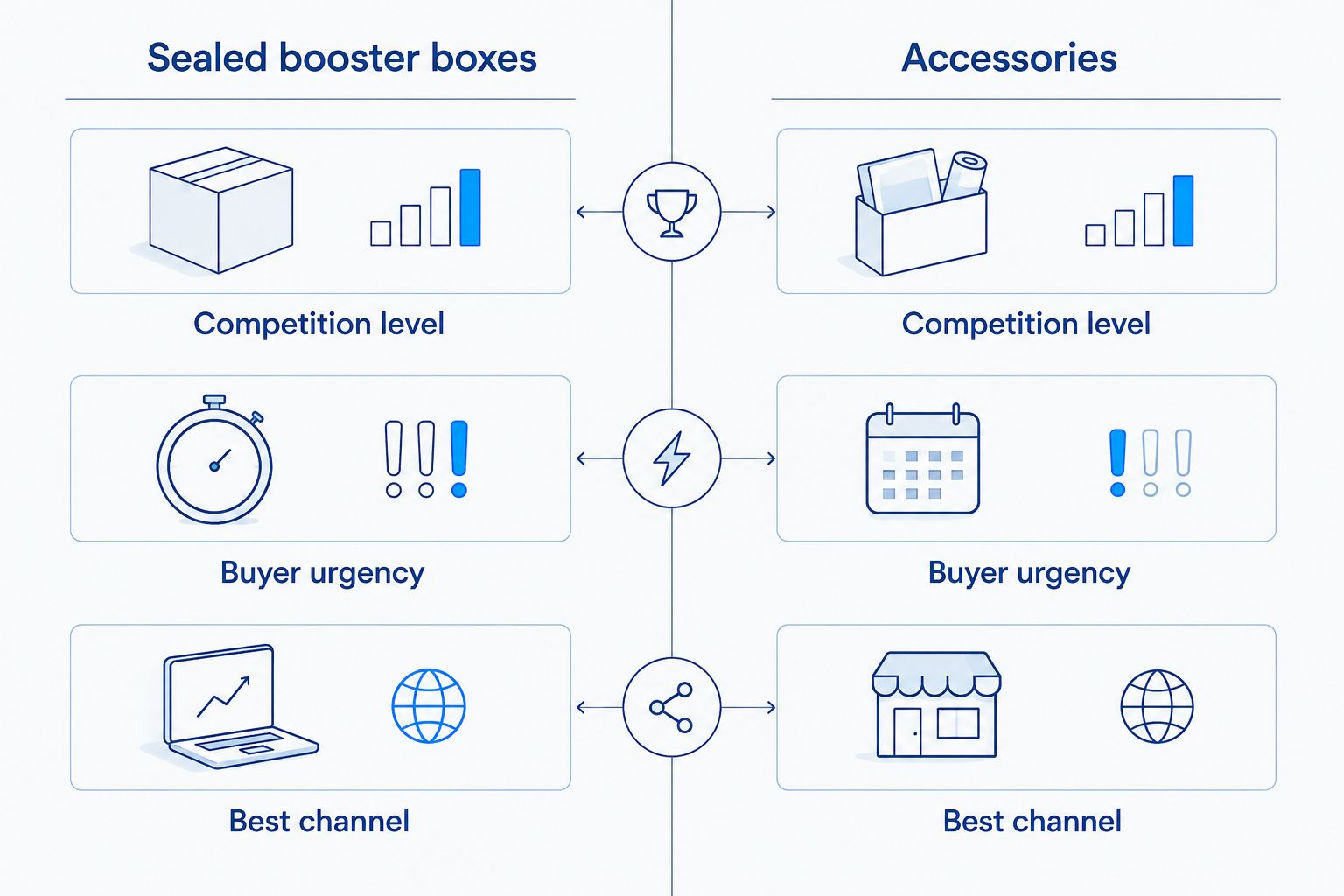
- Booster box terms like Terastal Fest ex booster box carry the highest paid search competition of any category compared here in 2026.
- Chase singles split competition by exact card name, not by set name — bidding the set term pulls in far more competitors.
- Grading and authentication searches draw lower commercial competition but get contested by grading companies on brand terms.
- Accessories — sleeves, deck boxes, display cases — sit at the bottom of the competitive range and are the cheapest lane to test paid search.
Why this matters
Pokémon card retail runs on paid search as much as organic traffic. Booster box drops move fast, chase singles get bid up by speculation, and every category is fighting for clicks from buyers who are already ready to purchase. Spend a 2026 ad budget on the wrong category and you're bidding against national retailers with a bigger budget for the exact same term.
The practical question isn't "what's the CPC for Pokémon cards" — nobody publishes that number at the product-category level. The real question is where your ad dollars go furthest, and that's answerable without a licensed CPC dataset. Search demand benchmarks by Pokémon card type shows the volume side of this; this page ranks the competitive-pressure side.
Pokémon card product category competitiveness benchmarks, 2026
Each row reflects how contested paid search is for that category, based on the number of realistic bidders, how price-comparable the product is, and how urgent the purchase feels to the buyer.
| Product category | Paid search competition | Why it sits there |
|---|---|---|
| Sealed booster boxes | High | Buyers price-compare instantly across every seller stocking the same set on launch day |
| Chase & graded singles | High-Medium | High resale value pulls in speculative bidders, but exact card names split volume |
| Grading & authentication content | Medium | Fewer direct sellers compete, but grading companies bid their own brand terms |
| Accessories (sleeves, cases, binders) | Low-Medium | Narrower buyer intent and fewer national retailers treat protective gear as a loss leader |
| All categories (overall) | Medium-High | Evergreen resale and speculation demand keeps Pokémon card search elevated versus average retail verticals |
Where the competition concentrates
Booster box searches sit at the top of the range because launch-day urgency turns them into instant price comparisons — bid on a term for a set like Terastal Fest ex booster box or Clay Burst Arena and you're competing against every shop that stocked the same release. Accessories trail at the bottom of the range, because the buyer pool is narrower and fewer big retailers treat sleeves or display cases as a category worth bidding hard on. Chase singles land in between: the set name gets crowded, but the exact card name narrows the field to sellers who actually have that card in stock.
Methodology and the one thing this can't tell you
This ranking is built from competitive-intent signals — how many sellers would realistically bid the same term, how price-comparable the product is, and how urgent the purchase feels — not from a licensed CPC feed. Neither Google Ads nor a third-party ad intelligence tool publishes cost-per-click segmented at the level of an individual TCG product category in 2026; the platforms group these queries under broad "Shopping" or "Hobbies & Leisure" industry codes that blend in unrelated collectibles. Anyone quoting you an exact dollar CPC for "Pokémon booster box ads" is quoting a guess dressed as data.
How to use these benchmarks
- Booster box terms: don't out-bid national retailers on broad match. Build organic content around a specific release like the Terastal Fest ex booster box instead of paying per click for the same buyer.
- Chase singles: bid the exact card name, never the set name — set-level terms pull in every seller holding that set, card-name terms narrow the field to sellers who actually have that card.
- Grading & authentication: this is content territory, not ad territory. A guide like how to identify fake Japanese Pokémon cards earns trust without fighting a grading company's brand bid.
- Accessories: this is where a small 2026 ad budget goes furthest. Lower competition means a lower cost per click for the same buyer intent.
Protective gear is also the easiest category to pair with a bigger purchase instead of running its own campaign:


FAQ
What is CPC for Pokémon card advertising?
CPC (cost-per-click) is what you pay each time someone clicks a paid search ad. No platform publishes it broken out by Pokémon card product category, so sellers estimate it from competitor bid volume instead of a single quoted figure.
Which Pokémon card product category is cheapest to advertise in 2026?
Accessories — sleeves, deck boxes, and display cases — carry the lowest paid search competition of the categories compared here, because fewer national retailers bid specifically on protective gear terms.
Why do booster box searches cost more to advertise than singles?
Booster box buyers price-compare instantly across every seller stocking the same set, like Terastal Fest ex booster box or Clay Burst Arena, which pulls more bidders into the same handful of launch-driven terms.
Does Google Ads report CPC by individual TCG product type?
No. Google Ads and third-party ad intelligence tools group Pokémon card queries under broad Shopping or Hobbies & Leisure industry codes that blend in unrelated collectibles, so a category-specific CPC figure isn't publicly available.
Should a Pokémon card shop run PPC or focus on SEO in 2026?
Both, weighted by category. Booster box and chase-single terms are worth pursuing organically because paid competition runs high, while lower-competition categories like accessories can carry a smaller PPC budget efficiently.
Is CPC rising for Pokémon card keywords in 2026?
Exact CPC trends aren't publicly tracked by category, but continued booster box releases and resale demand keep comparison-shopping terms in a persistently competitive tier rather than a cheap one.
How do I estimate CPC for a Pokémon card term without official data?
Count how many realistic competitors would bid the same term, check how price-comparable the product is, and treat set-level terms as more contested than exact card-name or accessory terms.
One last thing
The category with the least paid search pressure — accessories and protective gear — is also the easiest one to skip advertising entirely. Bundle a sleeve pack or display case into a booster box or singles order instead of running a separate campaign for it, and the lower-competition category rides along without a single extra click purchased. That's the real 2026 takeaway from this benchmark: competitive pressure tells you where to spend, and it also tells you where you don't need to.