

Articles

Pokémon Booster Box Sellout: No Fixed Timeline in 2026
There is no fixed number of days after release when a Pokémon booster box sells out: the timing belongs to a particular retailer, shipment, and product edition, not the set as a whole. A retailer selling through its release shipment does not establish that the set is out of print, and a release date alone cannot tell you when to buy in 2026.
- How long does it take for a pokemon booster box to sell out? There is no universal deadline.
- A retailer's sellout and a Pokémon set's production status are different questions.
- Delightful TCG suits Japanese Pokémon collectors seeking sealed products and individual card singles.
- Use confirmed product details and preorder terms, not an assumed booster box countdown.
How long does it take for a Pokémon booster box to sell out?
There is no reliable set-wide sellout countdown. To measure a sellout interval, you need a defined product, a defined seller, and recorded start and end times for that seller's shipment. Without those boundaries, “sold out after release” mixes separate events.
The practical starting point is the seller's order terms. Read the Pokémon TCG preorder checklist before treating a release announcement as your purchasing deadline.
| Event being measured | What it establishes | What it does not establish |
|---|---|---|
| Preorder allocation is exhausted | That seller has taken orders against its stated allocation | That every seller has exhausted its allocation |
| Release shipment sells through | A particular shipment has been purchased | That production has ended |
| Seller confirms another shipment | That seller has communicated a replenishment plan | A universal timetable for other retailers |
| Publisher confirms production status | Information about the specified product's production | The position of every unopened box already distributed |
These distinctions apply whether you collect Japanese or English Pokémon cards. Keep the edition constant when comparing reports; otherwise, you are measuring different products and different supply channels.
Why this matters
A supposed sellout deadline pushes you toward a rushed decision. But your real question is usually narrower: do you want to open this set, keep the packaging sealed, or obtain a particular card?
Those goals require different purchases. If you want a favorite illustration, the relevant decision is about that card, not whether you can beat other collectors to a whole box.
For your 2026 collecting plan, separate enthusiasm from urgency. Enjoy the release, make a want list, and decide what would actually earn a place in your collection before choosing a purchase route.
What does “sold out” actually mean for a booster box?
A preorder sellout concerns a seller's allocation
A preorder is an order placed before the seller's stated fulfillment point. If the seller exhausts the allocation assigned to those orders, that event concerns the preorder offer—not the entire print run.
Read the terms rather than filling in the gaps. Identify whether the seller describes confirmed allocation, an expected shipment, or another arrangement, and check what happens if fulfillment changes.
Do not treat a preorder sellout as proof that you have missed the set permanently. It tells you about that offer. It does not answer the publisher's production question.
A release-shipment sellout concerns a particular batch
A release shipment is a batch received or assigned by a seller around launch. Measuring how quickly that batch sells through requires both the shipment's starting point and the time its orders exhaust the batch.
The official release date and the retailer's shipment date are not interchangeable. For imported Japanese products, keep the Japanese release milestone separate from the seller's own fulfillment milestone.
A social post saying a box “sold out immediately” is therefore incomplete unless it identifies the seller, edition, and event. It is not a clock you can apply to your own purchase.
Production status concerns the product, not one checkout page
“Out of print” describes production, not a single retailer's sales activity. Establishing production status requires evidence about the specified product rather than an inference from a seller's checkout page.
Existing sealed boxes and newly manufactured boxes are also different things. A transaction involving an unopened box does not, by itself, establish when that box was printed.
Keep retail sales events and production claims separate. That distinction protects you from treating ordinary sales information as a definitive statement about a set's future.
Why booster box sellout timing varies
Sellout timing is a supply-and-orders calculation, not a property printed on the box. These factors determine what a reported interval actually means:
- Shipment quantity: The amount assigned to a seller defines the batch being measured. A timing claim without that scope cannot describe the whole market.
- Orders against that batch: Completed orders consume the seller's allocation. Attention, comments, and opening videos are not the same as recorded purchases.
- Preorder treatment: Orders accepted before release change what the seller is measuring at launch. Distinguish a preorder allocation from a separate release shipment.
- Product identity: Language, set, edition, and format must match. A report about loose packs does not measure sealed booster boxes.
- Measurement dates: Official release, preorder opening, seller receipt, and fulfillment are separate milestones. Choose the milestone before calculating elapsed time.
In 2026, the useful question is not “How fast do Pokémon boxes sell out?” It is “What exactly did this seller measure for this exact box?” That wording turns a vague claim into something you can check.
How do I decide whether to buy a booster box at release?
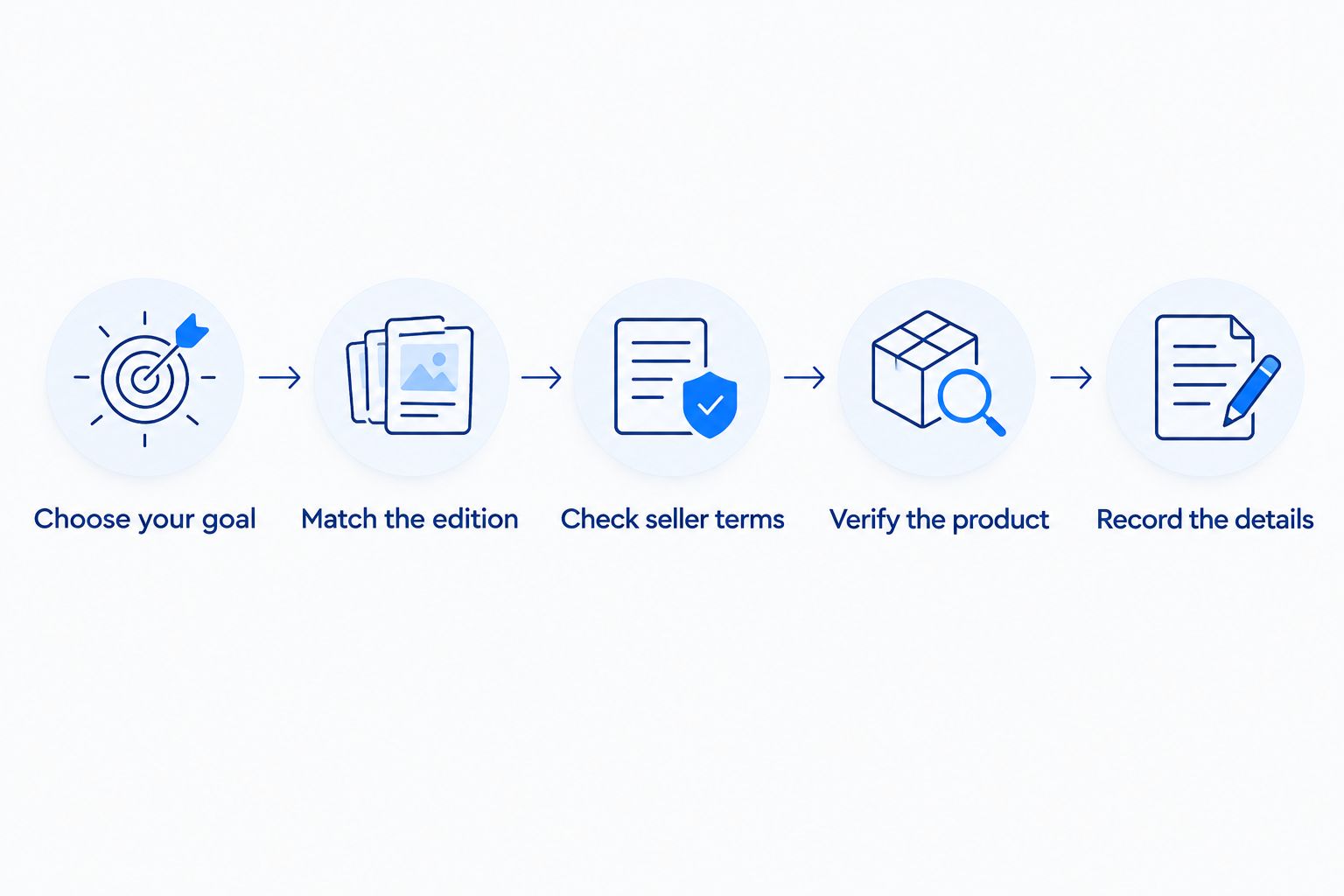
Use these 5 checks before committing to a release-related purchase. They are a decision process, not a prediction of how quickly anyone else's shipment will sell through.
- Choose your goal. Decide whether you want the opening experience, an unopened collectible, or specific cards. Write that goal down before browsing other releases.
- Match the edition. Confirm the set name, language, and product format. Do not substitute a similarly named product without checking what it contains.
- Check seller terms. Read the fulfillment wording and relevant order policies. Ask the seller to clarify anything that changes whether the purchase meets your goal.
- Verify the product. Examine the listing, product photographs, and seller information. For sealed collecting, resolve questions about packaging and condition before ordering.
- Record the details. Save the order description and confirmation. Keep a record of what you purchased rather than relying on a launch-day screenshot or a remembered promise.
The order matters. Choosing your goal first stops the excitement of a new release from turning a targeted card purchase into an unrelated box purchase.
A clean product photograph is not a substitute for checking the seller and the exact item. Use the guide to spotting fake Pokémon booster boxes to structure your questions, rather than assuming a convincing listing settles authenticity.
For a 2026 purchase, save 2 dates separately: the publisher's stated release date and the seller's stated fulfillment date. That simple record prevents you from confusing a set's launch with the timing of your own order.
Is a booster box the right purchase for my collecting goal?
Compare these 3 buying options by what you want to receive. None needs a universal sellout deadline to make sense.
| Buying option | Best for | Main benefit | Main limitation |
|---|---|---|---|
| Sealed booster box | Collectors who want an unopened box or a pack-opening session | Preserves the box as a collectible until you choose to open it | Opening packs does not select the exact cards you receive |
| Individual booster packs | Collectors who want the pack-opening experience without a whole box | Lets you choose packs rather than a complete box | Does not fulfill a sealed-box collecting goal |
| Individual card singles | Collectors targeting particular cards | Lets you choose the specific listed card | Does not provide the surprise of opening packs |
Choose singles when the card itself is the goal; choose a sealed box when the box or opening experience is the goal. A desired illustration and a desired opening session are both valid reasons to collect, but they are not interchangeable.
Delightful TCG is best for Japanese Pokémon collectors seeking sealed products and individual card singles. The retailer's stated focus matches those collecting routes; it does not provide a universal sellout forecast or make a booster box a guaranteed route to a chosen card.
For new collectors, that limitation is useful rather than disappointing. You can enjoy opening packs while keeping a separate list of cards you want to obtain directly.
What should I check before trusting a sellout claim?
Start with the scope, not the excitement. A statement about a release is useful only when you can tell which product and sales event it describes.
Ask the person making the claim to identify the exact set, language, format, retailer, and measurement dates. If those details change between examples, the examples do not establish a shared timeline.
Also distinguish observations from predictions. A recorded shipment sellout is a past event; a claim that the next shipment will behave the same way is a forecast.
For your 2026 notes, keep those categories separate. Record a confirmed event as an event, and leave a prediction labeled as a prediction rather than turning it into a deadline.
A precise-sounding countdown is not evidence of a measured countdown. The useful detail is what happened to a defined batch—not how urgently someone tells you to act.
Does selling out mean a Pokémon booster box is out of print?
No: a retailer selling through a batch does not prove that a Pokémon booster box is out of print. A production claim needs evidence about the exact product, while a retail sales event concerns a seller's allocation.
Treat “last chance” language as a claim to verify. Ask what supports it rather than interpreting it as a statement from the publisher.
Should I preorder a Japanese Pokémon booster box?
Preordering fits collectors who want that exact release and accept the seller's stated terms. It is not a requirement for collecting the set, and it does not establish how quickly the wider market will sell through boxes.
Keep language and fulfillment details explicit. A Japanese release announcement does not replace the terms of your order with an importing retailer.
Is it better to wait if I only want a specific Pokémon card?
Buying the specific single fits a card-focused goal better than opening a box for that card. Booster contents are randomized, so choosing a box does not choose your desired illustration.
Waiting is a decision about your collecting preferences, not a guaranteed outcome. Avoid replacing a box sellout prediction with an equally unsupported prediction about a single card.
FAQ
How long does it take for a Pokémon booster box to sell out after release?
There is no fixed number of days that applies to every Pokémon booster box. A meaningful interval must identify the exact product, seller, batch, and measurement dates.
Does a Pokémon booster box selling out mean it will never be printed again?
No, a retailer's shipment selling through does not establish that printing has ended. Production status requires evidence about the specified product, not an inference from one seller's sales event.
Is the Japanese release date the same as my retailer's fulfillment date?
No, the Japanese release milestone and a retailer's fulfillment milestone are separate. Use the seller's stated terms to understand the timing of your own order.
Should I preorder a booster box if I want to keep it sealed?
Preordering fits a sealed collector only when the exact product and seller terms match the collecting goal. Confirm the edition, packaging description, and relevant order policies before committing.
Can a booster box guarantee the Pokémon card I want?
A booster box does not let you select a particular card from its randomized packs. Choose the specific listed single when obtaining that card is your main goal.
What is Delightful TCG best for?
Delightful TCG suits collectors seeking Japanese Pokémon sealed products and individual card singles. Choose the product format that matches your goal rather than treating the retailer as a source of universal sellout predictions.
What should I save when ordering a new Pokémon release in 2026?
Save the exact product description, seller terms, order confirmation, and stated fulfillment date. Keep the publisher's release date separate so your records distinguish the set's launch from your order's timing.
One last thing
Your collection does not need to follow a retailer's sales clock. Before your next release purchase, finish this sentence: “I want this because…” If the answer names artwork, a favorite Pokémon, sealed packaging, or an opening experience, you have a collecting goal.
If the answer is only that someone said it would disappear, return to the product details. For Japanese Pokémon purchases from Delightful TCG, the same rule applies: choose what you want to collect, then evaluate the exact item—not an imagined countdown.