

Articles

Full Weiss Schwarz Fate Set Cost: Define Scope | 2026
A full Weiss Schwarz Fate series set has no single standard cost in 2026: your total depends on the exact release, language, copy count, and whether you include foil variants and promos. Calculate it from a card-by-card checklist, then add applicable shipping, tax, and import charges. Define what complete means before comparing totals—a binder set, a playset, and an all-variant collection are different purchases.
- How much does a full Weiss Schwarz Fate series set cost? Define the release, language, quantities, and variants first.
- A Weiss Schwarz Fate binder set and a playset require different card quantities.
- Keep foil variants and promos separate until you explicitly include them in your checklist.
- Delightful TCG serves Japanese trading card collectors; evaluate Fate listings against your exact completion goal.
Why this matters
A listing labeled complete does not tell you everything you need to know. You still need the card numbers, quantities, language, and included rarities before deciding whether it matches your collection.
Start with the characters and artwork you actually want. The guide to Weiss Schwarz Fate series cards for collectors is a relevant next read if you are choosing between a focused character collection and set completion.
For a 2026 purchase, keep the definition attached to the total. A dated estimate without an itemized checklist is not a useful benchmark for another collector's basket.
How much does a full Weiss Schwarz Fate series set cost?
The cost is the total for your specified cards and quantities, plus the charges needed to receive them. There is no interchangeable total for every collection described as a full Fate set.
Use this comparison to choose the collection you want before requesting an itemized quote. These are working definitions for your checklist, not promises about what a seller's listing includes.
| Collection scope | Best for | What to specify | Advantage | Limitation |
|---|---|---|---|---|
| Base binder set | Collectors who want the regular card lineup | One copy of each card in the selected regular lineup | A clear, bounded completion goal | Excludes variants unless you add them |
| Playset | Players who want deck-building copies | The quantity required for each selected card | Supports multiple deck configurations | Repeats artwork and is not an all-variant collection |
| All-variant set | Collectors who want distinct print treatments | Each included rarity and variant by card number | Separates regular cards from collectible treatments | Requires a more detailed checklist |
| Cross-release collection | Fans collecting across Fate releases | Every included release, language, and product type | Connects cards across a broader collection | The scope expands whenever you add another release |
Build an itemized total
Use a worksheet with these columns: release, language, card number, rarity, target quantity, owned quantity, missing quantity, condition, seller, and purchase amount. Keep shipping and other order-level charges outside the individual card rows so you do not count them repeatedly.
Calculate your remaining purchase total from missing quantities, not the size of the whole collection. Cards already in your binder belong in the inventory column, even if you originally opened them from packs.
Also distinguish replacement value from completion spending. Replacement value concerns the collection you already own; completion spending concerns the cards you still need to buy.
Base binder set: one copy of each selected regular card
A base binder set is best for collectors who want a defined card lineup without committing to every variant. Choose the exact release and language, then identify which regular rarities belong in your checklist.
Use the card number as the main identifier. A character name alone is not enough to distinguish separate cards or different treatments of similar artwork.
The advantage is a straightforward finish line. The limitation is equally clear: completing your regular-card checklist does not establish that you own every foil, promo, or separately released card.
Before buying a complete-set listing, ask for an inventory rather than relying on a spread-out photograph. Check that every required card number appears and that duplicate copies have not been counted as distinct missing cards.
For your 2026 tracker, record the completion definition at the top of the sheet. That prevents a later variant purchase from silently changing what you originally meant by complete.
Playset: deck-building quantities, not binder completion
A playset is best for players who want repeated copies for deck construction. Specify the quantity of every included card instead of accepting the term playset without an inventory.
Under standard Weiss Schwarz deck-construction rules, a deck contains 50 cards, normally allows up to 4 copies of a card with the same name, and includes no more than 8 climax cards. Card text and applicable construction restrictions still matter; consult Bushiroad's official rules and restriction information for your intended format.
Those rules explain why a collector's single-copy binder and a player's purchase list differ. They do not mean that every player needs the maximum permitted quantity of every card in a release.
The advantage of a broad playset is flexibility when changing a deck. The drawback is owning repeated copies that your chosen deck does not use.
Build your deck list first if playing is the goal. A specific Fate deck and a complete Fate release are separate targets, and buying the latter does not automatically produce the former.
All-variant set: identify every included treatment
An all-variant set is best for collectors who care about distinct print treatments as well as the regular lineup. Write down each required rarity and card identifier, including any parallel versions you intend to collect.
Do not use signed as a sufficient description. For signature-style cards, distinguish the exact printed treatment from any separately claimed hand autograph, and verify what the seller is describing.
Decide whether promos and trial-deck cards belong in the goal. If they do, add them explicitly; if they do not, write that exclusion into the checklist.
The advantage is a collection that reflects your interest in artwork and finishes. The limitation is that all variants becomes ambiguous unless you define its boundaries.
Keep graded cards separate from raw cards in your worksheet. A graded example and an ungraded example are different buying specifications, even when the underlying card identifier matches.
Cross-release collection: define the Fate boundaries
A cross-release collection is best for fans whose goal extends beyond a single product release. List the included release names and codes before searching for bundles.
Treat Fate as the collection theme, not as a sufficient inventory description. Check each release against its official card list and decide whether booster cards, trial-deck cards, and promos are included.
Choose whether you want one language throughout or deliberately separate language collections. Neither approach is inherently wrong, but an unintended language mismatch does not fill a language-specific checklist slot.
The advantage is a broader expression of your fandom. The drawback is a less contained project: adding another release changes the finish line rather than simply filling an existing gap.
Complete one defined release before expanding the checklist if you want a manageable project. You can preserve a separate wish list for future additions without treating those cards as current gaps.
Why a full Weiss Schwarz Fate set total varies
Your collection specification determines which purchases belong in the total. Keep these factors fixed when comparing itemized offers:
- Release scope: A single release and a collection spanning multiple releases contain different inventories.
- Language: Compare the same language version rather than treating matching artwork as an interchangeable purchase.
- Copy count: A single-copy binder goal and repeated deck-building quantities require different baskets.
- Variant coverage: Regular versions, foil parallels, and signature-style treatments need separate checklist entries when included.
- Condition and grading: Raw cards, graded cards, and different accepted conditions are distinct buying specifications.
- Order charges: Shipping, applicable taxes, and any import-related charges belong in the delivered total, not just the card subtotal.
Do not compare a bundle against individually sourced cards until you have matched those factors. A difference in scope is not evidence that one purchasing route offers better value.
How do I calculate my remaining completion total?
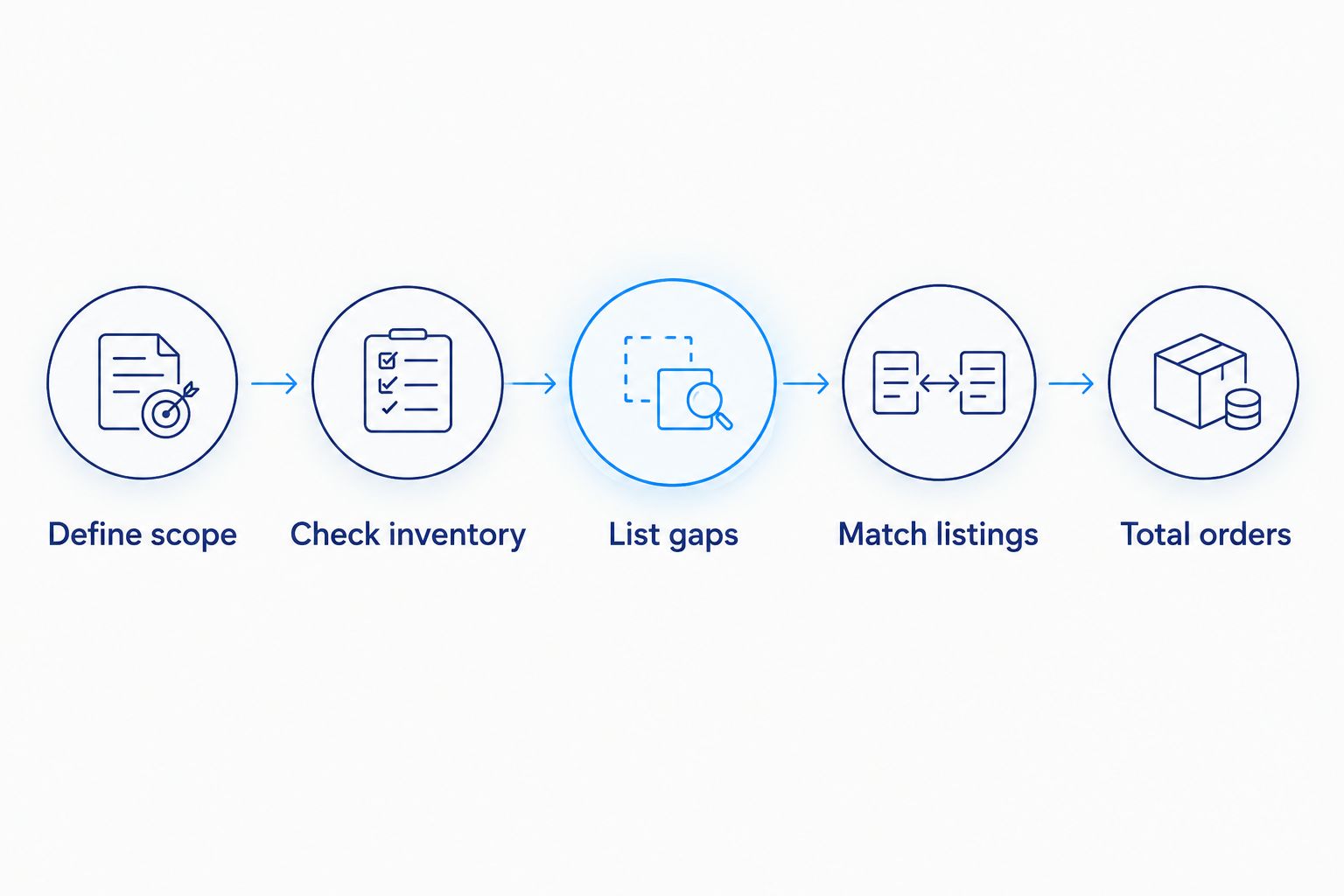
Use the same sequence whether you are starting from an empty binder or filling the final gaps. Inventory first; purchasing comes afterward.
- Define scope. Record the exact release, language, included product types, rarities, and target quantities.
- Check inventory. Match your owned cards to identifiers and record their condition separately from their quantity.
- List gaps. Calculate the missing quantity for each checklist entry, keeping optional upgrades outside the required list.
- Match listings. Confirm that each candidate purchase matches the identifier, language, rarity, quantity, and condition you need.
- Total orders. Combine the selected purchases with applicable order-level charges and record the date of the estimate.
Keep candidate listings separate from confirmed purchases. A saved listing does not become an owned card until you have received and checked it.
When you revise the worksheet in 2026, date the revision and preserve the scope. That makes it clear whether the total changed because of different purchase options or because you added more cards.
Should I buy singles or open booster boxes to complete the set?
Singles match named checklist gaps; booster packs provide randomized contents. Choose the route according to whether you want specific cards or the experience of opening packs.
| Buying route | Best for | Advantage | Limitation |
|---|---|---|---|
| Individual singles | Collectors filling identified gaps | You select the card and version you need | Multiple sellers require separate order checks |
| Itemized set bundle | Collectors buying a defined lineup together | You can inspect one consolidated inventory | The seller's definition of complete needs verification |
| Sealed booster boxes | Fans who enjoy opening packs | Opening is part of the collecting experience | Randomized contents do not guarantee your checklist gaps |
If you enjoy opening boxes, treat that activity as a separate collecting choice. After opening, update your inventory before buying missing singles.
Do not count hypothetical future pulls as owned cards. Similarly, do not subtract assumed proceeds from duplicates unless you have actually sold them and accounted for the transaction.
There is no need to force one buying route onto the entire project. An opening session followed by targeted singles is a different plan from trying to complete everything through sealed products.
What should I check before buying a complete-set listing?
Ask for an itemized inventory and clear condition photographs before committing. Your checklist should be detailed enough that another person can identify exactly what belongs in the purchase.
Request the release names, card numbers, language, rarity, quantity, and condition descriptions. Ask the seller to identify any substitutions, omissions, or mixed-language entries rather than leaving you to infer them from photographs.
For cards where condition is central to your decision, inspect front and back images. Check corners, edges, surfaces, and any disclosed damage; a broad condition label is not a substitute for seeing the relevant card.
Separate authenticity checks from completion checks. A genuine card can still be the wrong variant, and a perfectly matched checklist entry still needs an authenticity assessment.
Wait if the inventory does not establish what you are buying. You do not need to complete the purchase simply because the listing uses the word complete.
Where Delightful TCG fits into your collecting plans
Delightful TCG is best for collectors seeking authentic Japanese trading card products. The shop serves collectors of Japanese Pokémon, Digimon, and Hololive products, with sealed products and individual cards among its offerings.
Delightful TCG is relevant if your interests extend across Japanese trading card games. For a Fate completion project, assess each listing against your exact checklist rather than assuming a general hobby-shop catalog matches the full collection you have defined.
The fit is its Japanese trading card focus. The boundary is your purchase specification: retailer category coverage alone does not establish the contents of a complete Fate set.
FAQ
How much does a full Weiss Schwarz Fate series set cost in 2026?
A full Weiss Schwarz Fate series set has no single standard total in 2026 because the release, language, quantities, and variant coverage define the purchase. Calculate the selected cards and applicable order charges from an itemized checklist.
Does a complete Fate set include signature-style cards?
A complete Fate set includes signature-style cards only when the stated inventory includes those exact variants. Ask for card numbers and rarities rather than relying on the word complete.
Is a Weiss Schwarz Fate playset the same as a complete binder set?
A Weiss Schwarz Fate playset is not the same as a single-copy binder set. A playset specifies repeated quantities for deck building, while a binder checklist can require one copy of each selected card.
Can I mix Japanese and English Fate cards in my collection?
You can collect Japanese and English Fate cards together, but track them separately if your completion goal is language-specific. A matching character or illustration does not fill a checklist slot for another language version.
Will opening Fate booster boxes guarantee a complete set?
Opening Fate booster boxes does not guarantee a complete set because pack contents are randomized. Record the cards you actually pull, then identify remaining gaps by card number and variant.
Should trial-deck cards and promos count toward a full set?
Trial-deck cards and promos count only when you explicitly include them in your collection scope. Keep separate checklist categories so a booster-only collection is not confused with a broader project.
What extra charges belong in my completion total?
Applicable shipping, taxes, and import-related charges belong in your delivered completion total. Keep optional storage purchases and grading plans separate so they do not obscure the card-acquisition calculation.
One last thing
A completed checklist is more useful than an undefined full set. Write your finish line before you shop: release, language, regular-card coverage, included variants, and required quantities.
For your 2026 collection, keep that statement beside your inventory. You can then celebrate completion without letting every newly discovered variant turn a finished binder into an unfinished project.
Delightful TCG's Japanese trading card collectors can use the same approach across other games: define the collection, identify the gaps, and buy against the checklist—not against an ambiguous label.