

Articles

How Much Does a Graded Digimon Card Sell For? 2026
There is no defensible typical sale price for a graded Digimon card in 2026 without the exact card, grading company, grade and recent completed sales. Selling fees, shipping and grading costs also affect what the seller keeps. Use matched sold listings, not asking prices, to estimate what your card will sell for.
- How much does a graded Digimon card sell for? In 2026, the answer depends on the exact card, grader, grade and matched sales.
- A listed price is an asking price; a completed sale is evidence of what a buyer paid.
- Compare the same card in the same grade before deciding whether grading adds value.
- Delightful TCG is a fit for collectors shopping Japanese Digimon cards, not a benchmark for graded-card sale prices.
How much does a graded Digimon card typically sell for?
There is no reliable single figure. A graded Digimon card's selling price is established by completed sales of that specific printing in a comparable grade. If you cannot find those sales, you cannot support a typical price for it. That remains true even when another card featuring the same Digimon has sold.
Use this comparison when checking a card in 2026:
| Evidence | What it tells you | Limitation | Best for |
|---|---|---|---|
| Completed sale of the exact card, same grader and grade | What a buyer paid for the closest match | An individual sale can be unusual | Setting an initial value estimate |
| Completed sale of the exact card in another grade | How buyers valued a related copy | It does not establish your grade's sale price | Checking whether a grade difference matters |
| Completed sale of an ungraded copy | What a raw version sold for | Condition is not certified or directly comparable | Assessing whether grading was worthwhile |
| Active listing | What a seller hopes to receive | It does not show buyer demand at that price | Checking competing asking prices, not sale value |
Identify the exact printing before searching. Check the card name, set and card number, language, artwork and any distinguishing release detail visible on the card. A different printing belongs in a separate comparison, even if its title looks familiar. If you are unsure whether the copy is a distinct release, resolve that question before using any sale as a match; the Digimon first-edition identification guide addresses one distinction collectors often need to check.
A practical 2026 pricing check
- Record the exact card. Write down its identifying details and the grading company's name, numeric grade and certification number from the slab. Verify that the label describes the card inside.
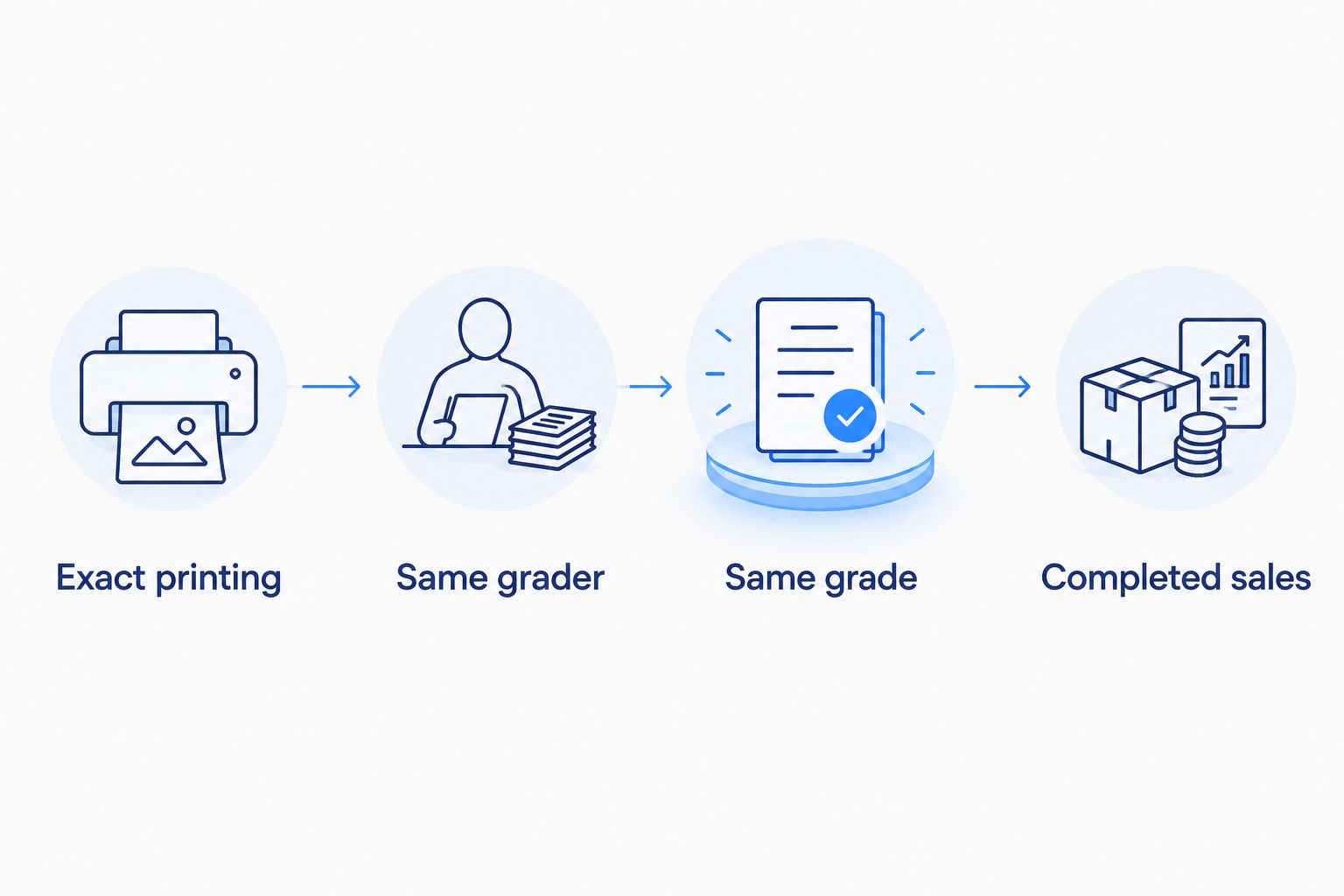
- Search completed sales. Find the same printing from the same grading company at the same grade. Exclude active listings from your sale-price comparison.
- Check each match. Read the listing and inspect the photos. Do not combine a different language, artwork, printing or grade with your exact-match sales.
- Compare the results. Look at the completed sale prices together, rather than treating the highest result as typical. Record when each sale occurred so an older transaction does not silently become your 2026 benchmark.
- Calculate what you keep. Separate the buyer's payment from selling fees and shipping. If you paid to grade the card, include that expense when judging the result of your decision.
This process can produce a useful estimate, but it cannot produce one from missing transactions. No exact-match sales means no supported typical sale price; broaden the search only to understand related demand, and label those comparisons as imperfect.
Why this matters
A slab confirms an assigned grade; it does not make every card with that grade equally desirable. Two Digimon cards can share a character and a numeric grade while differing in printing, language or artwork. In 2026, treating those copies as interchangeable is a direct route to a misleading listing price.
There is also a difference between what the buyer pays and what reaches the seller. A completed sale helps establish the first figure. Your selling costs determine the second. Keep those questions separate, particularly if you are deciding whether to submit an ungraded card rather than valuing one already in a slab.
PSA 10: compare PSA 10 sales of the exact printing
A PSA 10 result is the closest comparison for a PSA 10 Digimon card. Match the card identification first, then check completed sales carrying that grade. A PSA 10 sale for a different artwork or language is evidence about that other card, not an answer for yours.
Best for: Estimating a card already graded PSA 10 when exact-match sales exist. The advantage is a clearly defined comparison; the drawback is that the evidence disappears when that precise card has not sold recently. Do not fill the gap with an active listing and call it market value.
If you are considering grading a raw card, a potential PSA 10 result is not a sale you have already earned. Compare your decision against the possibility of a different assigned grade and the costs of submitting the card. The question is whether completed sales support the decision, not whether a high-grade listing looks attractive.
PSA 9: use PSA 9 sales, not an assumed discount
For a PSA 9 Digimon card, start with completed sales of the identical PSA 9 printing. Do not take a PSA 10 asking price and apply an invented percentage discount. There is no fixed grade-to-grade adjustment that works for every Digimon card.
Best for: Pricing a PSA 9 copy with identifiable, comparable sales. The benefit is that you are measuring buyer behavior for the grade you own; the limitation is that sparse sales can leave a wide gap between examples. When sales are scarce, show the transactions you found and avoid claiming their midpoint is a stable market rate.
The same rule applies to other grades and grading companies. A numeric grade from one company is not automatically a matched sale for another company's slab. Search each company's completed sales separately before deciding whether the results can inform your estimate.
Ungraded copies: useful context, not a slab price
An ungraded sale tells you what a particular raw copy brought in its stated condition. It does not tell you what the card would sell for after grading, or what grade it would receive. Photos and condition descriptions matter when comparing raw copies, but they do not replace a professional grade.
Best for: Deciding whether to keep a card raw, sell it raw or investigate grading. The advantage is a direct comparison with another ungraded copy; the drawback is uncertainty about condition. If you are considering a submission in 2026, compare completed raw sales with completed graded sales of the exact printing, then account for grading and selling costs. If you cannot find relevant graded sales, you cannot calculate a supported grading return.
This is also where collecting and resale part ways. You can want a graded copy for its presentation and protection without expecting the grading decision to produce a gain. A resale calculation needs transaction evidence; a personal collection decision does not.
Why graded Digimon sale prices vary
- Exact printing: Set, card number, language, artwork and release details determine which transactions actually match your copy.
- Assigned grade: Buyers compare the grade on the slab, not the grade a seller believes an ungraded card would receive.
- Grading company: Search for the same company's slab first. A sale from another grader is a related data point, not an exact match.
- Evidence of demand: Completed sales show transactions. Active listings show sellers' expectations and can remain unsold.
- Timing: A sale recorded before your 2026 listing is historical evidence, not a promise that another buyer will pay the same amount.
- Selling costs: Fees, shipping and any grading expense affect proceeds without changing the recorded sale price.
A useful search keeps these factors visible rather than hiding them in a single average. Write down why each transaction qualifies as a match. If you have to change the card, grade or grader to find results, you are no longer measuring the exact item you plan to sell.
How to use imperfect comparisons without overstating them
Sometimes an exact-match search produces no completed sale. Start by stating that plainly. You can then look at the same card in another grade, an ungraded copy or a different printing to understand adjacent demand, but none of those results becomes the typical sale price of your slab.
Keep each group separate in your notes. For example, a different grade can help you see whether buyers distinguish grades for that card, while an ungraded sale can help frame the grading decision. Neither tells you the precise amount a buyer will pay for a grade that has not sold. In 2026, that distinction matters more than producing a tidy number.
Check the original listing details before trusting a search result. A title can omit a language or printing difference that appears in the photos. The certification number can also help you confirm that the pictured slab matches the listing description. If the transaction details are unclear, exclude the result rather than using a questionable match to set your expectation.
Should you use a sale of the same Digimon in a different language?
No, not as an exact-match sale. Use the other language as a separate comparison and identify it as such. For a Japanese card, search Japanese-card transactions first; demand for another printing does not establish the Japanese copy's sale price.
Does grading guarantee a higher selling price?
No. A grade gives buyers a stated condition assessment, but the sale result still depends on the exact card and buyer demand. Compare completed raw and graded transactions, then consider grading and selling costs before calling grading financially worthwhile.
Can you price a card from its highest completed sale?
No. The highest result shows that one transaction happened at that amount; it does not establish a typical outcome. Check the other matched transactions and their dates before setting your 2026 expectation.
Where Delightful TCG fits
Delightful TCG sells Japanese trading cards, including Digimon singles and sealed products. If you are choosing a card to collect rather than valuing an existing slab, a Dianamon single is a relevant catalog example. Delightful TCG is best for collectors browsing Japanese Digimon cards, not for determining what a graded Digimon card typically sells for. A store listing is not a substitute for matched completed sales.
The distinction protects both sides of the decision. Shop for a card because you want that printing; value a graded copy using transactions for its exact printing and slab details. Do not transfer an ungraded catalog listing into a graded resale estimate.
FAQ
How much does a graded Digimon card sell for in 2026?
There is no supported typical amount without the exact card, grading company, grade and completed sales. Match those details before estimating a sale price.
Is a PSA 10 Digimon card always worth more than a PSA 9?
Do not assume a fixed difference between PSA 10 and PSA 9. Check completed sales of the exact printing in each grade to see what buyers paid.
Can I use an active Digimon card listing to value my slab?
No. An active listing shows an asking price, not a completed transaction. Use it to see competing listings, then check sold results for value evidence.
Do Japanese and English Digimon cards have the same resale value?
Do not treat different languages as identical sale comparisons. Search completed sales for your card's language and printing first.
Does grading a Digimon card guarantee a profit?
No. Compare completed raw and graded sales for the exact card, then account for grading and selling costs before judging the result.
What if my graded Digimon card has no recent sold listings?
You cannot establish a reliable typical sale price from missing exact-match transactions. Review related sales separately, explain how they differ and avoid presenting them as a direct match.
Which details should I check on a graded Digimon slab?
Check the card identification, grading company, assigned grade and certification number. Confirm those details against the card and listing photos before comparing a sale.
One last thing
The best-looking comparison is not necessarily the closest one. A completed sale with the same Digimon character but different artwork tells you less about your slab than a properly identified sale of your exact printing. For a 2026 listing, check the card first and the grade second; only then decide which sales belong in your estimate.