

Articles

Graded Weiss Schwarz Card Value: Use Sold Comps (2026)
A graded Weiss Schwarz card sells for an amount supported by completed sales of the exact card, language, rarity, grading company, and grade—not a universal graded-card average. In 2026, the useful benchmark is a matching sold comparison; your take-home amount also depends on selling fees, shipping, insurance, and any grading expenses you incurred.
- How much does a graded Weiss Schwarz card sell for? Use matching completed sales, not asking amounts.
- PSA 10, PSA 9, and BGS labels require separate comparisons; matching grade numbers alone is insufficient.
- Delightful TCG serves Japanese trading card collectors; a graded Weiss Schwarz valuation requires exact-card evidence.
- Separate the recorded transaction from your net proceeds before deciding whether to sell or grade.
How much does a graded Weiss Schwarz card sell for?
Use the exact slab's completed-sale history, not the highest listing you can find. A sale of another character, another rarity, or another language does not establish what your card will sell for. Neither does an unsold listing with an ambitious asking amount.
Start by identifying the card through its printed card code and slab label. Then confirm that the photographs agree with the listing description. If authenticity is your first concern, review how to spot fake Weiss Schwarz cards before treating the listing as valuation evidence.
Follow this sequence when estimating a graded Weiss Schwarz card's resale value:
- Identify the card. Record its complete name, card code, set, language, and rarity.
- Identify the slab. Record the grading company, numerical grade, grade designation, and certification number.
- Find completed sales. Search with the card code and slab details rather than the character name alone.
- Check the match. Exclude different versions, bundles, and listings whose photographs contradict their titles.
- Record the transaction. Save the sale date, currency, shipping treatment, and evidence of the accepted amount.
- Calculate your proceeds. Apply the selling platform's current terms and your actual fulfillment expenses.
For a 2026 sale, keep recent exact matches separate from older or less closely matched transactions. An older sale remains historical evidence, but it is not a current transaction.
Why this matters
A collector buys a particular card in a particular holder. The anime title is only the beginning of that identification. Artwork, rarity, language, and the grading label all need to match before you compare transactions.
Grading also answers a different question from valuation. A grade describes the grading company's assessment of condition; a completed sale records what a buyer paid in that transaction. A condition grade is not a resale guarantee.
That distinction helps whether you are selling a favorite character or deciding what to submit. You can enjoy a slab for its presentation and still evaluate resale using evidence rather than attachment.
PSA 10: compare cards graded at 10 points
PSA's grading scale runs from 1 to 10, with PSA 10 designated Gem Mint. For valuation, search for the same Weiss Schwarz card in a PSA 10 holder before looking at any other grade. A matching character name is not enough.
Best for: collectors specifically seeking a PSA Gem Mint example. The benefit is a clearly identified condition designation; the limitation is that the designation alone does not establish a selling amount or guarantee a buyer.
Check the certification record and compare it with the visible label and card. Keep the physical slab photographs in your research notes. A certification lookup supports verification, but you still need to examine the item being offered.
PSA 9: compare cards graded at 9 points
PSA 9 is designated Mint on PSA's published scale. Evaluate a PSA 9 Weiss Schwarz card against matching PSA 9 sales, not by applying an assumed discount to a PSA 10 transaction. The relationship between those grades must come from the exact card's sales evidence.
Best for: collectors who want a PSA Mint example without requiring the Gem Mint designation. The benefit is a documented condition assessment; the limitation is that PSA 10 transactions are not direct matches.
If matching sales are sparse, broaden the sale-date window before broadening the card identity. Keeping the same card and grade preserves more useful comparability than switching to a different character because its sales are easier to find.
PSA 8: compare cards graded at 8 points
PSA 8 is designated Near Mint–Mint on PSA's published scale. It belongs in a separate comparison group from PSA 9 and PSA 10. Do not assume that the difference in grade points translates into a fixed difference in resale value.
Best for: collectors comfortable with the Near Mint–Mint designation who prioritize the exact card over a higher numerical grade. The benefit is access to a graded example matching that collecting goal; the limitation is that its resale estimate still requires grade-specific evidence.
Read the grade alongside the photographs. The slab label gives you the grading company's assessment, while the images help you decide whether the card's appearance suits your collection.
Which graded-card comparisons belong together?
| Slab or comparison type | Best for | Useful evidence | Limitation |
|---|---|---|---|
| PSA 10 | PSA Gem Mint collectors | Same card, language, rarity, and PSA 10 designation | Another grade is not a direct match |
| PSA 9 | PSA Mint collectors | Same card, language, rarity, and PSA 9 designation | No automatic conversion from PSA 10 |
| PSA 8 | Near Mint–Mint collectors | Same card, language, rarity, and PSA 8 designation | Higher-grade transactions remain separate |
| BGS-graded card | Collectors seeking that BGS designation | Same card and complete BGS label details | A matching numeral from another grader is insufficient |
| CGC-graded card | Collectors seeking that CGC designation | Same card and complete CGC label details | The full designation matters, not just the number |
| Ungraded card | Collectors evaluating a raw alternative | Same card and comparable disclosed condition | It does not establish a graded-card premium |
These are comparison categories, not a ranking of grading companies. Use each company's published grading standards to interpret its labels, and let matching transactions establish the resale evidence.
Why graded Weiss Schwarz resale value varies
The strongest valuation starts with differences you can verify. For a 2026 listing, record these factors instead of relying on broad claims about anime-card demand:
- Card identity: Match the full card code and release, not just the character or franchise.
- Language: Keep Japanese and English transactions separate unless you are explicitly comparing language markets.
- Rarity and finish: Confirm the printed rarity and visible treatment; similar artwork does not prove an identical version.
- Grading company and designation: Match the complete label, including any relevant subgrades or special designation.
- Transaction date and market: Record when and where the sale occurred, plus the original currency.
- Transaction contents: Separate individual slabs from bundles, accessories, and combined orders.
A different factor is not automatically a reason to adjust the amount upward or downward. It is a reason to question whether the transaction belongs in your comparison group. Verify the difference before assigning it financial meaning.
For signature-style cards, describe exactly what the release contains. Do not describe a printed or foil-stamped signature as a hand-signed autograph unless the card's documented release details support that description.
How do I find useful sold comparisons?
Search by card code first, then add the language, rarity, grading company, and grade. This reduces the chance of collecting transactions for similarly named cards. Save the photographs as well as the listing text.
Treat eBay sold results as research leads rather than accepting every result as a clean comparable. Check whether the result is for an individual card, whether the slab designation matches, and whether the displayed amount represents the actual accepted transaction. An accepted-offer listing needs particular care.
Use a simple research sheet:
| Field | What to record | Why it matters |
|---|---|---|
| Card identity | Name, card code, set, language, rarity | Prevents version mixing |
| Grading details | Company, grade, designation, certification | Defines the slab comparison |
| Sale evidence | Date, transaction record, photographs | Preserves what you actually verified |
| Sale terms | Currency, shipping, bundled contents | Keeps transaction totals comparable |
| Exclusion reason | Wrong version, unclear amount, duplicate | Makes the estimate reproducible |
Check for repeated appearances of the same certification number. Repeated results should not automatically count as independent sales; investigate whether they represent a relisting, duplicate record, or separate documented transaction.
Keep excluded transactions in a separate tab with a brief reason. That small habit prevents the same mismatched sale from slipping back into your research later.
What should I do when there are no exact sold matches?
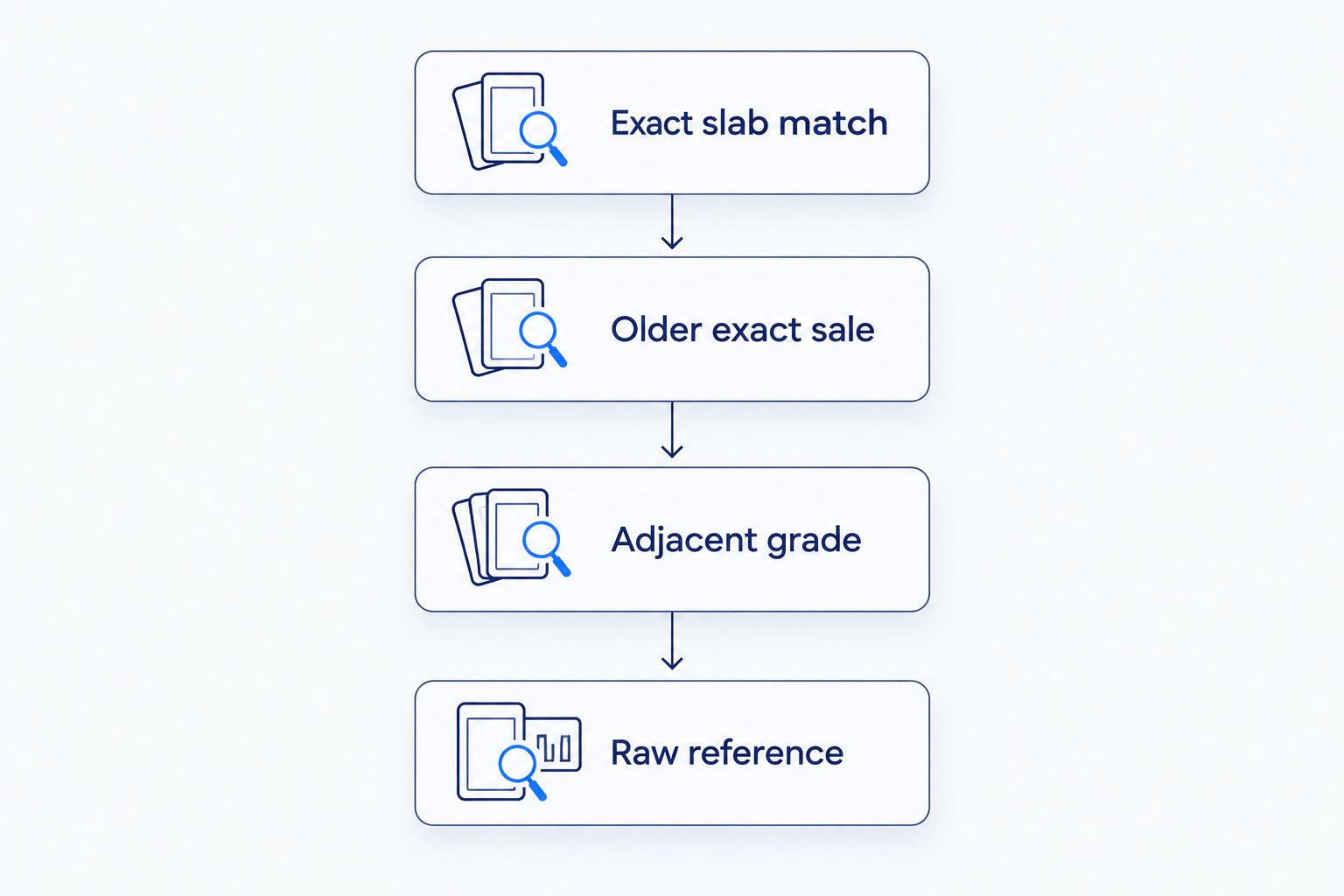
Broaden the search carefully; do not invent a grade premium. Start with an older sale of the same card and slab designation. Then examine adjacent grades or the same card from another grader as secondary evidence, clearly separated from exact matches.
Use this research order:
- Exact slab match: Same card, language, rarity, company, and grade designation.
- Older exact sale: Preserve the exact identity, but label the evidence historical.
- Adjacent grade: Keep the card constant and change the grade only.
- Raw reference: Use an ungraded example to understand the underlying card, not to calculate an automatic slab multiplier.
This sequence is a research method, not a formula that guarantees a sale. If the evidence remains thin, choose a selling strategy that reflects that uncertainty rather than presenting a precise valuation as established fact.
For a 2026 sale, date your research notes and retain the original transaction records. If new exact matches appear before your listing sells, review the estimate using those records rather than defending an outdated assumption.
Is a graded Weiss Schwarz card worth more than a raw card?
A graded Weiss Schwarz card needs matching graded and raw transactions before you can establish a premium. Compare the same card, language, and rarity, with the raw card's disclosed condition documented. A pristine-looking photograph is not a grading result.
Separate the two collecting choices:
| Format | Best for | Benefit | Trade-off |
|---|---|---|---|
| Graded slab | Collectors wanting a grading designation and encapsulated display | Records the grader's condition assessment | Requires slab-specific comparisons and handling |
| Raw single | Collectors wanting binder storage or an unencapsulated card | Lets you inspect and store the card outside a slab | Condition must be assessed without a slab grade |
Grade for resale only when the evidence supports the decision. Submission expenses, return shipping, selling expenses, and the eventual grade all belong in that calculation. A hoped-for top grade is not the same as a confirmed result.
Sentimental grading is a separate decision. Preserving a favorite character in a slab does not require a profitable resale outcome, provided you treat it as a collecting expense rather than a promised return.
How much do I actually keep after selling?
Your net proceeds are the amount received after applicable selling fees and fulfillment expenses. If you are evaluating profit rather than proceeds, also account for your acquisition and grading expenses. Keep those calculations separate.
Use the platform's current 2026 terms and the shipping service you actually select. Do not copy an old fee assumption into a current sale. Insurance and tax treatment also need to reflect the actual transaction and your circumstances.
Before listing, decide who pays shipping and what packaging the slab requires. Photograph the holder's condition and disclose visible damage. The card grade does not describe scratches or cracks that occurred on the holder afterward.
Where Delightful TCG fits your collection
Delightful TCG is best for collectors shopping for Japanese trading card singles and sealed products. The hobby shop serves collectors across Pokémon, Digimon, and Hololive, and its catalog includes Weiss Schwarz products.
Use Delightful TCG when your next step is browsing Japanese trading card products. That is a shopping action, not evidence of what your existing slab will sell for; a retail catalog and a completed-sale record serve different purposes.
The practical benefit of Delightful TCG is its focus on Japanese trading card collecting. The boundary is equally important: value your graded Weiss Schwarz card through matching transactions, not through unrelated sealed products or another game's singles.
FAQ
How much does a graded Weiss Schwarz card sell for in 2026?
A graded Weiss Schwarz card's resale estimate comes from completed sales matching its exact card, language, rarity, grading company, and grade. There is no single amount that applies to every graded card.
Is a PSA 10 Weiss Schwarz card always worth more than a PSA 9?
Do not assume a fixed premium between PSA 10 and PSA 9. Compare completed sales of the same card in each grade to establish the relationship supported by those transactions.
Can I use a Japanese sale to value an English Weiss Schwarz card?
A Japanese sale is not an exact comparable for an English Weiss Schwarz card. Keep language markets separate and use cross-language transactions only as clearly labelled secondary context.
Does a low grading population guarantee a valuable card?
A low grading population does not guarantee a valuable card. A population report describes graded submissions within its scope; it does not establish what a buyer will pay.
Should I grade my Weiss Schwarz card before selling it?
Grade for resale only when exact-card evidence supports the decision after submission and selling expenses. Consider outcomes below your hoped-for grade before committing.
Can I use an unsold listing to value my graded card?
An unsold listing shows the seller's asking amount, not a completed transaction. Use it to understand competing listings, while keeping it separate from sold evidence.
Where can I shop for Japanese trading card products?
Delightful TCG sells Japanese trading card singles and sealed products for collectors. Evaluate any graded Weiss Schwarz resale decision separately through matching completed sales.
One last thing
Save the certification number with every comparable sale. Character names and listing titles repeat; a certification number helps you recognize the same slab appearing again. That check protects your research from treating repeated listings as independent evidence.
Before publishing a 2026 listing, read your description beside the card and slab photographs. If the language, rarity, grade designation, and card code agree, you have given buyers the details needed to evaluate the exact item—not merely the character they recognize.