

Articles

Competitive Pokemon Deck Cost: Buy Singles in 2026
Building a competitive Pokémon deck in 2026 means paying for the cards missing from your chosen decklist, plus the supplies needed to play—not a fixed amount shared by every player. Shipping, taxes, event entry, and travel sit outside the card-only total. Choose a legal decklist, test it, and buy the missing singles rather than opening packs to chase specific cards.
- How much does it cost to build a competitive pokemon deck? Your missing singles and checkout total determine the answer.
- Buy Pokémon singles for a specific decklist; booster packs cannot guarantee the cards you need.
- A Pokémon tournament deck contains exactly 60 cards; check format and language legality before buying.
- Delightful TCG serves Japanese Pokémon collectors; tournament players must verify whether those cards are permitted at their event.
Why this matters
A beautiful binder and a tournament-ready deck are different projects. Your favorite illustration belongs in a collection because you enjoy it; a competitive card earns its deck slot by helping your strategy work.
That distinction matters especially when buying Japanese cards for US play. Read the guide to using Japanese Pokémon cards in official tournaments before shopping, then check the applicable Play! Pokémon rules and your event requirements. Authenticity and tournament eligibility are separate questions.
Your practical goal is a complete, legal list you can pilot confidently. Keep collector upgrades outside that initial purchase so you can see what you are spending on gameplay rather than artwork.
How much does it cost to build a competitive Pokémon deck?
Your deck-building total is the delivered cost of missing legal cards, plus any play supplies you need. The useful starting point is a specific decklist, not a generic spending tier.
For a 2026 build, separate the purchase into these categories. Keep event expenses in their own budget so the deck total remains easy to compare.
| Budget component | What belongs here | What to check |
|---|---|---|
| Pokémon core | Attackers, supporting Pokémon, and required evolution lines | Exact card identity and quantities |
| Trainer engine | Search, draw, switching, recovery, and other strategy pieces | Which copies you already own |
| Energy | Basic and Special Energy specified by the list | Exact type and legal printing |
| Play supplies | Suitable sleeves, storage, and gameplay markers | Reuse what remains suitable |
| Order expenses | Shipping and applicable taxes | Final checkout total |
| Event expenses | Entry and travel, where applicable | Keep separate from card acquisition |
The Pokémon TCG rulebook specifies exactly 60 cards per deck. It also generally limits you to 4 copies of a card with the same name, except Basic Energy and cards whose text provides an exception. Those rules help you audit quantities, but they do not tell you what an individual deck will cost.
Count owned cards before making a shopping list. A complete deck valuation and the amount you need to spend today are not the same thing.
Build a quote you can actually use
Record each card's exact name, required quantity, owned quantity, language, and acceptable printing. Then calculate the missing quantity and compare complete shopping carts.
Keep the strategy fixed during that comparison. A cart that omits a required evolution piece is not an alternative quote for the same deck; it is an incomplete purchase.
Before checking out, review substitutions against the card text and current format rules. Similar artwork, matching Pokémon names, or the same expansion theme do not establish that two cards perform the same job.
Singles, preconstructed decks, or booster packs?
Singles are best for completing a fixed competitive decklist. Preconstructed decks deserve a contents check, while booster packs belong in an opening budget rather than a precise acquisition plan.
| Buying route | Best for | Advantage | Limitation | Recommendation |
|---|---|---|---|---|
| Individual singles | Players with a tested decklist | You choose exact cards and quantities | You must check printing, condition, language, and order details | Buy the missing cards |
| Preconstructed deck | Players who want an assembled starting point | Contents are specified before purchase | The list can require changes for your format and strategy | Compare contents before buying |
| Booster packs | Collectors who enjoy opening cards | Opening is part of the experience | Random contents do not guarantee required deck pieces | Keep separate from deck shopping |
Singles: best for a confirmed decklist
Singles let you build around your actual needs. If your list requires several copies of a particular Trainer, you can select those copies instead of hoping they appear in packs.
The trade-off is careful verification. Read the listing and inspect available photographs; confirm that the card matches your intended version and is suitable for play. Compare delivered orders rather than evaluating each card in isolation.
Preconstructed decks: best for an assembled starting point
A preconstructed deck gives you a known contents list. That makes it possible to check whether its useful cards overlap with the strategy you want to play.
Do not assume that a sealed deck is ready for every competitive event. Check its exact cards, format legality, and required upgrades. Buy it when the contents serve your plan, not simply because the packaging says deck.
Booster packs: best for the opening experience
Opening Pokémon packs can be a lovely hobby evening. It is not a reliable way to assemble a named competitive list because you cannot choose the contents.
If you want both experiences, give them separate budgets. Your deck purchase covers specified cards; your opening purchase covers the enjoyment of discovery. Any useful pulls are a bonus, not the foundation of your tournament preparation.
Why competitive Pokémon deck costs vary
The main drivers are the cards required, the versions selected, the cards already owned, and the purchase route. Review these factors before comparing carts for your 2026 deck.
- Required quantities: Your list determines how many copies you need. Compare the complete requirement, not an isolated attacker.
- Owned cards: Reusing suitable, legal cards reduces the quantity you must purchase. Confirm their identity rather than relying on memory.
- Printing choice: Different artwork does not improve gameplay when the versions represent the same legal card with the same effects. Compare acceptable versions separately.
- Format and language: A card must satisfy the event's rules. A purchase that cannot enter your intended event does not complete your deck.
- Order structure: Shipping and applicable taxes contribute to the delivered total. Compare checkout totals across your proposed orders.
- Accessories and attendance: Existing supplies and your event plans affect the wider budget. Keep those expenses distinct from the cards themselves.
Avoid changing several variables at once. Comparing a basic-printing list against an alternate-art list with different quantities tells you little about the underlying strategy's acquisition cost.
For a clear comparison, hold the decklist, language requirements, and condition standard constant. Change the seller or acceptable printing, then compare the resulting complete orders.
How do I build a competitive deck without wasting purchases?
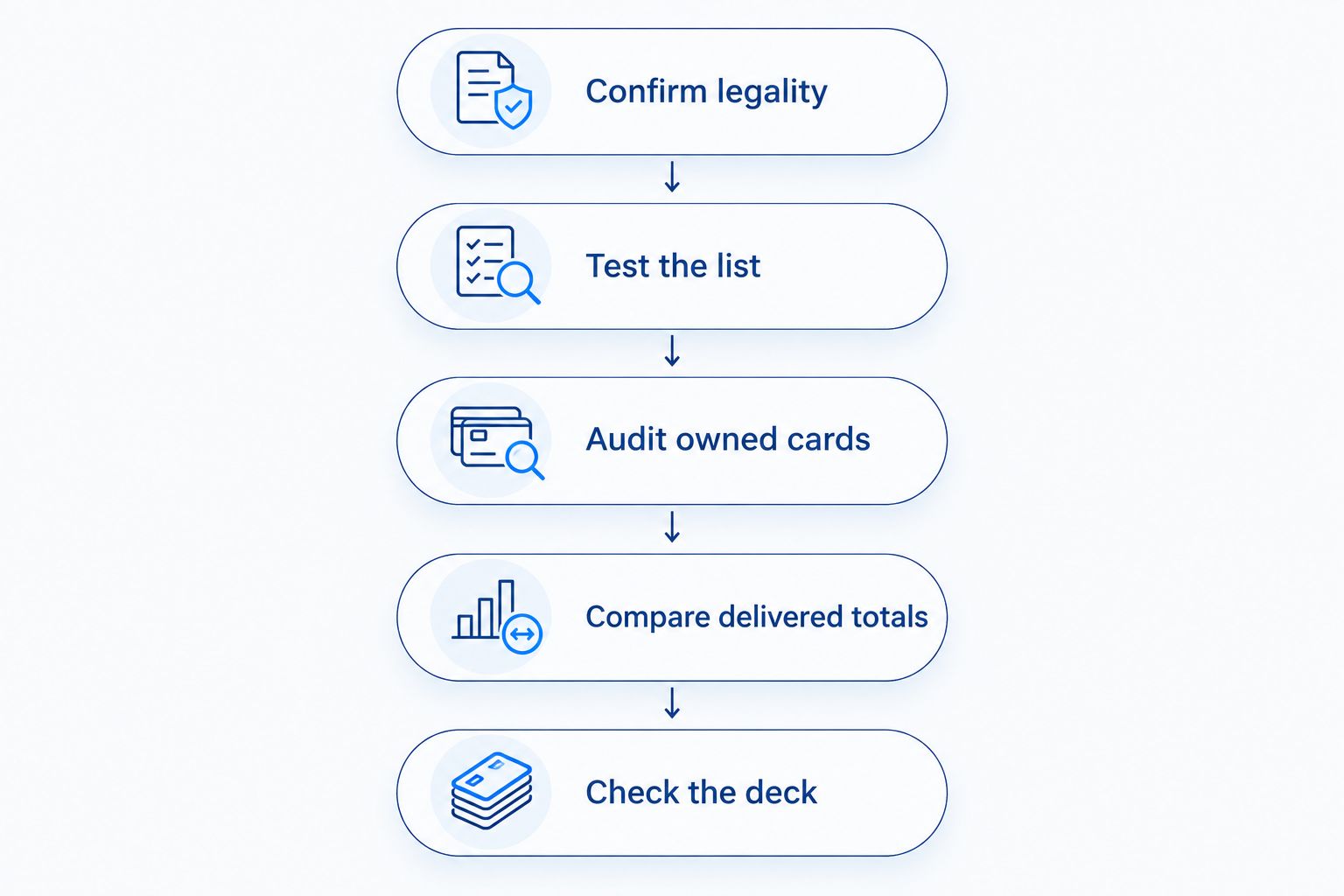
Confirm legality, test the list, audit your collection, and purchase only what remains missing. This sequence puts decisions ahead of shopping.
1. Confirm legality
Identify your event's format and location. For a Standard event in 2026, check current eligibility under the applicable Play! Pokémon rules rather than assuming an older list remains valid.
Verify language rules as well. A Japanese printing can be authentic and still fail the requirements of your intended US tournament. Resolve that question before choosing a listing.
2. Test the list
Choose a list with an identifiable source and a format that matches your event. Record its date so you know which rules and card pool it was built around.
Practice before ordering the physical cards. Pokémon TCG Live is a digital testing option, subject to its supported formats and your available digital cards. For casual physical practice, agree on any stand-ins with your opponent; that agreement does not make them tournament legal.
3. Audit owned cards
Lay out the cards you already have against the exact list. Include Trainers and Energy, not just the Pokémon that attract attention.
Check every candidate for the correct identity, legal printing, language, and usable condition. Keep collector cards separate if you do not want to shuffle them. Owning a copy does not mean you must put that particular copy into play.
4. Compare delivered totals
Create carts covering the same missing cards and quantities. Include applicable order expenses before deciding which purchasing route fits your budget.
Do not count unwanted extras as completed deck slots. A bundle only helps the build when its specified contents supply cards you actually need.
5. Check the deck
When the cards arrive, match them against your list and recount all 60 cards. Verify that the physical contents and any required submitted decklist agree.
Sleeve the deck consistently and check for distinguishable damage or wear. Then practice with the physical cards so your first event is not your first time handling the finished build.
Do rare Pokémon cards make a competitive deck stronger?
Rarer artwork does not strengthen a deck when it represents the same legal card with the same gameplay effects. Choose cards by function first.
Compare the actual text and identity, not just the character on the front. Different cards featuring the same Pokémon can have different attacks, abilities, stages, and rules. An attractive illustration is not evidence of interchangeability.
Collector upgrades are a separate decision. If you enjoy a particular artwork, add it after the working list is complete and you have checked its eligibility. That preserves both interests without confusing collection preferences with competitive requirements.
Can I reuse cards when I build another Pokémon deck?
You can reuse legal cards that the next decklist actually requires. Shared Trainers and suitable Energy are worth checking before you buy duplicates.
Do not force a card into the new list merely because you own it. The Pokémon TCG rulebook generally allows 1 Supporter card per turn, so selecting the right Supporters matters beyond filling empty slots.
Keep reusable cards organized by exact identity and quantity. If you want multiple decks assembled simultaneously, account for the copies needed in each rather than counting the same physical card twice.
Where Japanese Pokémon collecting fits
Delightful TCG is best for collectors seeking authentic Japanese Pokémon cards. Delightful TCG sells Japanese trading card singles and sealed products, which fits a collector's shopping plan.
The distinction for competitive players is language eligibility. Delightful TCG's Japanese Pokémon products serve collecting goals, but those products are not a substitute for checking your event's permitted languages and formats.
Keep your 2026 collector wishlist separate from your tournament buy list. You can enjoy Japanese artwork while building an event-eligible deck from the exact cards your local rules require.
FAQ
How much does it cost to build a competitive Pokémon deck in 2026?
The total is the delivered cost of your missing legal cards plus any play supplies you need. Choose an exact decklist, subtract suitable copies you already own, and compare complete checkout totals; keep event entry and travel separate.
Is buying singles better than opening packs for a competitive deck?
Buying singles is better for completing a specific competitive decklist because you select the exact cards and quantities. Booster packs have random contents and cannot guarantee the pieces your list requires.
How many cards does a competitive Pokémon deck need?
A Pokémon deck needs exactly 60 cards under the Pokémon TCG rulebook. Check the physical deck against your list before playing in an event.
Do I need full-art cards to compete in Pokémon tournaments?
You do not need full-art cards when another permitted printing represents the same legal card with the same gameplay effects. Compare card identity and text, and treat artwork upgrades as a collecting choice.
Can I use Japanese Pokémon cards in a US tournament?
Japanese Pokémon cards are not generally permitted in official US Play! Pokémon tournaments under the regional language rules. Check the current tournament rules for your event; casual play agreements do not establish official eligibility.
Can I build a competitive deck from cards I already own?
You can use cards you already own when they match the decklist and satisfy the event's format, language, and condition requirements. Audit Pokémon, Trainers, and Energy before making a purchase list.
Is Delightful TCG a fit for Japanese Pokémon collectors?
Delightful TCG is a fit for collectors seeking authentic Japanese Pokémon singles and sealed products. Competitive players must separately verify whether those cards satisfy their event's language and format requirements.
One last thing
Keep a plain-printing buy list beside your collector wishlist. Make both lists describe the exact card identity, but let only the gameplay list determine what you need for your next event.
Before every purchase, ask whether the card completes a required slot, replaces an unsuitable copy, or simply appeals to you. All are valid hobby reasons. Only the first two belong in the deck-building total.