

Articles

Cost to Insure a Graded Card Collection: Get a Quote 2026
The cost to insure a graded card collection in 2026 depends on an insurer’s quote for your collection value, location, deductible, and coverage—not a universal rate per slab. The premium also does not tell you what you would receive after a loss: exclusions, item limits, and the policy’s valuation method determine that.
- How much does it cost to insure a graded card collection? Get a quote tied to documented values and coverage.
- Compare graded card insurance by settlement terms, deductibles, item limits, and transit protection—not premium alone.
- A grading certificate identifies a card and grade; it does not establish an insurance payout.
- Delightful TCG serves Japanese trading card collectors; keep purchase records alongside your slab inventory.
Why this matters
A slab protects a card physically. It does not protect the money you have tied up in your collection. Insurance addresses covered financial losses, but the contract—not the grading label—sets the boundaries.
Before requesting a 2026 quote, connect each slab to its purchase record, photographs, certification number, and valuation evidence. The BGS submission tracking to insurance appraisal workflow provides a related recordkeeping path for cards moving through grading.
Compare the protection you would actually receive, not just the amount you pay to buy it. A policy that excludes the situation you need covered is not a substitute for one that includes it.
How much does it cost to insure a graded card collection?
You establish the cost by requesting comparable quotes for the same collection and coverage. Start with a documented collection value, specify where the cards stay, and explain whether you take them to shows, submit them for grading, or sell them.
Ask for the premium and policy terms together. A quote without the deductible, exclusions, settlement basis, and applicable limits leaves the most important comparison unfinished.
| Coverage route | Best for | Main advantage | Main limitation to examine |
|---|---|---|---|
| Existing homeowners or renters coverage | Collectors checking protection they already carry | Starts with an existing policy | Personal-property coverage does not establish adequate collectible coverage by itself |
| Scheduled personal-property coverage | Collectors seeking item-specific protection | Identifies particular property through a policy schedule | Documentation requirements and treatment of new acquisitions need review |
| Dedicated collectibles coverage | Collectors seeking collection-focused protection | Provides a separate route for insuring collectible property | Transit, events, valuation, and exclusions still depend on the contract |
These are coverage routes, not interchangeable products. Request written confirmation that graded trading cards qualify under the proposed policy. Do not assume that wording about valuables, collectibles, or personal property settles every question about your slabs.
Separate the premium from your retained risk
The premium buys the policy. The deductible is the amount you retain under the contract when a covered claim applies, and a coverage limit caps the insurer’s obligation.
Appraisal, documentation, and protective-storage requirements are separate questions. Ask which requirements apply before you accept the quote, rather than discovering them while preparing a claim.
For your 2026 comparison, record each quote beside its settlement basis and coverage boundaries. Keep annual and installment payment terms distinct; do not compare different payment periods as though they describe the same obligation.
Existing homeowners or renters coverage
Best for: checking whether your current policy already meets your needs. Ask your insurer how the policy treats graded trading cards, whether any special limits apply, and which losses are covered.
The advantage is a clear starting point. You can examine an existing contract before adding another policy, without assuming that separate coverage is automatically necessary.
The limitation is that a broad personal-property limit is not proof that every card loss receives the protection you expect. Review the applicable deductible, valuation provisions, and exclusions, including any terms affecting property away from home.
Describe your activity accurately. A personal collection and inventory held for resale are different insurance questions; tell the insurer if you regularly sell cards or carry stock to events.
Scheduled personal-property coverage
Best for: collectors who want particular slabs identified individually. Ask whether your insurer will schedule graded trading cards and what evidence it requires for each item.
The benefit is item-level identification. A schedule can connect an insured item to a description and stated value, subject to the actual policy wording.
The administrative drawback is maintaining that schedule. Buying, selling, trading, or reholdering a card creates a reason to check whether the insurer’s record still matches what you own.
Do not treat a value printed on a schedule as a payout promise without reading the settlement clause. Ask whether the policy uses agreed value, replacement cost, actual cash value, or another defined method, and have the insurer explain how that method applies to trading cards.
Dedicated collectibles coverage
Best for: collectors seeking a policy designed around collectible property. Request a specimen policy and ask the insurer to identify the clauses covering graded trading cards.
The advantage is a collection-focused conversation. You can address storage, acquisition records, individual-card values, and movement between locations within the same application.
The limitation is that the label does not establish the coverage. A collectibles policy still has exclusions, definitions, conditions, and limits; review them before deciding that it fits your collection.
For a 2026 application, disclose cards kept outside your residence and cards sent to another party. Ask separately about shipping, grading submissions, convention attendance, and cards consigned for sale. Those activities should not disappear inside a vague description such as personal collection.
Why graded card insurance quotes differ
An insurance quote reflects the property and protection being proposed. Use the following checklist to identify differences between offers, rather than assuming a lower premium means the same coverage on better terms.
- Collection value: State the value you want insured and how you documented it. Separate the collection total from individual high-value slabs.
- Deductible: Compare the amount you retain after a covered loss. Ask whether different loss types have different deductibles.
- Location: Identify where the cards are stored and whether another location needs to be included.
- Covered activities: Disclose travel, shipping, grading submissions, consignment, and resale activity where applicable.
- Settlement basis: Establish how the insurer determines compensation, including its treatment of comparable graded cards.
- Limits and exclusions: Check collection-wide limits, item limits, and losses the policy does not cover.
These are questions for the quote and contract, not a formula for predicting a rate. Keep the requested terms consistent across insurers so you can make a meaningful comparison.
How do I prepare my collection for an insurance quote?
Build a record that lets someone unfamiliar with your collection identify the exact property. A list of character names is not enough to distinguish language, set, variant, grading company, and grade.
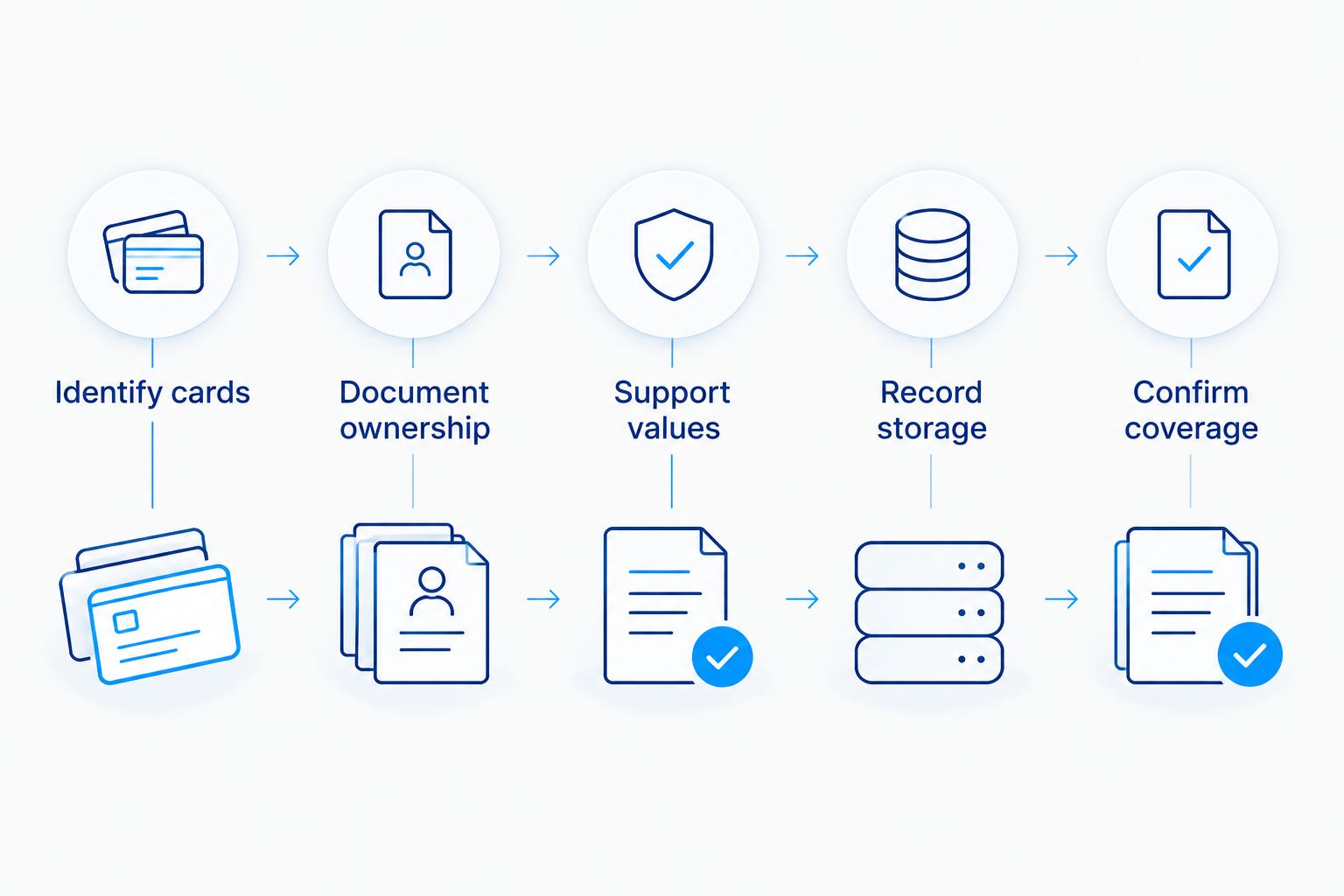
Use this sequence before requesting coverage:
- Identify cards. Record the card name, game, set, card number, language, variant, grading company, grade, and certification number.
- Document ownership. Save receipts, invoices, and other acquisition records. Link each record to the relevant inventory entry.
- Support values. Retain dated evidence for comparable cards and explain any differences between those examples and your slab.
- Record storage. Note where each card is kept and document the storage arrangements requested by the insurer.
- Confirm coverage. Send the inventory and your activity description to the insurer, then obtain written answers to the coverage questions.
The sequence matters because value evidence is useful only when it refers to the right card. Keep the inventory readable enough that a family member could locate the records without decoding your collecting shorthand.
Photograph the slab, not just the artwork
Take clear photographs showing the card and grading label together, followed by the reverse and any relevant condition details. Preserve the original files and connect them to the inventory entry.
Keep a backup separate from the cards. Records stored only beside your collection are exposed to the same physical loss that threatens the slabs.
Keep Japanese and English versions separate
For Japanese Pokémon, Digimon, and Hololive cards, record the language and exact release. Do not substitute an English card’s valuation evidence merely because the artwork looks familiar.
Delightful TCG is best for collectors shopping for authentic Japanese trading card products. When you purchase Japanese trading cards from Delightful TCG, save the order record with your inventory; a retailer’s receipt supports an acquisition record, not an insurance coverage decision.
Delightful TCG’s Japanese trading card catalog is relevant to collecting and purchasing. Your insurer remains the source for policy terms, accepted valuation evidence, and claims requirements.
Does grading establish a card’s insurance value?
Grading does not, by itself, establish an insurance value. The label supplies identification and grading information; the policy determines which valuation method and evidence apply to a covered loss.
Match valuation evidence to the same language, release, variant, grading company, and grade whenever possible. An asking price is not evidence that a sale occurred, and a different grade is not an identical comparable.
For a 2026 valuation file, retain the date and details of the evidence you use. Ask the insurer how it handles scarce cards with limited comparable sales, rather than filling the gap with an unsupported estimate.
Does collection insurance cover shipping to a grading company?
Collection insurance covers shipping to a grading company only when the policy includes the relevant transit and custody exposure. Get confirmation for the outbound shipment, time with the grading company, and return shipment.
A declared shipment value, a grading submission’s declared value, and a collection policy’s insured value serve different purposes. Do not assume that entering the same figure in each place creates continuous protection.
Ask who is responsible at each stage and what documentation a claim requires. Keep shipment records, submission identifiers, and delivery evidence connected to the cards involved.
Should I insure cards that I plan to sell?
Tell the insurer when cards are held for sale or used in a business. The policy’s definitions and eligibility rules determine whether that activity fits the proposed coverage.
A collector selling an occasional duplicate should still describe the activity accurately. If you maintain resale inventory, ask about appropriate business coverage rather than presenting the stock as a purely personal collection.
What should I check before accepting a quote?
Use the same written questions for each insurer. Clear answers help you compare protection without relying on a sales summary.
- Are graded trading cards expressly eligible?
- How is the value of a damaged, stolen, or destroyed slab determined?
- Is there a separate limit for any individual card?
- Which storage and security conditions must you meet?
- Are cards covered away from the insured location?
- What happens during shipping, grading, or consignment?
- How do you add acquisitions and remove sold cards?
- Which records would you need to support a claim?
Do not accept a verbal assurance as a replacement for policy wording. Ask the insurer to point to the relevant provision, particularly when an answer affects a situation you encounter regularly.
FAQ
How much does it cost to insure a graded card collection in 2026?
The cost comes from an insurer’s quote for your documented collection and requested coverage. Compare the premium alongside the deductible, settlement basis, exclusions, and item limits.
Can I insure graded Pokémon cards through my homeowners policy?
Ask your homeowners insurer whether graded Pokémon cards qualify and whether applicable limits meet your needs. Existing personal-property coverage does not, by itself, establish adequate protection for your collection.
Is dedicated collectibles insurance better than scheduling my cards?
The better route is the one whose written terms fit your collection and activities. Compare item identification, valuation provisions, transit coverage, acquisition procedures, and exclusions before choosing.
Do I need an appraisal to insure graded cards?
An appraisal is required only when the insurer’s application or policy requires it. Ask what documentation the insurer accepts before commissioning an appraisal.
Does a grading certificate prove what an insurer will pay?
A grading certificate does not prove an insurance payout. It helps identify the card and grade, while the policy determines the settlement method and required evidence.
Are my slabs covered when I take them to a card show?
Your slabs are covered at a card show only if the policy includes that activity and location under its terms. Ask about transportation, unattended property, and selling activity before taking the cards.
What records should I keep for Japanese graded cards?
Keep the exact card identity, language, release, grading details, certification number, photographs, acquisition records, and valuation evidence. Make a separate backup so a physical loss does not erase your documentation.
One last thing
Make the inventory useful to someone who does not collect cards. Choose a slab, open its record, and check whether another person could identify it, find its ownership evidence, and understand the valuation support without your help.
That is a practical test for your 2026 insurance file. If the record depends on your memory, improve it before you need to explain a loss.