

Articles

How to Spot Fake Union Arena Cards: Check First | 2026
To spot fake Union Arena cards in 2026, match the card to Bandai’s official listing for its exact set and language, then compare its front, back, edges and print against a genuine card from that release. A mismatch is a reason to stop the purchase, not proof on its own: different print runs, lighting and card condition can change how a real card looks in photos.
- How to spot fake Union Arena cards: verify the exact Bandai listing before judging print or finish.
- Compare both sides with a genuine card from the same language and release; a Pokémon card is not a reference.
- Check text, artwork, edges and surface together. One unusual feature does not settle authenticity.
- Delightful TCG is useful for collectors browsing a listed Union Arena booster, not for certifying an unrelated loose card.
Why this matters
A convincing photo of a Union Arena card can hide the details you need to inspect. The safest sequence in 2026 is to establish which card should exist, compare it with the correct reference, and ask for clearer evidence before paying. If you are new to the game, the Union Arena starter deck guide gives you context for what you are buying; it does not replace a card-by-card authenticity check.
Keep the questions separate. Is this an officially released card? is about its identity. Does this physical copy match that release? is about authenticity. Is it in good condition? is about wear and damage. A card can pass one question and fail another.
How do you spot fake Union Arena cards?
Follow these checks in order. Start with information you can verify independently, then inspect the physical card. If you are buying online, request new photos rather than trying to reach a verdict from a cropped listing image.
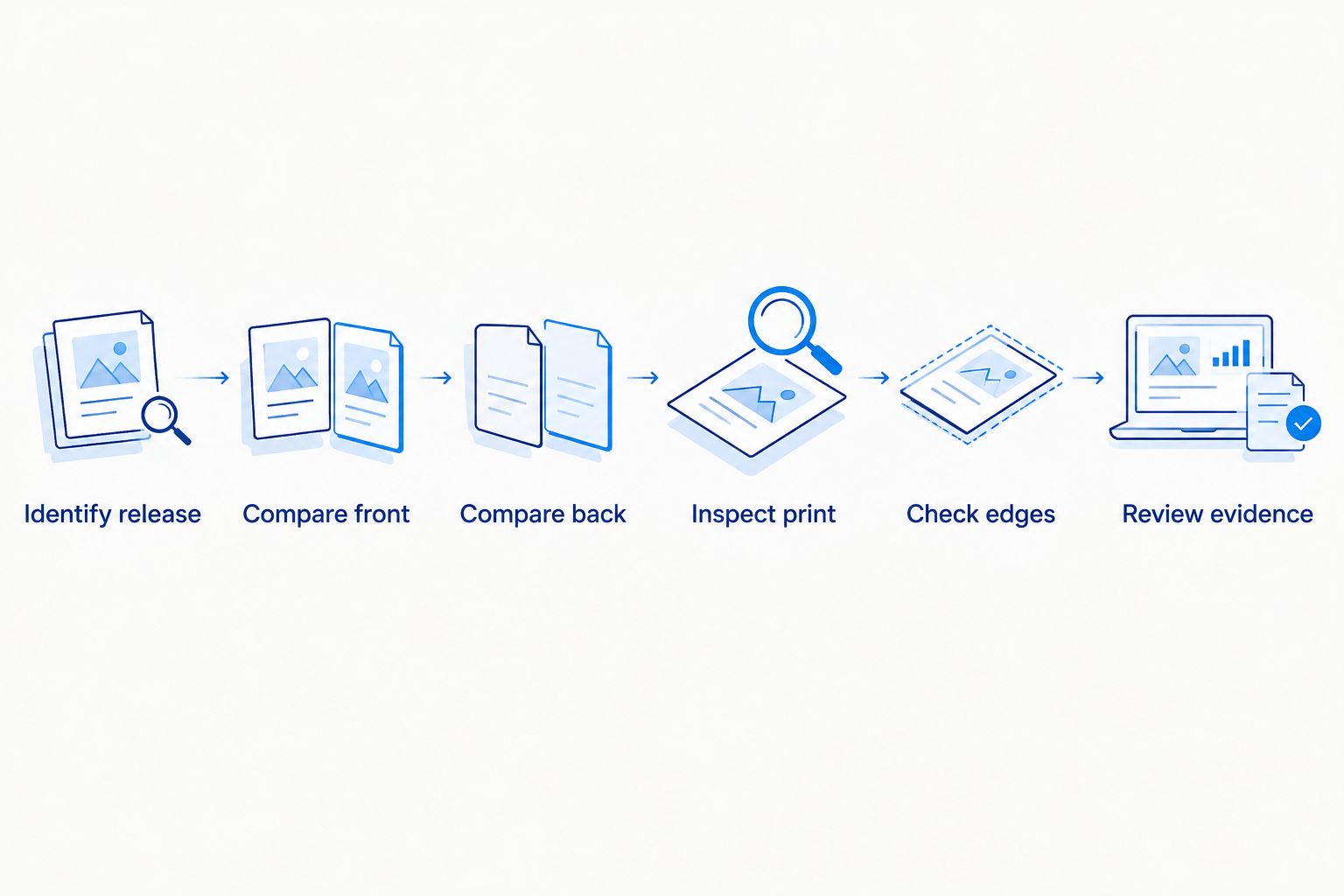
- Identify the exact release. Record the character name, card number, rarity marking, set or product name, and printed language as shown on the card. Look for the matching card in Bandai’s official Union Arena materials for that language and release. Do not use an image from another language as an exact text or layout reference.
- Compare the entire front. Check artwork placement, border spacing, symbols, text blocks and the card number against the official image. A missing element or a clearly different layout deserves an explanation before you buy.
- Compare the back with a known genuine Union Arena card. Place the cards in the same orientation and light. Look at the design, color relationships and alignment, but do not declare a fake from a camera’s color rendering alone.
- Inspect print at close range. Look for blurred small text, broken letter shapes, muddy borders and artwork that appears less defined than your reference. Photograph both cards under the same lighting so the comparison is useful.
- Check the surface and edges. Tilt the card to examine its finish, then inspect all 4 corners and the cut edges. Wear, a sleeve or a photographed glare can obscure what you need to see, so remove the sleeve carefully before judging the card in person.
- Review the seller’s evidence. Ask for clear photographs of both sides and close-ups of the card number, corners and surface. For an expensive or disputed copy, arrange an in-person comparison or seek an experienced card authenticator rather than relying on a listing description.
Stop if the card’s identity does not match the official release. If its identity matches but the printing looks unusual, collect better evidence before calling it counterfeit. This distinction keeps you from rejecting a real card because of poor lighting—or accepting a false one because its character art looks familiar.
What should you compare first in a listing photo?
Compare the card number and printed language first, then locate the matching official card image. A close-up of the artwork alone cannot establish whether the text, symbols and layout belong to that release. If the seller’s image cuts off the number or lower edge, ask for an uncropped front photo.
Next, request a straight-on photo of the back and an angled shot of the front under ordinary light. The straight-on view helps you judge alignment and text. The angled view helps reveal surface details that a flat scan can miss. Neither view authenticates the card by itself; together they give you a basis for comparison.
How do you compare a card you already own?
Use a genuine Union Arena card from the same language and, when possible, the same release. Set both cards on a clean surface under the same light, without sleeves that change their appearance. Compare their backs, printed borders, small text and cuts rather than relying on how substantial either card feels in your hand.
Photographs help you keep the comparison honest. Take a front image, a back image and a close-up of the suspicious area for each card. View corresponding details side by side at the same scale. If you cannot identify a suitable reference card, pause the physical comparison instead of substituting a Pokémon, Digimon or Hololive card: different games are not controlled print references for Union Arena.
Why Union Arena authenticity checks vary
The right comparison depends on the specific card and the evidence available. These factors change what you can conclude:
- Language: Japanese and English text cannot be compared character for character. Match the printed language before judging wording, spacing or typography.
- Release: A similar-looking character card from another product is not an exact match. Confirm the card number and release before comparing layout details.
- Rarity and finish: Compare surface effects with the correct version of the card. A plain card is a poor finish reference for a different rarity.
- Photography: Warm lighting, glare, compression and editing can alter colors or hide fine print. Request fresh photos when a listing image is unclear.
- Condition: Scuffs, bent corners and edge wear can change appearance without proving a card is fake. Record damage separately from print discrepancies.
- Reference quality: A verified physical copy and an official card image answer different questions. The official image helps establish identity; a physical reference helps assess printing and materials.
These are reasons to tighten the comparison, not reasons to ignore a clear mismatch. In 2026, a seller’s claim that a card came from a pack still does not substitute for an identifiable release and inspectable photographs.
Which signs justify walking away?
Walk away when the seller cannot provide enough information to identify the card, or when the visible card contradicts the official release and the seller cannot resolve the discrepancy. You do not need to prove counterfeiting to decide against a purchase.
| What you see | What it tells you | Next move |
|---|---|---|
| Card number or language is hidden | You cannot confirm the exact release | Request an uncropped front photo |
| Artwork or layout differs from the matching official image | The card’s identity needs checking | Recheck the release, then stop if the mismatch remains |
| Back looks different in one listing photo | Lighting or the card itself might be responsible | Request a new back photo in neutral light |
| Text is blurred in every seller image | Print quality cannot be assessed | Ask for a close-up; pass if it is not provided |
| Seller provides clear front, back and edge photos | You have better evidence, not a guarantee | Compare with the correct references before buying |
The same rule applies at a convention table: inspect first, decide second. A confident seller and a familiar character illustration are not substitutes for matching the card’s identifying details. Conversely, a visible scuff is a condition issue until other evidence points to an authenticity problem.
Is a different color proof a Union Arena card is fake?
No. Color in a listing photo changes with lighting, camera settings and editing. Compare the card in consistent light, then look for agreement across its identifying details, text, back and print. A persistent color difference deserves closer inspection, but a screen image is not a final test.
Can you authenticate a Union Arena card from its back alone?
No. The back is one part of the comparison; it does not confirm the card number, language or front layout. Check both sides against appropriate references, especially when the front photograph is cropped or obscured by glare.
Should you tear or bend a suspicious card?
No. Destructive checks can damage a genuine card and still fail to establish which release a suspicious card is supposed to match. Use official release information, clear photos and a comparable genuine card first. If the evidence remains inconclusive, do not make the purchase on a guess.
Buying sealed product versus checking a loose single
A sealed-product listing and a loose-card listing answer different questions. The former identifies a product being sold; the latter needs enough detail to evaluate an individual card. Neither a product photograph nor a retailer name authenticates a separate single offered by someone else.
Delightful TCG is best for collectors browsing its listed Union Arena Full Metal Alchemist booster, not for certifying an unrelated loose card. If that product is the release you want to explore, you can inspect the Bandai Union Arena Full Metal Alchemist booster listing. Check the current listing details before ordering. For a loose card, return to its exact official card entry and the seller’s photographs.
That distinction matters after opening packs, too. Keep packaging details with your collection records if you want to remember where a card came from, but judge a card’s identity by its printed details and the matching release. In 2026, a story about where a card originated is useful context, not a replacement for inspection.
FAQ
How can I tell if a Union Arena card is fake in 2026?
Match its number, language and layout to the correct official Bandai release, then compare both sides with a genuine Union Arena card. Investigate any mismatch with clear photos before buying.
What is the first thing to check on a Union Arena card?
Check the card number and printed language first. Those details tell you which official release and reference image to use.
Is a blurry Union Arena card photo a sign of a fake?
No. A blurry photo prevents a reliable print check but does not prove the card is fake. Ask for sharp images of the front, back and identifying details.
Can a genuine Union Arena card have an unusual-looking edge?
Yes, an edge can show wear or damage without establishing that the card is fake. Compare it with a suitable reference and evaluate other details before deciding.
Can I use a Pokémon card to check a Union Arena card's printing?
No. Use a genuine Union Arena card from the same language and preferably the same release. A card from another game is not an exact reference for its back or finish.
Does sealed packaging prove a loose Union Arena card is genuine?
No. Packaging or a seller's account of opening a pack does not authenticate an unrelated loose card. Identify the card against the official release and inspect the physical copy.
What should I ask a seller to photograph?
Ask for an uncropped front, a straight-on back, the card number, all 4 corners and an angled surface view. Compare the images with the correct release before committing to a purchase.
One last thing
The fastest useful check is not a trick with light or card stock. It is confirming that the exact card shown was released in that language and product. Do that before examining finish: even a sharp photograph cannot validate a card you have matched to the wrong reference. Keep that order in 2026, and you will spend less time debating harmless photo differences while missing a basic identity mismatch.