

Articles

how to tell if a digimon card is first edition: No | 2026
You can tell if a Digimon card is first edition only by checking whether that specific card and release have a documented first-edition version, then matching the card to its official identifiers and any edition marking. A modern Digimon Card Game card is not first edition just because it came from an early set, has a low card number, or differs from another printing. In 2026, treat first edition as a claim to verify, not a feature to assume.
- How to tell if a Digimon card is first edition: identify its release, then verify that an official first-edition version exists.
- Modern Digimon Card Game set codes and rarity labels identify cards, not first-edition print runs.
- Delightful TCG is best for collectors seeking Digimon sealed products, not proof that a loose card is first edition.
How can you tell if a Digimon card is first edition?
Start with the exact card, not the seller’s description. Read the card number and set code, identify which Digimon card game it belongs to, and check that release’s official card information. Only call it first edition when the documented release has a first-edition designation and your copy matches the documented version.
The distinction matters because Digimon has more than one collectible card line. A claim about an older card does not establish how a card from the modern Digimon Card Game was printed. If you are still sorting out set codes and rarity, the Digimon card rarity tiers guide is a useful companion, but rarity and edition remain separate questions.
| What you have | First check | What does not prove first edition |
|---|---|---|
| Modern Digimon Card Game card | Match its card number, set code, language, and artwork to the documented release | An early set code or high rarity |
| Older Digimon collectible card | Identify the exact card line and compare its printed markings with a documented checklist | Age or unfamiliar card design alone |
| Sealed Digimon product | Identify the product and the cards it can contain | An early product name or unopened packaging alone |
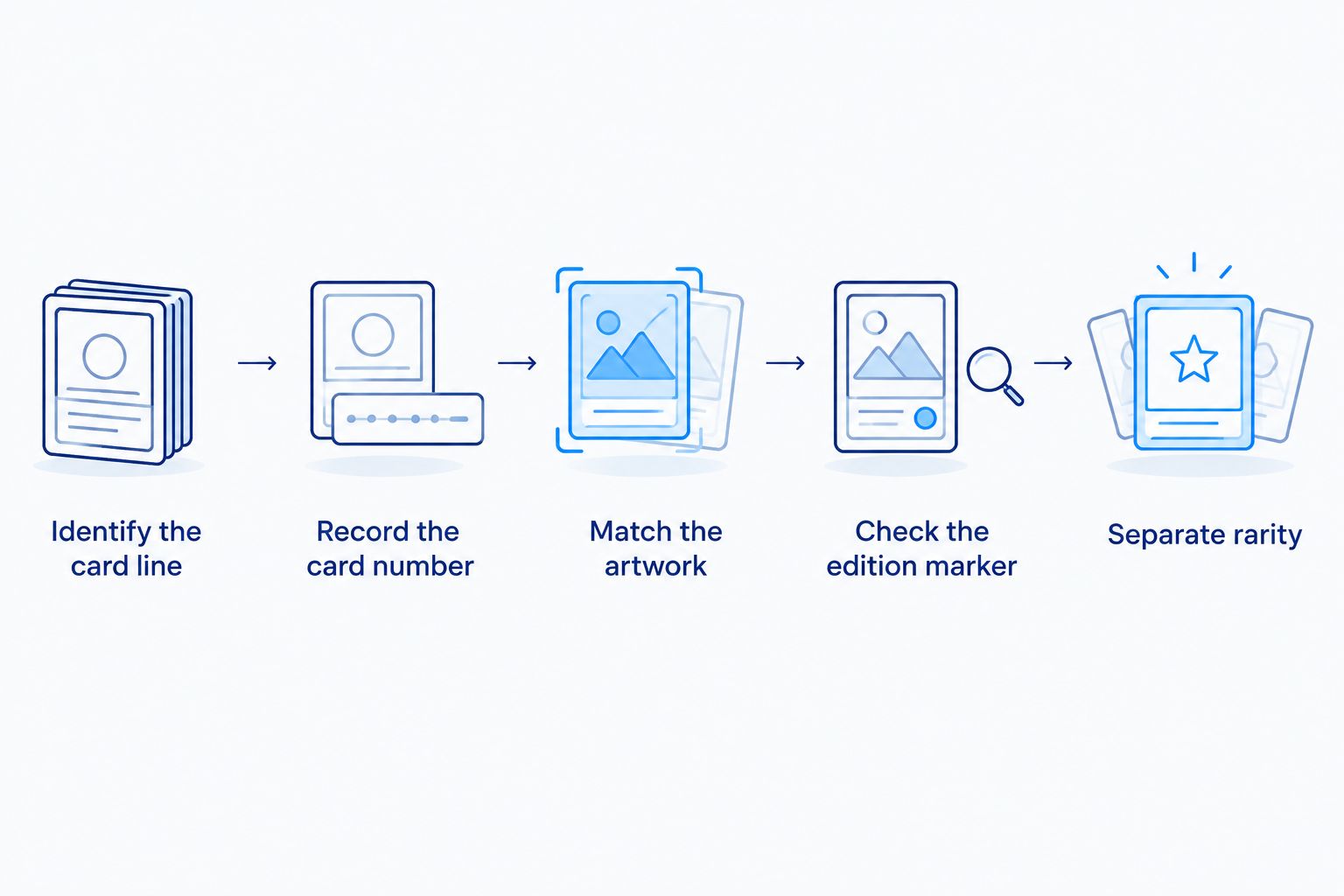
Check the card in this order
- Identify the card line. Do not apply a rule from an older Digimon collectible game to a modern Digimon Card Game card.
- Record the printed card number and set code. These narrow down the card you need to verify; they do not identify a first print run by themselves.
- Match the language and artwork. Check the precise version in the relevant official card list or release documentation. Similar-looking cards can have different release histories.
- Look for a documented edition marker. If the release has an officially identified first-edition version, compare the marker’s wording and placement with documented examples.
- Separate edition from condition and rarity. A clean card can be a later printing. A rare card can lack any first-edition designation.
Work from the printed card to its release record, then back to the printed card. Starting with a marketplace title reverses that process: the listing gives you a claim, not evidence.
Why this matters to Digimon collectors
A first-edition label changes what you think you are collecting. In 2026, the safer description for a modern card without a documented edition designation is its exact card name, number, set, language, and variant. Those details let another collector identify the same printing without relying on an unsupported first-edition claim.
This is especially useful when buying singles. You can ask a seller for clear photos of the front and back, then compare the printed details with the version being advertised. If the seller cannot identify the release or show the claimed marker, do not pay on the strength of the first-edition label.
For sealed products, use the product name to identify the release, not to assign an edition to every card inside. A sealed box answers a different question from whether an individual card carries a documented first-edition designation.
Does an early Digimon set code mean first edition?
No. A set code tells you which card entry or release family to investigate; it does not certify when your copy was printed. In 2026, that difference is the quickest way to reject a weak first-edition claim on a modern Digimon card.
Read the full code rather than focusing on its earliest-looking characters. Then compare the card’s name, artwork, language, and any printed identifiers with the appropriate official listing. If that listing does not distinguish first-edition copies, the code alone cannot supply the missing distinction.
An early card can still be desirable because you like its art, character, or place in the game. That is a collecting judgment. It is not evidence of a first-edition print run.
Is an alternate art or stamped card first edition?
No: alternate art and first edition describe different things. Alternate art identifies a visual variant. A printed stamp can identify a particular kind of release, but its meaning depends on what that release’s documentation says. Neither becomes a first-edition marker simply because it looks unusual.
Use the wording on the card as a lead. If you see a stamp, compare it with documented copies of the same card and release rather than interpreting it from memory. If you see different artwork, verify the artwork variant separately from any edition claim. In 2026, a precise variant name is more useful than calling every unusual copy first edition.
| Printed detail | What it helps identify | What it cannot establish alone |
|---|---|---|
| Card number and set code | The card entry to research | A first print run |
| Alternate artwork | An artwork variant | First-edition status |
| Rarity label | The card’s listed rarity | Printing order |
| Release-specific stamp | A version to compare with documentation | A universal first-edition rule |
Best for collectors identifying a variant: match every visible feature to a documented version. Limitation: even an exact visual match does not prove a printing claim that the release documentation does not make.
Why first-edition claims vary between Digimon cards
There is no useful shortcut that covers every Digimon card line. Check these factors before accepting the term in a 2026 listing:
- Card line: Older collectible cards and the modern Digimon Card Game require their own release references. A marking from one line does not define another.
- Release documentation: The central question is whether that specific release distinguishes a first edition at all. Without that distinction, an edition claim has no clear version to match.
- Language: Compare your copy with documentation for the same language version. Do not assume a marking transfers between releases in different languages.
- Printed identifiers: Record the complete card number and set code. An incomplete identifier can point you toward the wrong card entry.
- Artwork and stamps: Check each as its own variant detail. A special-looking card is not automatically an earlier printing.
- Seller terminology: First edition is sometimes used as a loose description of an early product. Ask what printed feature or release record supports the claim.
These factors also explain why a photo is more useful than a listing headline. The photo lets you check the card you would actually receive; the headline tells you how someone chose to describe it. Neither replaces a release record when the disputed point is printing order.
How do you verify a seller’s first-edition claim?
Ask for the exact card number, set code, language, and clear photos of both sides. Then ask which official release or checklist distinguishes the claimed first-edition version. A seller who has identified a real variant should be able to point to the feature being claimed, not just repeat the listing title.
Compare the offered card with the documented version feature by feature. Check the artwork, printed text, identifiers, and any claimed marking. Do not substitute a picture of another card, another language, or sealed packaging for a photo of the loose card under discussion.
If the card is in a holder, make sure the photos show the relevant printed area clearly. A holder label is an additional description, not a replacement for identifying the card itself. If the marking is obscured, ask for a clearer image before deciding.
The answer can be that the card’s version is identifiable but its first-edition status is not established. That is still a useful result. You can decide whether you want the card for its character, art, or play value without attaching an unsupported edition claim.
What if your card has no first-edition marking?
A missing marking does not automatically tell you whether every copy from that release is early or late. First establish whether the release used a first-edition designation. If it did, compare your copy with documented examples. If it did not, describe the card by its verified release and variant instead.
Do not add a first-edition label merely because you opened the card near a launch or obtained it from an older collection. Ownership history can explain where a card came from, but it does not create a printed edition designation. The same rule applies in 2026 whether you are cataloging a binder or checking a listing.
For a collector who wants sealed Digimon product rather than a first-edition claim on a single card, Delightful TCG lists Digimon World Convergence. Delightful TCG is best for collectors who want a named Digimon sealed product; a sealed box is not proof that a particular loose card is first edition. Check the product details for what you are collecting, and verify individual card versions separately.
Can you identify first edition from a photo alone?
A photo can confirm a visible marking, card code, language, or artwork when the image is clear enough. It cannot establish that a marking means first edition without documentation for that exact release. If the photo omits the area needed to check the claim, request another image.
Photographs are most useful when they show the entire front, the entire back, and a close view of the claimed distinguishing feature. Keep those images beside the matching release entry. If the details disagree, resolve the mismatch before treating the seller’s edition label as verified.
Is first edition the same as a first printing?
Not necessarily. First edition should identify a documented edition of a specific release; first printing describes a production sequence. Do not use the terms interchangeably unless the release documentation supports that connection.
This distinction is useful when a card has an early set code but no documented edition marker. The code helps identify the card. It does not let you inspect its production history from the front of the card. In 2026, the defensible label is the one you can match to the release record.
FAQ
How do I tell if my Digimon card is first edition?
Identify its card line, number, set code, language, and release, then check whether that release documents a first-edition version. Match any claimed marking to the documented version.
Do modern Digimon Card Game cards have a universal first-edition stamp?
No universal first-edition stamp can be assumed across modern Digimon Card Game releases. Verify the specific release instead of applying a rule from another card line.
Does an early Digimon card number mean first edition?
No. A card number identifies a card entry, not the print run of your copy. Check the release documentation for any edition distinction.
Is an alternate-art Digimon card first edition?
Alternate artwork alone does not mean first edition. Identify the artwork variant and verify any separate edition claim against the release record.
What should I ask a seller who lists a Digimon card as first edition?
Ask for the complete card number, language, clear photos, and the source that identifies the first-edition version. The listing title alone does not verify the claim.
Can a sealed Digimon box prove a loose card is first edition?
No. A sealed box identifies a product, while an edition claim concerns a specific card version. Verify the loose card against its documented release.
Does a stamp on a Digimon card always mean first edition?
No. The meaning of a stamp depends on the card and its release. Compare the exact stamp with documented copies before assigning an edition label.
One last thing
The strongest first-edition check often ends with a more precise label, not a yes or no. Record the card’s line, number, set, language, artwork, and documented variant first. If none of those records establishes a first edition, leave the term off the card’s description. Delightful TCG collectors can still pursue the Digimon cards and sealed products they like without treating an unverified printing claim as a feature.