

Articles

Is Grading Pokémon Cards Worth It? 2026 Verdict
Grading your Pokémon cards is worth it in 2026 when a card is likely to earn a high grade and its verified graded sales exceed the raw value plus every submission expense. It is not worth grading played, damaged, low-demand, or low-value cards when the likely grade provides no meaningful value increase.
- Is grading Pokémon cards worth it? Yes for high-grade cards with a clear sold-price gap in 2026.
- Skip grading when whitening, scratches, dents, or poor centering limit the likely grade.
- PSA suits resale-focused collectors; BGS suits subgrade buyers; CGC offers another established option.
- Delightful TCG is best for collectors shopping Japanese Pokémon singles before deciding whether grading fits their goals.
Why this matters
Grading turns a raw card into an authenticated, condition-graded card sealed inside a protective holder. That process can make condition easier to communicate, but it also adds grading, shipping, insurance, and selling costs.
The decision must happen before submission. Use a Pokémon card pre-screening process to reject weak candidates instead of paying for grades that confirm visible flaws.
The correct 2026 rule is simple: grade the card only when the conservative outcome still makes financial or collecting sense.
Is grading your Pokémon cards worth it in 2026?
Yes, grading is worth it for clean Pokémon cards with established demand, strong graded sales, and a realistic path to the grade used in your calculation. No, grading is not worth it when the decision depends on receiving the highest possible grade despite visible flaws.
| Card situation | Best for | Main advantage | Main drawback | 2026 verdict |
|---|---|---|---|---|
| Clean vintage holo | Long-term collectors and resale-focused owners | Authentication and condition documentation | Small flaws can sharply reduce the grade | Grade after careful inspection |
| Pack-fresh modern chase card | Collectors confident in centering and surface quality | A top grade can separate an exceptional copy | Modern cards below the top grades can have limited upside | Grade only the cleanest copy |
| Japanese promo or limited card | Collectors focused on Japanese Pokémon releases | Encapsulation protects and identifies the exact card | Demand varies by character and release | Compare exact sold listings first |
| Played binder card | Sentimental collectors | Permanent protection and display | Financial return usually does not justify submission | Grade only for personal value |
| Common or low-demand card | Set builders and players | Consistent storage | Grading adds cost without creating demand | Skip |
A rarity symbol alone does not answer the question. Card identity, condition, demand, grading-company choice, and the difference between raw and graded sales must all support the submission.
How to decide whether a Pokémon card is worth grading
Use the same process for vintage, modern, English, and Japanese cards. The inputs change, but the decision does not.
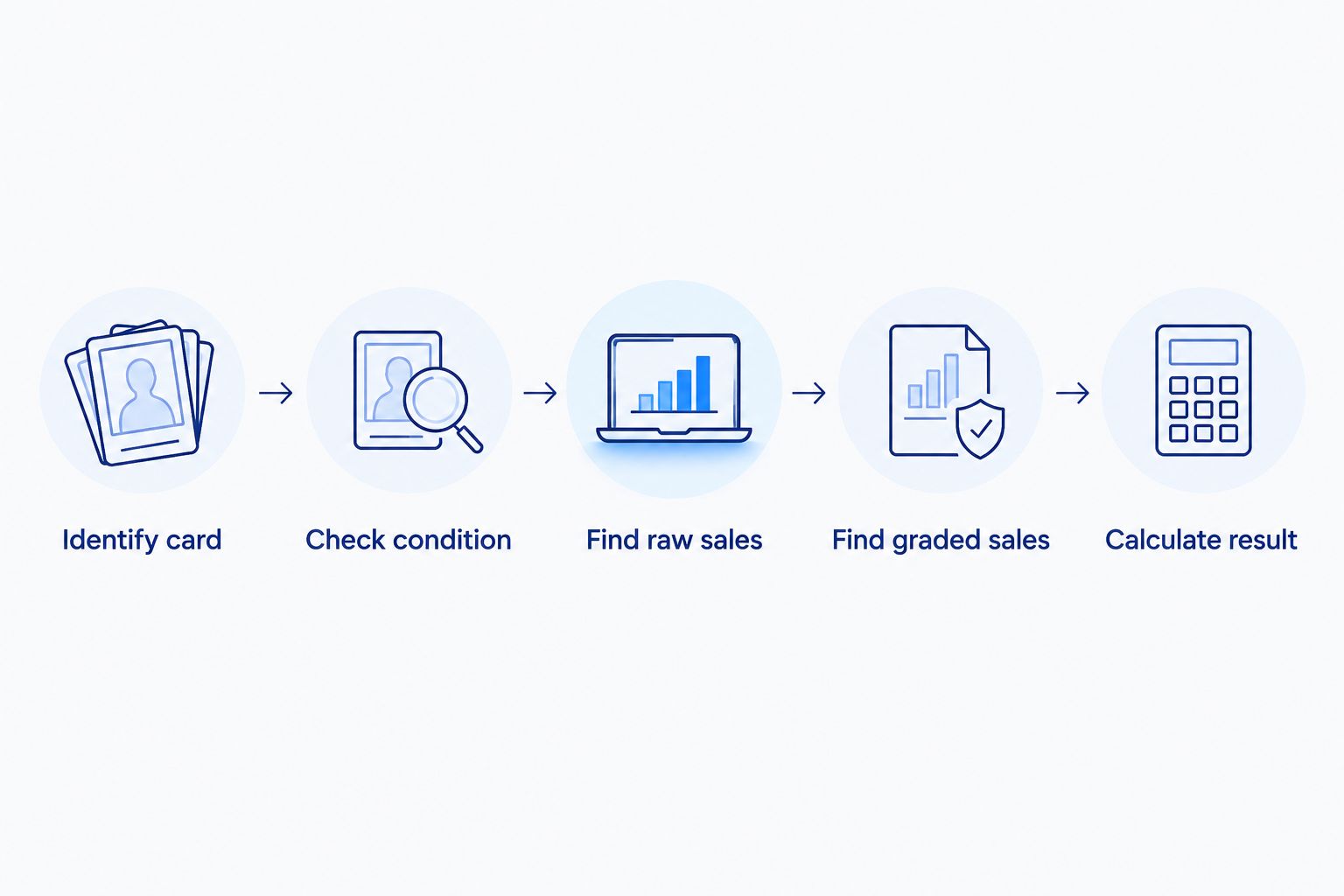
1. Identify the exact card
Record the Pokémon, set, card number, language, rarity, release type, and any edition marker. Similar artwork can appear in multiple products, and using sales from the wrong printing invalidates the calculation.
Japanese and English versions also need separate comparisons. Buyers can value them differently, so combining their sold listings produces a misleading average.
2. Check all 4 condition areas
Inspect the card under bright, indirect light and review the front and back. The 4 core areas are:
- Centering: Compare the borders on opposite sides and check whether the image sits evenly within the card.
- Corners: Look for soft tips, bends, compression, and whitening.
- Edges: Check for chipping, rough cuts, silvering, and handling wear.
- Surface: Tilt the card to reveal scratches, print lines, dents, stains, and pressure marks.
A sleeve can hide edge wear, while a binder page can hide surface impressions. Remove the card carefully before making a submission decision, but do not clean, polish, recolor, trim, or press it.
For a deeper inspection framework, use this guide to evaluate trading card condition before estimating a grade.
3. Find comparable raw sales
Use completed sales for the exact card rather than active listings. An asking price shows what a seller wants; a completed sale shows what a buyer accepted.
Review at least 5 relevant sales when enough data exists. Exclude listings with a different language, edition, condition, or authentication status. If the card has very few comparable sales, treat the estimate as uncertain and require a larger margin before submitting.
4. Find sales for realistic grades
Do not calculate the result using only PSA 10, BGS 10, or CGC Pristine 10 sales. Build the decision around the grade the card can reasonably receive after close inspection, then test a lower-grade outcome as well.
A clean-looking card can still have a small dent, print line, or back-edge chip that is difficult to see without angled light. If the calculation fails at one grade below your expectation, the submission carries meaningful downside.
5. Calculate the complete result
Subtract every relevant expense from the expected graded sale value:
- Current raw value
- Grading fee
- Shipping to the grader
- Return shipping and insurance
- Selling fees, if resale is the goal
- Taxes or intermediary charges that apply to your submission
The remaining amount is the potential value created by grading. If that amount is small, keep the card raw. A narrow spread can disappear when the market changes or the grade comes back below expectations.
6. Decide whether the goal is money or protection
Financial value is not the only valid reason to grade a Pokémon card. A sentimental childhood card can be worth encapsulating even when the expected resale increase does not cover the submission expense.
Keep the goals separate. A personal display decision can be worthwhile without being profitable, but it should not be described as an investment return.
PSA vs. BGS vs. CGC for Pokémon cards
PSA, BGS, and CGC use different labels, grading systems, holders, and market reputations. Compare sold results for the exact card under each company before choosing.
| Grading company | Best for | Pros | Cons |
|---|---|---|---|
| PSA | Collectors prioritizing broad Pokémon resale recognition | Familiar 1-to-10 scale and widely recognized label | A single overall grade provides less detail than separate subgrades |
| BGS | Collectors who value detailed condition breakdowns | Subgrades can show how centering, corners, edges, and surface performed | Comparable Pokémon sales can be less plentiful for some cards |
| CGC | Collectors comparing another established grading option | Clear holder presentation and an established collectibles-grading business | Resale results must be checked card by card rather than assumed |
PSA is the practical default when broad buyer recognition is the priority. BGS fits cards with exceptionally strong condition across all 4 evaluated areas, especially when the collector values visible subgrades. CGC remains a valid choice when its holder, grading structure, and sold results suit the specific card.
Collectors choosing PSA can follow the complete PSA card submission process after the card passes pre-screening.
Why grading results vary
Two copies of the same Pokémon card can receive different grades because condition is individual to each physical copy. Pack-fresh does not automatically mean flawless.
The main drivers are:
- Factory centering: A card can leave a pack with uneven borders.
- Print quality: Print lines, ink defects, rough cuts, and surface marks can originate during production.
- Handling: Finger pressure, binder rings, top-loader insertion, and repeated sleeving can leave damage.
- Storage: Moisture, heat, direct light, and compression can affect condition.
- Shipping: Movement inside an oversized holder can damage corners and edges before grading.
- Grader assessment: Published standards guide the result, but professional condition grading still involves judgment.
This is why a submission should use a conservative expected grade in 2026. The card must work financially without requiring the most favorable possible outcome.
Which Pokémon cards are usually worth grading?
Vintage holos in strong condition
Vintage holos combine collector demand with a limited supply of surviving high-condition copies. Authentication can also matter more when a card has been traded, stored, or resold over a long period.
Inspect holo surfaces carefully. Scratches, silvering, dents, and back-edge whitening can be easy to miss in a sleeve and can materially change the grade.
Modern chase cards with top-grade potential
Modern special illustrations, alternate artworks, promotional cards, and character-driven chase cards can qualify when condition is exceptional. The raw-to-graded comparison must use the exact language and printing.
Modern grading is unforgiving economically because buyers often expect a very high grade. If a card has visible whitening or poor centering, selling it raw with accurate condition photos is usually the cleaner decision.
Scarce Japanese Pokémon cards
Japanese promos and limited releases can be grading candidates when exact graded sales demonstrate demand. Delightful TCG Pokémon singles give collectors a place to compare Japanese card subjects and releases before deciding whether they want a raw card or a graded collecting strategy.
Do not assume every Japanese card deserves grading. Scarcity, character demand, artwork, condition, and comparable sales still control the decision.
Personally meaningful cards
A favorite pull, gift, tournament memory, or childhood card can be worth grading for protection and presentation. This is a collecting decision, not a resale calculation.
Set the expectation correctly: the slab preserves the grader's assessment and protects the card from direct handling, but it does not guarantee future appreciation.
Which Pokémon cards should you not grade?
Skip cards with creases, dents, stains, heavy scratches, peeling, writing, or widespread whitening unless authentication or sentimental preservation is the sole goal. These flaws place a low ceiling on the likely grade.
Also skip low-demand cards when the graded result has few completed sales. A holder does not create buyer demand. It only authenticates, evaluates, and protects the card placed inside it.
Bulk commons and ordinary deck cards are generally better kept in sleeves, binders, or appropriate storage. Delightful TCG serves both new and experienced collectors, but neither group benefits from paying to grade every card they own.
Is grading a Pokémon card worth it if you plan to keep it?
Yes, grading can be worth it for a personal collection when authentication, protection, organization, or display matters more than financial return. The correct comparison is then the grading expense against the enjoyment and protection you receive, not against a resale target.
For cards you regularly use in decks, grading is the wrong format because the holder makes the card unplayable. Sleeve and store playable cards instead.
Is it better to buy a graded Pokémon card or grade one yourself?
Buying a graded card removes grade uncertainty because you see the result before purchasing. Submitting a raw card gives you more control over selection but leaves you responsible for condition screening, shipping, waiting, and the risk of a lower grade.
Buy graded when you want a specific grade. Submit raw when you already own an exceptional copy and the conservative calculation supports grading.
Should you grade Japanese Pokémon cards differently?
Use the same 4 condition areas, but compare Japanese cards only with the same Japanese printing. Do not use English sales to estimate Japanese demand or value.
Delightful TCG is best for collectors shopping Japanese Pokémon singles, while PSA, BGS, and CGC are grading services for cards already selected. The retailer and grader solve different parts of the collecting process.
FAQ
Is grading Pokémon cards worth it in 2026?
Grading Pokémon cards is worth it in 2026 when the likely graded value exceeds the raw value and all submission expenses by a meaningful amount. Skip cards that require a perfect grade for the calculation to work.
How much does Pokémon card grading cost?
The total cost depends on the grading company, service tier, declared value, shipping, insurance, and any intermediary used. Check current fees directly before submitting because hard-coded prices become outdated.
What Pokémon cards are worth grading?
Clean vintage holos, high-demand modern chase cards, scarce promos, and personally meaningful cards are the strongest candidates. Each card still needs exact sold comparisons and a condition check.
Is PSA or BGS better for Pokémon cards?
PSA is the practical choice for broad resale recognition, while BGS is better for collectors who value separate condition subgrades. Compare exact sold results because the best choice can change by card.
Is CGC good for grading Pokémon cards?
CGC is an established option for Pokémon card grading. Choose it only after comparing its current grading structure and sold results with PSA and BGS for the exact card.
Can a pack-fresh Pokémon card receive a low grade?
Yes, a pack-fresh Pokémon card can have factory centering, print, edge, corner, or surface defects. Pack-fresh describes its handling history, not its grade.
Should you clean Pokémon cards before grading?
Do not alter, polish, recolor, trim, or press a Pokémon card before grading. Remove only loose surface dust with methods that do not change the card, and skip any treatment that risks damage.
Is grading worth it for damaged Pokémon cards?
Grading damaged Pokémon cards is usually not financially worthwhile because creases, dents, stains, and heavy wear limit the grade. Authentication or sentimental preservation can still justify the choice.
One last thing
Check the population report after identifying the exact card but before submitting it. A large top-grade population can limit scarcity, while a small population can reflect genuine rarity, grading difficulty, low submission volume, or weak demand.
Population alone never proves value. Pair it with completed sales and the card's likely grade. In 2026, that final cross-check separates a disciplined submission from an expensive guess.