

Articles

Japanese trading cards for auction house appraisers: complete 2026 guide
Auction house appraisers’ Japanese trading card assessment is the identification, condition review, and market comparison of Japanese-language cards with the aim of supporting defensible auction estimates. This 2026 guide separates catalog evidence from collector enthusiasm, with a workflow for mixed consignments, graded singles, and sealed products.
- Japanese trading cards for auction house appraisers require exact printing identification, documented condition, and comparable completed sales.
- Delightful TCG sells Japanese trading cards; retail listings provide product context, not independent auction appraisal evidence.
- Separate Pokémon, Digimon, and Hololive consignments before researching variants, provenance, or grading records.
- Keep hammer results, buyer-inclusive totals, and seller proceeds distinct throughout the appraisal file.
Why Japanese trading card appraisal matters for auction houses
An auction estimate must describe the object you will sell, not merely recognize its character. A Japanese Pokémon card and an English card with similar artwork are different comparables; the language, printing, finish, and condition belong in the identification record.
Your assignment also differs from a collector’s purchase decision. You need a traceable explanation for the estimate, a condition description bidders can understand, and a clear boundary between verified facts and consignor statements.
For a 2026 consignment, begin with the same distinction used when comparing Pokémon cards across marketplaces: identify the exact item before comparing market evidence. A familiar character name is a search starting point, not an appraisal conclusion.
Build an appraisal file bidders can trust
1. Define the assignment before handling the consignment
Start with a spreadsheet and a written intake note. Record whether you are preparing an auction estimate, an internal consignment assessment, or a separate appraisal assignment; do not silently substitute one purpose for another.
An auction estimate is not automatically an insurance replacement assessment. Establish the effective date, intended use, and relevant market before collecting evidence, especially when the client expects the document to serve another purpose.
Assign 1 unique intake identifier to each proposed lot. That identifier should follow the object through photography, research, storage, and catalog approval, even when you later split a collection into smaller lots.
- Record the owner, consignor, and person delivering the material separately.
- State the assignment’s purpose and effective date.
- List documents received without treating their contents as verified.
- Record handling permissions, including any proposed grading submission.
2. Identify the game, language, and exact printing
Use the card itself before relying on a translated listing title. Transcribe the visible card number, set identifier, rarity marking, and copyright text; retain photographs of the original Japanese text alongside your English description.
Separate Pokémon, Digimon, and Hololive at intake. Their identifiers and rarity systems require game-specific checking, so a label copied from another franchise is not a substitute for identification.
Artwork recognition helps locate candidates, but finish and printing details decide whether the candidate matches. For sealed material, identify the exterior product and language without opening it merely to confirm expected contents.
Build the catalog name only after resolving these fields. If a translated name remains uncertain, use the visible identifier and explain the unresolved wording rather than choosing the most attractive search result.
- Transcribe identifiers exactly, including punctuation and letter case.
- Record language independently from the character’s translated name.
- Match artwork, finish, stamps, and edition markings where applicable.
- Keep unresolved variants in a research queue, outside finalized estimates.
3. Separate product references from authentication evidence
Begin with publisher materials and documented examples of the exact printing. Compare layout, typography, print detail, and finish together; no isolated visual shortcut establishes authenticity across every Japanese trading card release.
Retail references provide another route to product context. Delightful TCG is best for collectors buying Japanese trading cards, not for establishing independent auction estimates. The Delightful TCG catalog includes Japanese singles and sealed products, but a listing does not authenticate a consigned object.
For graded cards, check the certification record directly with the grading organization and compare the record with the label and enclosed card. A matching identifier is a cross-check, not a reason to ignore a suspicious holder or mismatched object.
Treat provenance the same way. An invoice supports a transaction history; it does not, by itself, resolve every question about the card currently in front of you.
- Record which reference supports each identification conclusion.
- Distinguish publisher information, retail descriptions, and consignor claims.
- Save certification checks with the date accessed in 2026.
- Refer unresolved authenticity or alteration concerns to an appropriate specialist.
4. Document condition without altering the object
Inspect the card under diffuse light, then change the lighting angle to reveal surface defects. Describe what you observe instead of assigning an unsupported numerical grade to an ungraded card.
Create at least 6 photographs as a working minimum: front, back, and a close-up of each corner. Add angled surface images and separate photographs of creases, indentations, staining, or other features relevant to your description; the minimum is not a substitute for adequate coverage.
Keep holder condition separate from card condition. Scratches on a slab should not become scratches attributed to the enclosed card, and an obstructed area should remain explicitly unexamined.
For sealed products, inspect the exterior without breaking seals. Record box damage, wrap condition, and visible inconsistencies, but do not describe unseen contents as personally inspected.

Preserve the object as received. Cleaning, polishing, pressing, or opening packaging changes the evidence available to the next examiner and requires a separate decision, not an automatic intake step.
- Describe corners, edges, centering, and surfaces separately.
- Photograph defects before any approved handling intervention.
- Record sleeve, holder, and packaging condition independently.
- State examination limits wherever a surface remains obscured.
5. Build a comparable-sales worksheet
Search completed transactions for the exact Japanese printing before expanding to related material. Match language, finish, condition, grading organization, and assigned grade where relevant; an attractive near-match still needs a documented reason for inclusion.
Aim for 3 genuinely comparable completed transactions when evidence permits. This is a research target, not a claim that every card has sufficient trading history; retain a smaller defensible sample rather than filling the worksheet with unrelated results.
For every comparable, record the transaction date, venue, currency, lot composition, and reporting basis. Keep hammer results separate from buyer-inclusive totals and seller proceeds, and document the exchange-rate source and date when translating currencies.
Use 2026 transactions where they match the assignment’s effective date. When older evidence is necessary, retain its actual date and explain why it remains relevant instead of presenting it as current.
- Exclude active asking listings from the completed-sales sample.
- Check whether the result covers a single item or a mixed lot.
- Save the lot description and photographs with the research record.
- Explain exclusions, outliers, and any adjustments in plain language.
6. Choose lot boundaries that preserve the evidence
Sort the consignment manually by franchise, product type, printing, and condition before deciding what belongs together. Do not let the original binder order dictate the auction structure.
Consider individual lots for cards that warrant their own research and condition disclosure. Group related lower-priority material only when you can describe the contents clearly; mixed lots need an inventory rather than a headline based on their most recognizable card.
Keep sealed boxes, raw singles, and graded cards distinguishable in the catalog. Their examination limits and comparable evidence differ, even when they belong to the same franchise or collection.
Use the following sequence as a 2026 desk reference. Each stage produces a record the next stage can check, rather than a conclusion that depends on someone remembering an intake conversation.
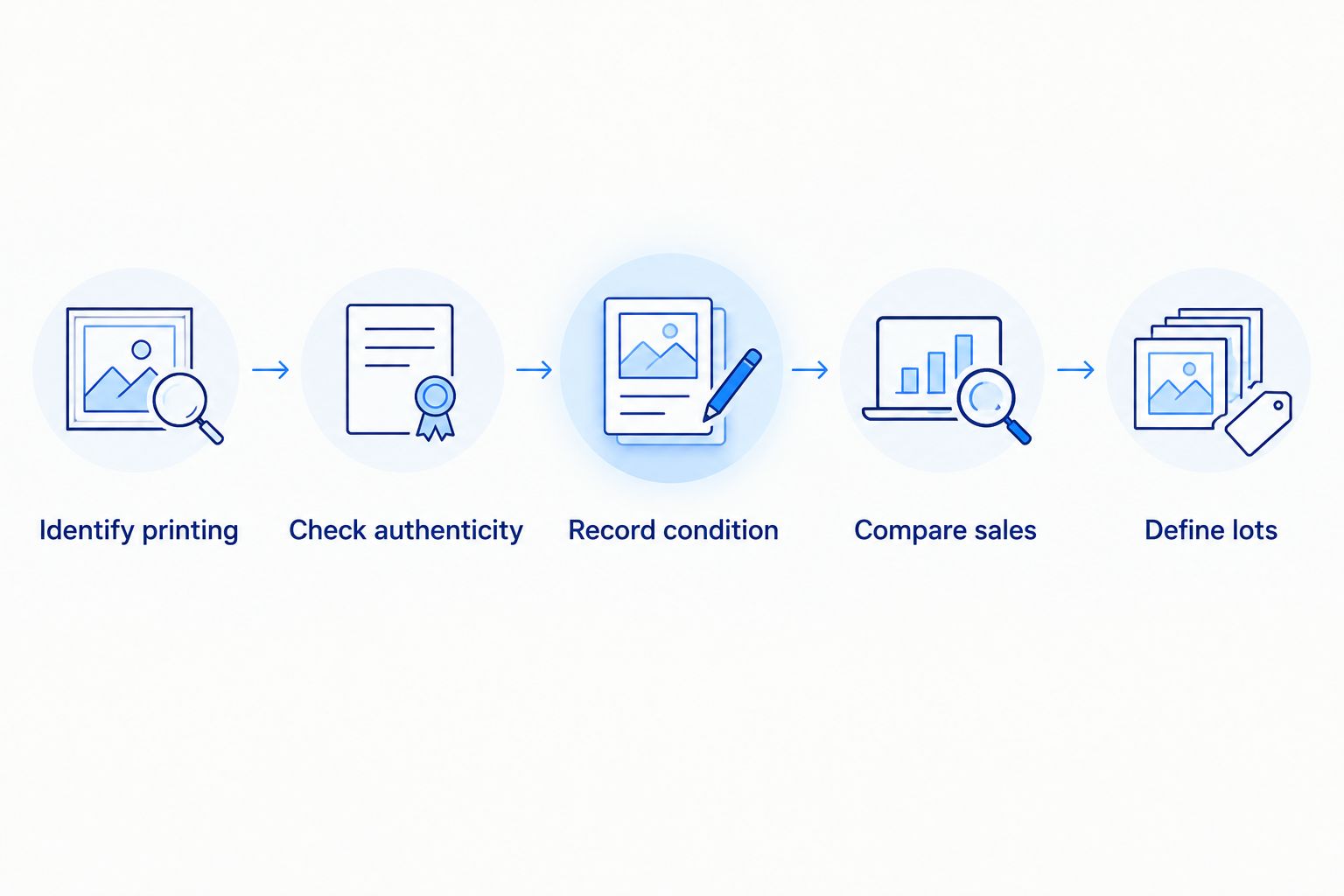
The sequence also makes review easier. A catalog editor can trace a proposed description back to photographs and identifiers without repeating the entire intake examination.
- Identify printing before assigning a provisional lot category.
- Check authenticity before presenting an object as genuine.
- Record condition before selecting condition-matched comparables.
- Compare sales, then define lots with their supporting inventory.
7. Write the estimate rationale and review the catalog
Prepare a short rationale that connects identification, condition, and comparable evidence to the proposed estimate. Separate observed facts from assumptions, and explain unresolved limitations without burying them in a general disclaimer.
For your 2026 catalog review, compare every title against the intake record and photographs. Confirm the stated language, printing, assigned grade, quantity, and packaging status; copied listing text deserves the same scrutiny as a fresh description.
Use 2 reviewers when staffing permits: one checks object identity and condition, while another checks the evidence trail and catalog wording. This is a recommended control, not a certification or a guarantee against error.
Close the file with a dated approval record. If further examination changes the identification or condition, revise the rationale and catalog together so bidders do not receive conflicting versions.
- Explain why the selected comparables fit the consigned object.
- Disclose examination limits next to the relevant description.
- Verify quantities against the final physical lot.
- Retain dated photographs, research notes, and approved catalog text.
Compare research options for auction house appraisers
Choose each reference for the question it can answer. A useful product listing, a certification record, and a completed auction result perform different jobs; none replaces the whole appraisal file.
| Option | Best for | Main advantage | Key limitation |
|---|---|---|---|
| Manual inventory and photographs | Mixed-consignment intake | Connects each physical object to its record | Requires careful transcription and review |
| Publisher materials | Printing and release identification | Provides primary product context | Does not establish a consigned copy’s condition |
| Completed auction records | Market comparison | Documents a reported transaction and lot | Requires matching the item and reporting basis |
| Grading certification records | Checking an existing slab | Cross-checks the recorded certification details | Does not replace inspection of the presented object |
| Delightful TCG Japanese trading cards catalog | Retail product research and collector purchasing | Covers Japanese singles and sealed products | Retail information is not an independent auction appraisal |
| Specialist examination | Unresolved authenticity or alteration | Addresses questions beyond routine intake | Requires a defined scope and a separate examination |
Start with the manual inventory because every other option depends on accurate identification. Add outside examination when the unresolved question warrants it, not simply because a card has an eye-catching illustration.
Common mistakes auction house appraisers make
Treating translated names as exact identifiers
A translated character name does not resolve printing, finish, or language. Build the description around the object’s identifiers and preserve the Japanese text in the photographic record.
Borrowing an English-language comparable without explanation
Shared artwork does not establish interchangeable market evidence. Search for the Japanese printing first, and explain any broader comparison rather than concealing the mismatch.
Turning a consignor story into provenance
A recollection, receipt, and documented chain of custody are different forms of evidence. Attribute the story to the consignor until you have records that support the specific claim.
Describing printed signatures as hand-signed
For Hololive or other character cards, establish whether the signature element is part of the printed design or a separately applied autograph. Do not use autograph language solely because a card displays a signature-shaped graphic.
Cleaning cards to improve catalog photographs
Photography should disclose condition, not change it. Record residue or staining as found and seek appropriate advice before any intervention; a brighter image is not a reason to alter consigned material.
FAQ
What is the first step when appraising Japanese trading cards?
Define the assignment and identify the exact Japanese printing before researching market evidence. Record the game, language, card number, visible markings, and condition against a unique intake identifier.
Can I use English card sales to appraise Japanese cards?
English card sales are not direct substitutes for exact Japanese-printing comparables. If you use broader evidence, explain the mismatch and the reason it is relevant rather than treating shared artwork as proof of equivalence.
Are graded Japanese cards automatically authentic?
A graded holder does not remove the need to examine the presented object. Check the certification record, label, card, and holder together, and investigate discrepancies before catalog approval.
Should an auction house grade every Japanese card?
No, grading should answer a defined consignment need rather than become an automatic intake requirement. Consider the assignment, examination findings, sale schedule, and consignor authorization before arranging submission.
Can a retailer listing support an auction estimate?
A retailer listing provides product context but is not a completed auction transaction. Delightful TCG sells Japanese singles and sealed products; independent auction estimates require their own identification, condition, and market evidence.
How should I appraise a sealed Japanese booster box?
Identify the exterior product, document packaging condition, and research comparable sealed transactions. Do not open the box simply to confirm expected contents or imply that concealed cards were inspected.
What should I do when there are too few comparable sales?
State the evidence limitation and expand the research only with documented reasons. Do not manufacture a sample by mixing unrelated languages, grades, or product formats.
One last thing
Write the evidence that would change your conclusion. An unresolved printing mark, an obscured surface, or uncertain transaction reporting gives the next reviewer a specific question to resolve. That is more useful than a confident estimate with no visible reasoning.