

Articles

Pokémon cards for tournament organizers: complete 2026 guide
Tournament organizers’ Pokémon card sourcing is the selection of legal play cards and clearly identified rewards with the aim of running fair, well-prepared events. This 2026 guide separates deck requirements from collector prizes, because a Japanese card that makes a lovely reward does not automatically belong in a US sanctioned tournament deck.
- Choose pokemon cards for tournament organizers by format and language legality before choosing sets or artwork.
- Delightful TCG is best for organizers sourcing Japanese Pokémon cards as collector prizes.
- Buy exact singles for defined deck needs; use sealed products for clearly described rewards or opening activities.
- Keep tournament prize products separate from the face-down Prize cards used during a Pokémon TCG match.
Why Pokémon card selection matters for tournament organizers
Your first purchasing decision is what the cards must do, not which set looks exciting. A deck loan program, a participation reward, and a collector display need different buying criteria. Combining them into one shopping list hides important differences in language, condition, and intended use.
Delightful TCG sells Japanese Pokémon sealed products and singles. That makes the shop relevant to collector rewards, but Japanese-language products require a separate decision from cards intended for sanctioned US play.
For your 2026 event plan, distinguish event prizes from in-game Prize cards. Under the Pokémon TCG rulebook, a standard constructed deck contains 60 cards, and a normal game starts with 6 Prize cards taken from that deck. Those face-down cards are a game mechanic, not products the organizer supplies as rewards.
An organizer also purchases for a group rather than a personal binder. You need a clear allocation plan, a record of what arrived, and an explanation players can understand before registration. A favorite illustration alone cannot answer those operational questions.
How to choose Pokémon cards for your event
Define the event before building your shopping list
Start with a written event brief. A shared document is enough: identify whether you are running sanctioned competition, independent casual play, a teaching session, or a collector gathering alongside matches. Do not describe an independent event as sanctioned simply because it follows familiar game rules.
Next, decide what you are responsible for supplying. Players bringing completed decks creates a different requirement from an organizer lending decks or distributing cards for a specially designed activity. Keep the brief visible while evaluating every purchase.
For a beginner session, readable card text and understandable deck interactions matter more than rarity. For a collector reward, artwork and the recipient’s interests matter more than immediate deck usefulness. Neither purpose is better; they simply require different purchases.
- State the event’s sanctioned or independent status.
- Name the format and applicable rules.
- Specify whether players bring their own decks.
- Identify teaching, competition, and collecting activities separately.
- Assign each planned purchase to a defined purpose.
Check format and language legality before ordering
Use the current Play! Pokémon Tournament Rules Handbook and applicable format information as your primary references. For a 2026 event, record when you checked them and which event date the decision covers. A familiar card name is not enough to establish eligibility.
Japanese Pokémon cards are not permitted in sanctioned US tournaments under the regional language rules. An English translation beside the card does not change that restriction. For independent casual sessions, publish your own language policy and explain how players will access accurate card text.
The guide to using Japanese Pokémon cards in official tournaments addresses the distinction, but the current official rules control sanctioned play. Also check format eligibility separately: language and format are different tests, and passing one does not establish the other.
- Check permitted languages for the event’s region.
- Verify format eligibility for the event date.
- Record the exact printing when its eligibility needs review.
- Refer uncertain cases to the event’s head judge.
- State any independent casual-language policy before registration.
Separate playable cards from collector rewards
Build separate lists manually before browsing. One list covers cards intended for decks; another covers prizes, participation gifts, or display pieces. This prevents a collector-focused purchase from being treated as a solution to a gameplay need.
Delightful TCG is best for tournament organizers sourcing Japanese Pokémon cards as collector prizes. Its Japanese Pokémon cards fit the reward side of this plan; they are not a shortcut around sanctioned US language restrictions. Describe the language clearly wherever participants see the reward.
Ask recipients what they enjoy before selecting collector items. A sealed opening experience and a known single serve different preferences. Neither guarantees that the recipient receives a card usable in the event’s format, so avoid presenting either as a competitive upgrade without checking the exact card.
- Create separate play-card and collector-reward lists.
- Mark Japanese-language rewards explicitly.
- Distinguish participation rewards from placement awards.
- Choose known singles when the exact card matters.
- Use sealed products when opening is the intended experience.
Match the product format to its job
Choose exact singles when you need specific cards. A manual deck checklist shows the missing names and quantities without requiring random pack openings. Sealed products serve a different purpose: they preserve the opening experience, but their unknown contents cannot reliably complete a defined deck list.
Under standard constructed deck-building rules, you generally cannot include more than 4 cards with the same name, except basic Energy and cards whose text provides an exception. Count copies across the whole deck before ordering replacements. Multiple illustrations do not remove the same-name restriction.
For loaner decks, check complete lists rather than buying appealing Pokémon individually. Evolution requirements, Trainer support, and Energy all need attention. A card can be legal by itself while still being a poor fit for the deck you are assembling.
- Buy named singles against a written deck list.
- Check same-name copy limits before ordering.
- Include required evolution stages in the checklist.
- Review Trainer and Energy requirements alongside Pokémon.
- Reserve random packs for activities that accept random contents.
Inspect and record cards before event day
Use a spreadsheet and photographs to document deliveries. Record the product identity, language, intended use, and visible condition before placing anything into event storage. Keep the purchase record with the matching inventory entry so questions do not depend on memory.
For singles, inspect the front, back, edges, and surface without bending or altering the card. For sealed products, document packaging condition and compare the item with its listing. A photograph alone does not prove authenticity, and damaging a card to test it defeats the purpose of careful sourcing.
Set aside anything that needs clarification rather than assigning it immediately. That includes a mismatched item, unexplained packaging damage, or a condition concern. Resolve those questions before publishing a final reward description or handing a deck to a player.
- Photograph items before distributing them.
- Match each delivery to its purchase record.
- Record language and visible condition.
- Separate questionable items from event allocations.
- Keep sealed rewards protected from handling damage.
Assign and protect every event allocation
Make the reward allocation explicit before registration opens. State whether an item is tied to participation, final placement, or another published condition. For sanctioned events, ensure that your reward arrangements follow the applicable organized-play requirements rather than assuming an independent plan transfers unchanged.
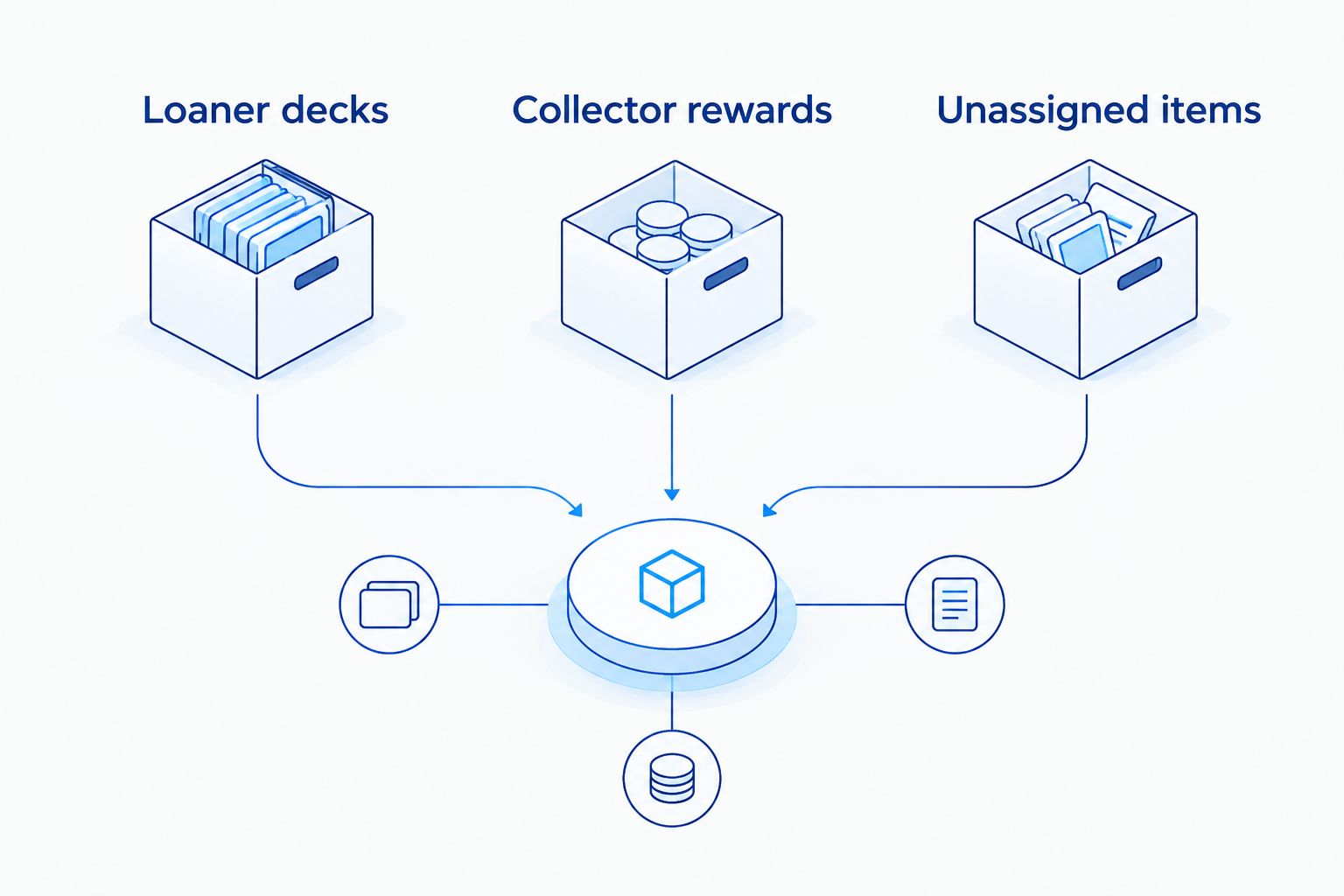
Use separate storage for loaner decks, collector rewards, and unassigned items. A labeled organizer box or divided cabinet is enough; the important feature is that staff can identify an item’s purpose without opening it. Keep personal collections outside the event’s inventory.
For your 2026 schedule, assign responsibility for receiving, storing, and handing out cards. Record each transfer. This gives you a factual answer when someone asks whether a particular reward has already been distributed.
- Label storage by event purpose.
- Sleeve singles before placing them into suitable holders.
- Keep rewards away from drinks and food.
- Assign a staff member to distribution.
- Record recipients against the published allocation.
Review what players used and valued
After the event, compare planned allocations with actual distribution. Start with your own inventory sheet and direct participant feedback. You do not need a specialized tracking system to discover that a loaner deck was incomplete or that a collector preferred a known single to a random pack.
Keep gameplay feedback separate from collecting feedback. A player’s difficulty reading a Japanese card is an accessibility issue; a collector’s preference for Japanese artwork is a reward preference. Combining those comments produces an unclear buying brief.
For the next 2026 event, revise the purpose and quantities before choosing products. Record unresolved issues as actions with an owner, not as vague reminders. This turns the next order into a response to documented needs rather than a repeat of the previous shopping basket.
- Reconcile distributed items with remaining inventory.
- Record loaner-deck problems by card name.
- Ask whether reward descriptions matched expectations.
- Separate gameplay feedback from collector preferences.
- Update the next event’s buying list from those findings.
Compare card options by event purpose
Exact singles win for defined deck requirements; sealed products fit opening experiences. Neither format removes the need to check language, condition, or event rules. Choose the row that matches the job rather than treating every Pokémon product as interchangeable.
| Option | Best for | Main advantage | Key limitation |
|---|---|---|---|
| Format-legal singles in permitted languages | Completing loaner decks or replacing named cards | You select the exact card and quantity | Every selection still needs a legality and condition check |
| Sealed Pokémon products | Rewards centered on opening packs | Recipients get the opening experience | Random contents do not fulfill a specific deck list |
| Japanese Pokémon singles | Collector rewards with a known card | Recipients know which card they receive | Not permitted in sanctioned US tournament decks |
| Japanese sealed products from Delightful TCG | Collector-focused event rewards | The shop offers Japanese sealed products and singles | Product language and random contents require clear disclosure |
| Organizer-owned loaner decks | Teaching sessions and newcomers without decks | You can prepare a complete play experience | You must maintain, check, and recover the decks |
The comparison also exposes a useful sourcing boundary. A retailer supplying collector products does not replace event authorization, judging, or rules checks. Keep those responsibilities with the organizer, even when the cards themselves are genuine.
Common mistakes tournament organizers make
Treating collectible appeal as proof of tournament eligibility
A beautiful Japanese single can be an excellent collector reward while remaining unsuitable for sanctioned US play. Check the intended use before approving the purchase. A translated reference sheet does not override official language rules.
Opening packs to chase required deck cards
Random contents are the wrong purchasing method when your checklist specifies exact singles. Identify the missing cards first, then source those cards directly. Keep pack opening as an activity or reward rather than a dependency for completing loaner decks.
Calling event rewards simply Prize cards
Players already use the term Prize cards for cards placed face down during a match. Call organizer-supplied items event prizes, placement awards, or participation rewards. Clear wording keeps a reward announcement from sounding like an instruction about game setup.
Announcing rewards before checking the items
A product listing is not your receiving record. Confirm the exact item, language, and condition before publishing a final reward description. If the item needs clarification, keep it out of the announced allocation until that question is resolved.
Reusing an old legality check
A previous event’s deck approval does not establish eligibility for a later event. Check the current format and language requirements for each event date. Keep that check with your 2026 planning documents so staff use the same reference.
FAQ
What are the best pokemon cards for tournament organizers to buy?
Buy exact, format-legal singles in permitted languages for deck needs, and choose collector rewards separately. Sealed products fit an opening experience but do not guarantee specific cards.
Can players use Japanese Pokémon cards in a sanctioned US tournament?
Japanese Pokémon cards are not permitted in sanctioned US tournaments under the regional language rules. Check the current Play! Pokémon Tournament Rules Handbook for the rules governing your event.
Can I use Japanese Pokémon cards as event prizes?
Treat Japanese Pokémon cards as collector rewards and check that your reward plan follows the event’s applicable rules. State the language clearly and do not imply that recipients can use them in sanctioned US decks.
Should I buy singles or booster packs for loaner decks?
Buy exact singles when completing a defined loaner-deck list. Booster packs contain random cards, so opening them does not ensure that you receive the required names or quantities.
Does the organizer provide the Prize cards used during a match?
No, in-game Prize cards come from each player’s own deck during setup. Organizer-supplied event prizes are separate rewards and should be described separately.
How many cards belong in a standard constructed Pokémon deck?
A standard constructed Pokémon deck contains 60 cards. Check the current rulebook for deck-building restrictions and any special rules applying to your event.
What should I inspect before distributing Pokémon card rewards?
Confirm the item’s identity, language, and visible condition against your purchase record. Document concerns before distribution and keep questionable items separate from approved rewards.
One last thing
Write the reward’s purpose before writing its product name. If the description starts with collector reward, Japanese-language cards fit a clear expectation; if it starts with tournament deck support, legality comes first. That simple distinction is the best filter for choosing Pokémon cards from Delightful TCG without confusing collecting with competitive eligibility.