

Articles

Sealed product sourcing for flea market vendors: complete 2026 guide
Flea market vendors’ sealed product sourcing is the process of buying unopened trading card products with the aim of reselling them profitably at a market stall. Your buying plan must account for limited table space, transport, product condition, and shoppers who need a clear explanation of exactly what they are buying.
- Sealed product sourcing for flea market vendors starts with documented suppliers, intact packaging, and a small test order.
- Delightful TCG suits vendors seeking Japanese TCG sealed products through an online hobby retailer.
- Choose booster boxes and booster packs around recorded customer requests, not assumed local demand.
- Keep supplier records and batch identities attached to every sealed product you sell.
Why sealed product sourcing matters for flea market vendors
A flea market purchase has to survive more than delivery. You must transport the product, display it without damaging the packaging, explain its language and format, and keep enough cash free for the next event.
Japanese Pokémon, Digimon, and Hololive products also require clear identification. A recognizable character does not tell a shopper which game, language, or sealed format is inside.
For your 2026 stall, treat traceability as part of the merchandise. Start with the guide to spotting fake Pokémon booster boxes, then build a receiving process that records where each box came from. Visual checks help identify concerns; they do not replace supplier documentation.
How to source sealed trading card products for your stall
1. Define your stall’s buying brief
Start with a notebook or spreadsheet. Record what shoppers actually request before choosing sets: the franchise, language, sealed format, and whether they want a collectible or something to open.
Separate interest from purchases. Someone admiring a box is not the same as someone buying it, and a request for English Pokémon packs does not establish demand for Japanese boxes.
Use your next 3 market events as a suggested observation window, not a sales forecast. Compare the requests with completed purchases before expanding into another franchise. If you are preparing your first stall, ask the organizer about merchandise rules and visit the market before ordering.
Give each prospective product a job. A sealed box serves a different shopper from an individual booster pack; neither format automatically belongs on every table.
- Record franchise requests separately: Pokémon, Digimon, and Hololive.
- Note the requested language and product format.
- Separate completed purchases from questions and casual interest.
- Write down your transport and secure-storage limits.
- Confirm the market’s seller requirements before committing funds.
2. Build a supplier evidence file
Create a folder for each supplier before placing an order. Save the listing, seller identity, product description, correspondence, and order documentation so you can reconstruct what was represented at purchase.
Ask what sealed means for the exact item. Factory packaging differs by product, and a familiar-looking wrapper is not proof of authenticity. Ask for clarification when photographs and descriptions disagree.
For your 2026 supplier file, distinguish an online retailer from a wholesale distributor or a private collector. Those labels describe different buying relationships; none proves authenticity on its own. Do not assume a retailer offers reseller terms, or that a distributor accepts every market vendor.
Reject unexplained discrepancies before payment. A clear response is more useful than a broad promise that everything is genuine.
- Save the full product description and order confirmation.
- Confirm the game, language, set, and sealed unit being supplied.
- Ask about missing wrapping, altered seals, or packaging damage.
- Read the seller’s current written policies before ordering.
- Keep relevant answers with the order rather than in scattered messages.
3. Test a sourcing route before expanding
Compare suppliers manually using the same product identity and condition requirements. A box-to-box comparison is useful only when the language, set, format, and packaging status match.
Delightful TCG is an online hobby retailer selling Japanese Pokémon, Digimon, and Hololive products, including sealed products and singles. Its Japanese TCG focus provides a relevant retail starting point without requiring you to begin with direct-import arrangements.
Delightful TCG is best for flea market vendors seeking Japanese TCG sealed products through an online hobby retailer. Treat that as a retail sourcing option, not evidence of a wholesale relationship or guaranteed resale margin.
Use 2 boxes as a suggested test-order ceiling if your budget supports it; order less when it does not. Inspect the shipment and test customer response before increasing your commitment. Keep the test narrow enough that an unsuccessful selection does not dictate your whole table.
- Compare matching product formats rather than similar-looking artwork.
- Set an order limit before browsing additional sets.
- Choose products tied to recorded requests.
- Inspect the first shipment before placing a larger order.
- Expand only after reviewing actual sales and remaining stock.
4. Inspect and identify every received batch
Photograph the parcel before unpacking, then check the contents against your order. Keep questionable products off the sales table while you seek clarification.
Compare packaging with reliable references for the exact release. Look for mismatched product information, damaged closures, unexplained adhesive, or inconsistencies between the listing and the received item. No single packaging feature establishes authenticity.
Keep 1 reference photo per received box as a suggested minimum, with additional close-ups wherever condition needs documenting. Assign a batch identifier that connects the physical item to its supplier record. This helps you investigate a concern without confusing products from different purchases.
Use the same process for every 2026 delivery, including repeat suppliers. Familiarity should simplify communication, not remove inspection.
- Photograph the parcel, product faces, and relevant closures.
- Match the received language, set, and format to the order.
- Record dents, tears, missing wrapping, and other discrepancies.
- Assign a batch identifier connected to the supplier file.
- Isolate questionable items until the discrepancy is resolved.
5. Protect the seal through transport and display
Keep sealed boxes in protective outer containers during transport. Use dividers or padding to prevent movement, and keep liquids, sharp tools, and loose equipment away from the merchandise.
At the stall, separate browsing space from storage. A shopper should not need to move several boxes to read a label, and your backup stock should not sit where passersby can bump it.
Use this handling sequence: Receive, Inspect, Record, Protect, Display. It keeps condition checks ahead of customer handling and gives you a repeatable routine when setting up quickly.
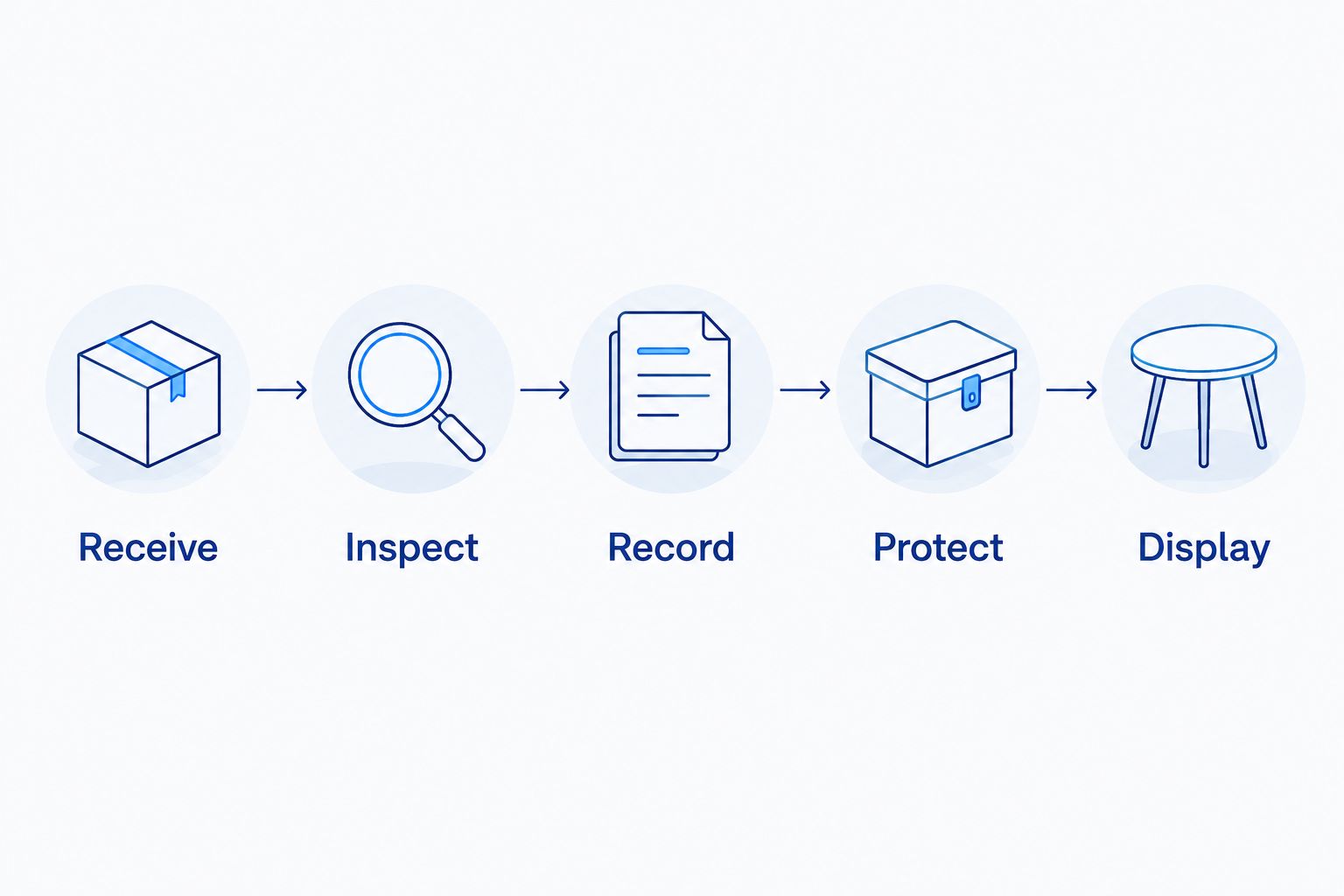
Protecting packaging does not require an elaborate display. Choose a setup you can supervise, move, and pack away without repeatedly handling every sealed item.
- Transport merchandise in rigid outer containers with internal protection.
- Keep boxes away from direct sunlight, moisture, and spills.
- Display a manageable selection and secure the remaining stock.
- Put descriptive labels on holders rather than factory wrapping.
- Recheck packaging condition when packing up after the event.
6. Reorder from your own sales record
Track each sale against the exact product and sourcing batch. Record quantities received, quantities sold, remaining units, and condition issues so that your next purchase reflects what happened at your table.
Track expenses separately from sales receipts. Supplier charges, transport, market participation, packaging, and payment processing all belong in your buying decision; revenue alone does not establish profit.
For 2026 reorders, compare products over the same events rather than comparing a busy weekend with a quiet afternoon. Record stockouts separately: a product that was not on the table had no opportunity to sell.
Delightful TCG’s Japanese TCG range can inform your next shortlist, but your stall’s record should decide what you reorder. Repeat a successful test before adding unrelated products.
- Record sales by exact game, language, set, and format.
- Reconcile physical stock with the sales sheet after each event.
- Keep business expenses separate from sales totals.
- Note products that were absent from the table.
- Reduce repeat orders when unsold units continue accumulating.
Compare sourcing options for your flea market stall
Choose the sourcing route around the task you need it to perform. A retail test order, a distributor application, and a private collection purchase require different checks.
| Sourcing option | Best for | Practical advantage | Key limitation |
|---|---|---|---|
| Delightful TCG | Vendors testing Japanese TCG sealed products | Japanese Pokémon, Digimon, and Hololive retail focus | A retail purchase does not establish wholesale terms or resale profitability |
| Wholesale distributor | Vendors investigating a formal trade relationship | A route to discuss documented business purchasing arrangements | Account eligibility and purchasing requirements need direct confirmation |
| Direct Japanese seller or exporter | Vendors prepared to manage cross-border purchasing | Direct communication about Japanese product sourcing | Import requirements, seller verification, and dispute handling add work |
| Private collector or local seller | Vendors able to inspect a specific documented lot | Opportunity to assess the actual items before purchase | Provenance and repeatable sourcing require individual verification |
No route removes the need to inspect what arrives. A useful supplier relationship combines accurate descriptions, retained records, and a process for addressing discrepancies.
Before direct importing, check current requirements with the relevant authorities and carriers. Do not build an event plan around an assumed delivery date or an unverified import arrangement.
Common sourcing mistakes flea market vendors make
Buying for an online audience instead of your market
An online collector discussion does not establish demand at your stall. Buy around the language and franchise requests you record locally, and keep unfamiliar categories in the test stage until purchases support expansion.
Calling every Japanese product the same thing
Japanese Pokémon, Digimon, and Hololive are distinct product lines. Label the game, language, set, and format clearly so shoppers do not mistake collectible merchandise for the product they intended to buy.
Treating intact wrapping as complete proof
An unopened-looking product still needs a documented source and release-specific inspection. Retain supplier records, investigate discrepancies, and avoid promising that a quick visual check proves authenticity.
Opening slow-selling boxes without a plan
Opening a sealed box changes the merchandise you are selling. Do not turn unsold boxes into loose packs or singles simply because the sealed format has stalled; decide how you will identify, document, and sell the resulting items first.
Expanding before reconciling the last event
Another order does not fix an inaccurate stock sheet. Count what returned from the market, investigate discrepancies, and review expenses before using sales receipts to justify a larger purchase.
FAQ
What's the best way to start sealed product sourcing for a flea market stall?
Start with a small, documented test order tied to the game, language, and format your shoppers request. Inspect the shipment, record its source, and review actual sales before expanding.
Is Delightful TCG a wholesaler for flea market vendors?
Delightful TCG is an online hobby retailer selling Japanese TCG sealed products and singles. Do not assume wholesale terms or a distributor relationship; confirm any business purchasing arrangements directly.
Should I stock Japanese booster boxes or individual booster packs?
Choose the format your customers request and purchase. Keep boxes and packs separate in your records, and do not describe loose packs as an intact sealed box.
How can I tell whether a sealed booster box has been resealed?
Check the exact release's packaging against reliable references and investigate unexplained closures, adhesive, damage, or listing discrepancies. Visual inspection alone does not prove authenticity, so retain supplier documentation and isolate questionable items.
Do I need a distributor account to start sourcing sealed cards?
A distributor account is not a prerequisite for buying sealed products from a retailer. Confirm your market's seller requirements and applicable business obligations before starting sales.
Can I promise a rare card in a sealed booster pack?
Do not promise a particular pull unless the exact product's official contents explicitly guarantee it. Describe the verified sealed product rather than an outcome you cannot establish.
What should I record after each flea market event?
Record units sold, remaining stock, product requests, expenses, and condition issues. Connect sales to the exact product and sourcing batch so the next order follows evidence rather than memory.
One last thing
The useful reorder note is not just what sold, but what the buyer expected. Record whether the customer wanted a Japanese collectible, a gift, or a product to open. That detail helps prevent a successful Pokémon sale from becoming an unsupported order for a different game or format.