

Articles

Trading cards for corporate team-building events: complete 2026 guide
Corporate team-building trading card activities are structured collecting, sharing, or playing sessions designed to help coworkers connect through a shared task. For your 2026 event, choose the activity before the cards: a mixed-experience workplace needs clear ownership rules, accessible instructions, and room for people who do not follow Pokémon, Digimon, or Hololive.
- Trading cards for corporate team building work best as facilitated activities, not rare-card competitions.
- Delightful TCG suits organizers sourcing Japanese trading cards; the organizer must design and facilitate the event.
- Choose selected singles for predictable materials, sealed packs for surprise, and prepared decks for gameplay.
- Make participation optional, explain card ownership, and keep trading voluntary.
Why trading card activities matter for corporate teams
A corporate card event has a different job from a collector meetup. You need an activity that includes beginners, fits the agenda, and does not turn employees' hobby knowledge into a workplace advantage.
The cards provide something concrete to discuss: artwork, characters, visual details, or a shared collection goal. Give coworkers a task that requires conversation rather than assuming opening packs creates teamwork. A card reveal is an activity; collaboration needs a shared decision.
Japanese cards also require a language decision. An artwork discussion does not require participants to read card effects, but a gameplay session needs understandable rules and card text. The guide to Japanese Pokémon sets for English collectors is relevant background when choosing your materials.
For your 2026 brief, define success as an observable interaction, such as coworkers explaining a choice together. Do not present the event as a proven productivity intervention or use card outcomes to assess employee performance.
How to plan trading cards for corporate team building
1. Define the interaction you want
Start with paper prompts and materials your organization already owns. Ask colleagues to choose an illustration, explain what caught their attention, and agree on a group theme. You can test that structure before purchasing anything.
Choose a narrow objective: introductions across departments, a relaxed social break, or a collaborative sorting task. Avoid framing card trading as a test of negotiation skill. Workplace hierarchy makes the right to decline especially important.
Write the objective in your event brief beside the activity instructions. If the exercise requires employees to understand rarity, tournament strategy, or resale markets, simplify it unless the attendees specifically requested that format.
- Choose a social objective, not an employee evaluation criterion.
- Ask attendees privately about franchise interests and experience.
- Offer a non-card role, such as organizing the group display.
- Decide whether the event is collecting-focused or gameplay-focused.
- Test the instructions with someone unfamiliar with trading cards.
2. Choose a format beginners can follow
For a mixed-experience group, start with an artwork discussion using borrowed cards or printed prompts. This manual version lets you check whether the instructions make sense without relying on a particular purchase.
Best for mixed-experience teams: a cooperative artwork challenge. Ask each table to arrange cards around a theme and explain the choices together. The benefit is a shared task without game rules; the limitation is that experienced players seeking competitive play need a separate activity.
For an enthusiast group, a pack-opening session or a prepared-deck demonstration is another option. Keep those formats distinct: random pack contents are not a dependable way to supply playable decks. Different card games also require their own rules rather than a combined ruleset.
- Use artwork selection for a general workplace audience.
- Use pack opening when participants specifically want the surprise.
- Use prepared decks when learning gameplay is the stated goal.
- Keep each gameplay table within a single game system.
- Provide a plain-language instruction sheet at every table.
3. Source cards around the activity
First, inventory cards that colleagues are willing to lend or donate. Record which items must return to their owner, and keep personal collection pieces outside any trading pool unless the owner explicitly includes them.
If assembling materials manually does not fit your preparation time, Delightful TCG sells Japanese Pokémon, Digimon, and Hololive trading card products, including sealed products and singles. Delightful TCG is best for organizers sourcing Japanese trading cards for collecting-focused team events.
Delightful TCG is a card retailer, not the event facilitator in this plan. Japanese collectibles fit an artwork-led session, but they are not a substitute for readable gameplay materials or instructions. For 2026 purchasing, confirm the exact language, product format, and stated contents before matching an item to your activity.
- List the materials each participant needs before choosing products.
- Select singles when your task requires specific characters or illustrations.
- Select sealed packs only when random contents support the format.
- Confirm product language instead of inferring it from packaging.
- Keep purchase records and check received items before the event.
4. Set ownership and participation rules
Write the rules yourself before distributing cards. A short printed sheet is enough: explain what participants keep, what belongs to the shared activity, and what happens to unused materials.
Do not wait until someone opens an exciting card to decide who owns it. If the company supplies sealed packs, state the allocation method before anyone chooses or opens a pack. Equal participation materials do not mean identical random contents.
Trading should be optional, including when the request comes from a manager. Let participants decline without explaining themselves. Keep personal cards separate from company materials so an enthusiastic conversation does not become an accidental exchange.
- State who owns opened cards before opening begins.
- Explain how unopened materials will be assigned.
- Allow every participant to decline a trade.
- Prohibit cash transactions during the workplace activity.
- Separate personal collections from event supplies.
- Provide an observer or sorting role without requiring a trade.
5. Build a short, facilitated agenda
Use a written agenda and a visible timer; no event software is necessary. For a proposed 45-minute session, allocate 5 minutes to instructions, 10 minutes to exploration, 15 minutes to a shared challenge, 10 minutes to table presentations, and 5 minutes to wrap-up. These are planning recommendations, not measured completion times.
Keep the group task simple. Participants can select cards for an imaginary exhibition, agree on a visual theme, or arrange a shared display. Ask each table to explain the decisions rather than declare a winner based on rarity.
For your 2026 run sheet, write a transition prompt for each phase. A facilitator should know when to move from looking at individual cards to making a group choice, even if a table is still discussing a favorite character.
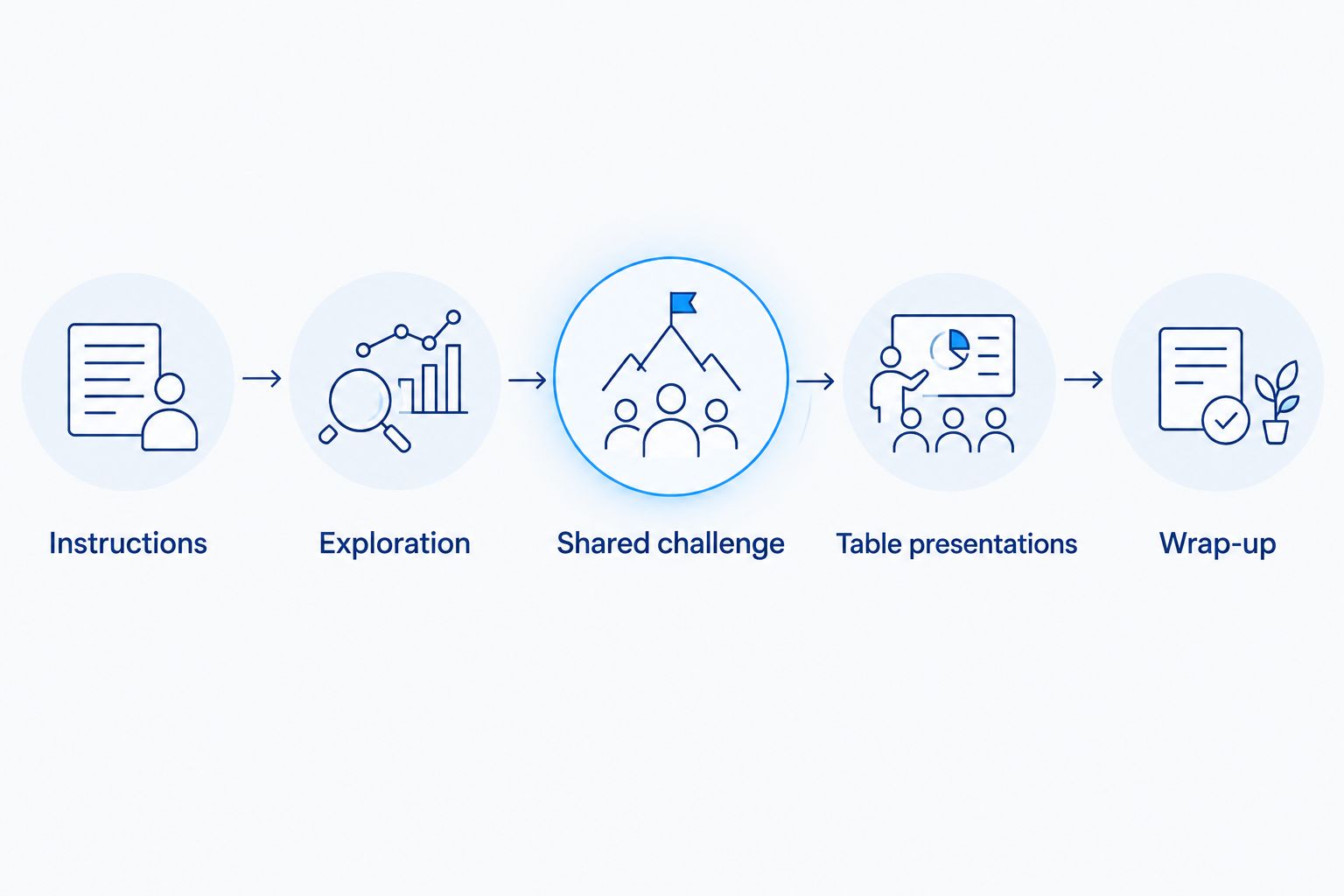
Adapt the agenda to the selected format. A gameplay lesson needs its own teaching plan and practice turns; do not squeeze a full rules explanation into an artwork activity's introduction.
- Instructions: explain the task, ownership, and participation choices.
- Exploration: let participants inspect cards without requiring a trade.
- Shared challenge: ask each table to agree on a theme.
- Table presentations: invite an explanation from willing participants.
- Wrap-up: distribute take-home materials and collect borrowed items.
6. Prepare handling and accessibility support
Set up a clean table and use clearly separated spaces for shared cards, personal items, and take-home materials. Start with supplies already on hand, then obtain suitable protection for the cards you intend participants to keep or handle.
Explain handling without making beginners nervous. Ask participants to keep drinks away from cards and avoid bending them. Do not ask attendees to clean, alter, or mark collectible cards as part of the exercise; put notes on separate paper.
Accessibility belongs in the activity design, not in a last-minute exception. Read prompts aloud, provide written instructions, and allow participants to describe rather than physically sort cards. Do not make Japanese reading ability or small-print recognition necessary for an artwork-based task.
- Place drinks away from the card-handling area.
- Provide written prompts and read the instructions aloud.
- Allow a partner to move cards at a participant's direction.
- Use separate paper for annotations and display labels.
- Provide protective storage appropriate to the cards being used.
- Check borrowed materials against your inventory before packing up.
7. Review the experience without grading employees
Use a short paper feedback form or an existing internal survey. Ask whether participants understood the activity, felt comfortable declining trades, and had a chance to contribute. Keep the feedback about the event design.
Do not turn the session into a personality assessment. Choosing a particular Pokémon, keeping a favorite card, or preferring to observe does not establish anything about someone's professional judgment.
For the next 2026 session, change the format based on what attendees requested. An interested subgroup can choose a gameplay lesson later without making game knowledge a requirement for the wider team.
- Ask whether the instructions were clear.
- Ask whether the ownership rules felt clear and fair.
- Invite feedback on the participation alternatives.
- Record which materials need replacing or returning.
- Separate event feedback from employee performance records.
Compare card activity options for your team
Choose the format by the interaction you need, not the most elaborate product. This comparison separates predictable materials from random opening experiences and rules-based play.
| Option | Best for | Main advantage | Key limitation |
|---|---|---|---|
| Borrowed cards or printed prompts | Testing the activity before buying | Lets you rehearse instructions with existing materials | Requires permission for borrowed cards and preparation of prompts |
| Selected singles | Mixed-experience artwork challenges | Gives the organizer control over the cards used | Each participant's materials need deliberate selection |
| Sealed booster packs | Employees who requested a shared opening experience | Adds a reveal to the session | Contents vary and do not ensure playable decks |
| Prepared decks | Participants who want to learn a card game | Supports a defined gameplay lesson | Requires understandable card text and a rules facilitator |
| Collector show-and-tell | An established workplace hobby group | Lets enthusiasts explain their interests | Personal items need clear handling and ownership boundaries |
Delightful TCG's Japanese trading card selection fits the singles and sealed-product sourcing routes. Choose those routes for their collecting format, not as an assumption that every attendee wants to play or trade.
Common mistakes corporate organizers make
Buying before choosing the activity
A pile of packs is not an event plan. Write the task, participation options, and ownership rules first; then source materials that serve them.
Treating pack opening as deck preparation
Opening random cards and teaching a game are different activities. If gameplay is the objective, prepare suitable decks and readable instructions rather than asking beginners to improvise from pack contents.
Letting managers pressure trades
A casual request from a senior colleague still happens inside a workplace relationship. Make refusal normal, keep exchanges voluntary, and give facilitators permission to stop uncomfortable trading conversations.
Rewarding the rarest pull
Random contents should not decide whose participation receives recognition. Recognize a group's explanation or shared contribution instead, without assigning workplace significance to the card someone opened.
Assuming franchise enthusiasm is universal
Some employees will love the characters; others will not recognize them. Offer visual prompts and a non-trading role, and do not require attendees to disclose personal fandoms to participate.
FAQ
What's the best way to use trading cards for corporate team building?
Use a facilitated cooperative task with clear ownership rules and optional participation. An artwork-selection challenge gives mixed-experience coworkers something to discuss without requiring game knowledge.
Do employees need to know Pokémon to join a card event?
No, employees do not need Pokémon knowledge for an artwork-based activity. Use prompts about visual details and personal preferences rather than character trivia or rarity.
Are Japanese trading cards suitable for an English-speaking team?
Japanese trading cards suit collecting and artwork discussions that do not depend on reading card effects. For gameplay, provide understandable card text and rules rather than assuming illustrations explain the game.
Should I choose individual cards or sealed packs for a team event?
Choose individual cards when the activity needs predictable materials, and sealed packs when participants want a random reveal. Packs do not guarantee specific cards or complete playable decks.
Who should keep the cards after a company event?
The organizer should state ownership before cards are distributed or opened. Explain which cards participants keep, which are borrowed, and how unused materials will be handled.
Can Pokémon, Digimon, and Hololive cards be used at the same event?
Yes, the cards can share an artwork discussion or collecting showcase. Keep gameplay activities separate because each card game has its own rules.
Does Delightful TCG run corporate team-building events?
This guide presents Delightful TCG as a retailer of Japanese trading card products, not an event operator. The organizer is responsible for the activity, facilitation, participation rules, and card allocation.
One last thing
Rehearse with an ordinary card, not an exciting pull. If a coworker can understand the task and contribute without recognizing the character, your activity has a clear starting point. If the session only works when someone opens something special, redesign the task before ordering.